
Therapy can help you underst | Georgia Telehealth Therapy
In this episode
Stress and anxiety aren't the same thing. Stress shows up because of something specific. Anxiety can show up uninvited.
If you're waking up with knots in your stomach, racing thoughts that won't quit, or feeling on edge for no clear reason — that's worth talking about.
Therapy can help you underst
Transcript
Imagine um a smoke alarm just blaring in your house, right? That awful sound. Yeah, exactly. It's that airpiercing high-pitched screech. You run to the kitchen, you check the bedrooms, you look down the hall, and there's no fire. Nothing. Right. There's not even a hint of smoke anywhere. Yeah. But the alarm, it just will not stop. It's exhausting. It really is. And the thing is that is the exact reality millions of people wake up to every single day. Yeah. But, you know, instead of calling it what it is, which is a fundamentally disregulated nervous system stuck in this generalized alarm state, Yeah. we just casually dismiss it. We do. We really do. We tell them, or
well, we tell ourselves that we're just like stressed out. Yeah. And we've completely watered down our clinical vocabulary in that way. I mean, people use words like stress and anxiety interchangeably in everyday conversation now. Like, they're just like they're the exact same thing, right? Treating them like simple synonyms. But confusing the two isn't just, you know, a matter of semantics. That casual interchangeability actually becomes this massive barrier to getting the right kind of help because you can't fix it if you don't know what it is. Exactly. You cannot effectively treat a problem if you refuse to name it accurately. Mislabeling your experience usually means you end up um applying the completely wrong solution. Okay, let's
unpack this. Welcome to the deep dive. Our mission today is to decode this incredibly practical briefing we received from Coping and Healing Counseling or CHC. Yeah, a really fascinating document. It is. They are a telealth therapy practice based down in Georgia and they've put together this clinical framework that breaks down the critical everyday difference between stress and anxiety, which we desperately need, right? But more importantly, it shows you how to actually read your own internal signals and it outlines a very specific blueprint for how people um access specialized care. Yeah. The framework draws a very firm, really necessary line in the sand between these two experiences. It starts by defining stress as well acute and
situational. Situational meaning meaning it is fundamentally tied to a specific identifiable cause. You can literally point your finger at the stressor, right? Like you have a massive presentation at work tomorrow. Your heart is racing, you're sweating, you're stressed. Exactly. And the defining characteristic of that stress is that it actually eases when the situation resolves. You give the presentation, you walk out of the conference room, and that heavy weight just lifts right off your chest. There's a clean, logical, causeand effect relationship there between the environment and your internal state. The environmental trigger disappears, and so your biological reaction just, you know, powers down. Powers down. But then um the framework pivots to anxiety. Yeah. And the
definition changes entirely. Right. This is where we get back to that smoke alarm analogy. The fire alarm is going off, but there's absolutely no fire in the kitchen. None. There's no presentation at work. There's no immediate threat. But that same earpiercing alarm is just blaring endlessly through the house. What's fascinating here is how that analogy perfectly captures the concept of proportion. Proportion, right? Proportion is the central dividing line in this framework. Anxiety isn't defined just by how uncomfortable the feeling is. It is defined by how disproportionate that feeling is to the actual trigger. Oh, I see. So, um, if the fire alarm goes off because you lit a single scented candle in the living room.
Yes. The response is entirely disproportionate. I mean, your brain and your body are reacting as if the entire house is burning to the ground, but the reality of your environment just simply does not match the intensity of your internal alarm. That's a perfect way to put it. And because that alarm isn't tied to a specific logical trigger, it generalizes. It spreads out. Exactly. It spreads out. It starts to color everything you do until the feeling of panic or dread itself becomes your baseline state. Wow. Yeah. You are no longer reacting to a threat. You are just living inside the reaction. And since that internal fire alarm is just blaring with nowhere to go, right? And
no fire to put out, that excess nervous energy eventually shortcircuits the physical body. It has to go somewhere, right? That's why you get the physical manifestations this framework details. It gets incredibly specific about how a generalized state of anxiety actively disrupts sleep, ruins your appetite, shatters your focus, and um puts severe strain on your relationships because it creates a systemic disruption. You start experiencing very real tangible physical sensations. I mean, the framework highlights waking up with literal knots in your stomach. Yeah, that stood out to me. It describes racing thoughts that loop endlessly and this overarching just exhausting feeling of being on edge for absolutely no clear reason. Here's where it gets really interesting because
I want to pause on that specific symptom for a second. Okay, sure. Wait, hold on. If I am waking up every single morning with literal knots in my stomach or like if my appetite is completely gone to the point where I can't even eat lunch, isn't that just a physical problem like a gastrointestinal issue? You would think so, right? Yeah. So, why is the text framing physical stomach problems as a mental health signal? Well, that is the crucial pivot point of this entire approach. The framework uses a very powerful phrase to reframe those exact symptoms. It says the body is sending a signal. Sending a signal. Yes. Those knots in your stomach, that inability to
fall asleep, the racing heart, they are not just random physical malfunctions to be managed with an antacid or, you know, a sleeping pill. They are communication. So your nervous system is trying to tell you something is profoundly wrong and it's just using the only language it has available, physical sensation. Exactly. And therapy is presented here as the translation tool for that language. I love that. A translation tool, right? Because when you sit down with a specialized therapist, you aren't just going there to vent about your week, right? You are going to learn how to translate the physical and mental signals your body is desperately broadcasting. You are mapping that physical knot in your stomach back
to the unseen, unadressed emotional trigger that your conscious mind has just well been ignoring. Which means if your nervous system is communicating something that deeply ingrained and complex, simple everyday platitudes are going to fall completely flat. Oh, absolutely. I mean, you've been there. You are internally panicking. Your thoughts are racing a mile a minute. Your stomach is in literal nods and a well-meaning friend looks at you and says, "Just try to relax or just take a deep breath." Yes. makes you want to scream because telling someone with clinical anxiety to just relax is exactly like telling a malfunctioning smoke detector to just quiet down when its sensors are locked in an alarm state. Right. It
simply does not work that way. The mechanism is jammed. It's honestly infuriating. If you could just relax, you know, you would have done it hours ago. Exactly. The framework is so validating because it explicitly calls out the societal tendency to just brush off anxiety. It states clearly that anxiety often requires much more than just trying to relax. If we connect this to the bigger picture, this is precisely why a very hard boundary must be drawn between casual wellness coaching and clinical therapy. Oh, that's an important distinction. It really is. Stress because it is acute and tied to a specific situation might be something you can manage with lighter interventions like a coaching session or something.
Yeah, maybe a coaching session, some lifestyle tweaks or basic stress management techniques. But anxiety represents a disregulated nervous system. It persists. It generalizes. Exactly. And because of that, it requires highly specialized therapeutic translation. And the framework highlights specific clinical red flags for providers and referral partners, right? Like when a client describes always being on edge or says they are never able to relax. That is no longer just everyday venting, right? That is a documented clinical signal. And that signal requires escalation to specialized care. It requires the heavy lifters of the therapeutic world. I mean, the framework names specific interventions like CBT, ACT, and psychonamic therapies. Let's break those down a little bit because they sound
intimidating, but they're so foundational. CBT is cognitive behavioral therapy, right? And CBT isn't just talking. It's a highly structured intervention where a therapist helps you identify the exact distorted thought pattern that is triggering your body's alarm. the thing making the smoke detector go off. Exactly. And then they give you the logical tools to actively dismantle that thought so your nervous system can finally, you know, stand down. And then ACT stands for acceptance and commitment therapy. Yes. Which instead of just fighting the anxiety, ACT helps you change your actual relationship to the anxious thoughts, teaching you how to stop letting them dictate your actions. It's powerful stuff. Then you have psychonamic approaches which dig even deeper
into the root causes. Exploring how past experiences are playing a role, right? Exploring how past experiences and unconscious processes are fueling that disproportionate alarm in your present life. These are rigorous established clinical tools designed to rewire how your brain processes perceived threats. You cannot simply coach away a generalized nervous system alarm. No, you can't. But the framework makes a very careful point to say that both experiences stress and anxiety are totally valid. They both deserve care. It's not a competition of who is suffering more. Right. It's not a contest. They just require entirely different toolkits to resolve. But you know, knowing the difference and knowing what toolkit you need is really only the first part
of the journey. Exactly. Identifying the signal is great, but getting the actual help to translate that signal is usually the hardest part of the equation. Oh, absolutely. Which brings us to the structural model of coping and healing counseling itself. They aren't just providing definitions here. They are providing the literal access bridge to the treatment. And the operational model they outline is just a massive paradigm shift in accessibility. It really is. They operate a 100% teleaalth fully HYPA compliant practice and the geographic scope they highlight is remarkable. I mean they serve all 159 counties in the state of Georgia. So what does this all mean? Like think about what that actually means for a second for
the person listening right now. It's huge. Georgia is a massive state with highly diverse geography. If you live in a rural county, driving to a specialized therapist who is actually trained in CDT or ACT might take 2 hours each way. Yeah, that's a 4hour round trip just to get the translation tool your body needs. And by operating entirely via teleaalth across every single county, geography is completely removed as a disqualifying factor for receiving specialized mental health care. It fundamentally changes the landscape. I mean, taking a therapy session from your own living room rather than sitting in some sterile clinical waiting room after sitting in traffic for an hour. Yeah, who wants to do that, right?
That specifically lowers the barrier to entry for someone whose anxiety is already keeping them on edge. You aren't cut off from the heavy lifters just because of your zip code. And the heavy lifters are explicitly defined in this text. CHC maintains a team of over 15 licensed therapists and the framework lists their specific credentials. LCSWS, LPC's and LMFTs, right? Which are essentially the gold standards of clinical mental healthare. They are I mean LCSWS are licensed clinical social workers who have deep training in how a person's environment and social systems impact their mental health, right? And LPC's are licensed professional counselors focusing heavily on mental health and emotional disorders. And then LMFTs are licensed marriage and
family therapists who specialize in treating the relationship dynamics. Having that specific variety of rigorous training available under one roof is critical. It allows them to treat individuals, couples, families, and teenagers from age 13 and up. Because anxiety doesn't just isolate the individual, right? It actively strains the entire family unit. It affects everyone. And the specialties they focus on directly align with the dysregulation we've been discussing. anxiety, depression, trauma and PTSD, grief, relationships, and severe stress. They have built a culturally competent, diverse team equipped to handle those specific clinical signals. But even with a diverse team of specialists and, you know, a teleaalth infrastructure that reaches every corner of the state, we still have to address
the elephant in the room, the financial barrier. Yes. The cost. This is where the framework elevates from just being a practical brochure to a look at the actual democratization of mental health. It really does. Therapy has historically been treated as a luxury good, but the specific financial data outlined here changes that narrative completely. The data points are incredibly specific, which removes the paralyzing fear of unknown costs, which is a fear that ironically prevents highly anxious people from ever picking up the phone. Exactly. The framework lists that they accept major insuranceances including Etna, Sigma, Blue Cross Blue Shield, United Healthcare, and Humana. And for those major insuranceances, the co-pays range from just $10 to $40 per
session, which is incredibly accessible. But the statistic that fundamentally alters the landscape is their Medicaid acceptance. The co-pay for Medicaid is 0. A co-pay. That is the ultimate dismantling of the financial wall. It really is. A Z co-pay turns specialized therapy from a luxury into a basic accessible utility. It is profound. We are talking about a person who is constantly on edge, whose nervous system is entirely disregulated, who might live hours away from a major city, right? They can access culturally competent, licensed therapeutic intervention from the safety of their own home, potentially for absolutely zero out-of- pocket cost. It bridges the gap perfectly between recognizing that your body is sending a distress signal and actually
having the specialized tools required to translate and resolve that signal. It is an incredibly empowering shift in how we approach mental health access. Let's briefly recap the journey we've taken through this clinical framework for you. We started by demanding more from our vocabulary. We separated the acute environmentally driven nature of stress from the generalized disproportionate reality of anxiety. We learned that we have to stop ignoring the physical signals like the knots in our stomach or those racing thoughts and recognize that our body is actively trying to communicate a profound nervous system dysregulation. We established that clinical signals like the feeling of never being able to relax demand more than well-meaning advice. No more just take
a deep breath. Exactly. They require specialized therapeutic translation through rigorous tools like CBT and ACT. And finally, we explored how modern statewide teleaalth models are breaking down massive geographic and financial walls, turning clinical ideals into practical everyday realities for everyone across Georgia. It is a complete road map from identifying the symptom to accessing the solution. And if you want to utilize that solution, the framework provides CHC's direct contact information. Yes, you can reach coping and healing counseling by phone at 404832102. You can visit them online to see their providers at cheat theapy.com or you can email them directly at support theapy.com. The translation tools are waiting. They really are. But before we wrap up our
deep dive today, I want to leave you with a final thought to mull over something that builds right off the core of what we've explored today. The source tells us that anxiety lingers even when nothing is wrong in your immediate environment. So, if your nervous system is constantly sending out warning signals that don't match your current situation, what past event or unadressed feeling might your body still be trying to translate for you right now? Thank you so much for joining us for this deep dive. We'll catch you on the next one.
More episodes
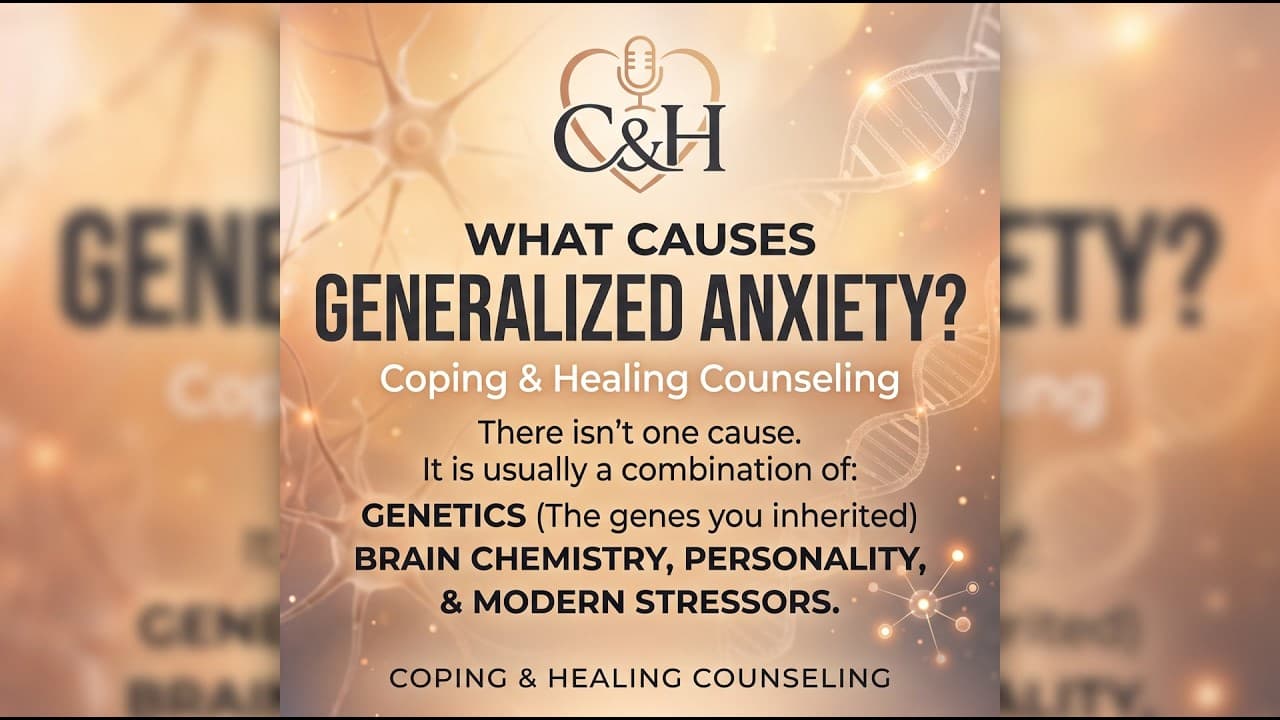
What causes generalized anxiety? — Full Episode | Georgia Telehealth Therapy
What causes generalized anxiety?
What are the 5 symptoms of major depressive disorder? — Full Episode | Georgia Telehealth Therapy
What are the 5 symptoms of major depressive disorder?

RSD and ADHD: Why One Short Text Can Wreck Your Whole Day | Georgia Telehealth Therapy
This one is for the friend who apologizes three times in a single text.
If this resonated, we have therapists who can help.
15+ licensed therapists, all 159 Georgia counties, telehealth-only. Medicaid covered at $0 copay.
Book a free consultation