
PSA for anyone who's been wondering 'is... | Georgia Telehealth Therapy
In this episode
PSA for anyone who's been wondering 'is this just stress, or am I actually dealing with anxiety?' — we made it easy to find out. 2-minute GAD-7 screening, 100% free, 100% confidential. It's the same tool therapists use. Take it before bed tonight: chctherapy.com/mental-health-tests 💙
Generated from Coping & Healing Counseling: Accessible Telehealth for Georgia
#CopingAndHealing #GeorgiaTherapy #Telehealth #MentalHealth #Podcast
Transcript
Have you ever had one of those days you finally just collapse onto the couch? Oh, we all know that feeling. Right, you are completely and utterly exhausted. Like your bones literally feel heavy. Yeah, you're physically done. But somehow you are completely unable to stop moving or you know, thinking or doing. It's like your brain didn't get the memo that the day is over. Exactly. You have absolutely nothing left in the tank, but your brain is still just running a marathon, mapping out tomorrow's schedule or I don't know, worrying about an email you sent 3 days ago. Or wondering if you left the oven on. Yes, the classic oven panic. It is an incredibly common, I
mean, almost universal modern experience. And yet it's one of the most confusing and isolating states to find yourself in. It really is because you feel like you're the only one. Right. You're sitting completely still in your living room. But everything inside your central nervous system feels like it is hurtling forward at 100 miles an hour. Which brings us to the core mission of our deep dive today. We are going to tackle that age-old nagging question that so many of you have probably asked yourselves while staring at the ceiling at 2:00 a.m. The big question. Is this just everyday stress or um am I actually dealing with anxiety? Making that distinction is absolutely critical. And to
help us navigate this landscape today, we are drawing our insights from the clinical framework of Coping and Healing Counseling or CHC. They're a really fantastic resource. They are. They're a comprehensive telehealth therapy based in Georgia. And rather than just looking at vague definitions, we are using their clinical materials as a sort of case study. A way to ground the conversation. Exactly. Uh. We want to understand exactly what happens when our natural evolutionary stress responses just get jammed in the on position. Because you know, 19% of US adults experience anxiety each year. Okay, let's unpack this. Because when we hear broad statistics like you know, almost one in five people, it can feel incredibly abstract. a
number on a page. Right, almost 20% of people are walking around managing this daily. But I want to bring this right down into the daily lived reality of the person listening. Like how does this actually manifest? Well, from the source material we are looking at, anxiety doesn't always look like a dramatic cinematic panic attack. Oh, definitely not. Often it masquerades as everyday personality quirks. It is um incredibly quiet. Quiet is the perfect descriptor. We often romanticize or just kind of normalize these behaviors. We really do. The clinical materials we are reviewing specifically outline five quiet signs that anxiety is running your life. And these are so recognizable, it's almost scary. But rather than just reading
down a list, it helps to look at the unifying theme behind all of them, which is hypervigilance. Hypervigilance, okay, break that down for us. Hypervigilance is basically your brain's threat detection system working overtime. Which explains the constant need to predict the future. Like the materials talk about rehearsing conversations before they happen. Oh, this is a huge one. And we aren't talking about practicing a speech for a wedding, right? We are talking about standing in the shower, exhausting yourself by scripting out every possible branching path of a mundane interaction with a co-worker. Just to feel a baseline level of safety. You are trying to manufacture predictability in a fundamentally unpredictable world. That sounds exhausting. It is.
And that same hypervigilance drives another quiet sign. Planning three exits before you enter any room. Wait, like literally looking for the doors. Yes. You aren't just arriving at a dinner party and looking for the appetizer table. Your brain is tactically assessing the environment for social or um physical threats and mapping escape routes. And when you are constantly living a few steps in the future, assessing threats like that, the present moment just becomes unbearable. You can't enjoy where you are. Right, which covers another sign. Feeling on even when you are supposed to be resting, the engine is just idling at 1,000 RPM. You're resting physically, but mentally you are sprinting. Which also perfectly explains the chest
tightness when your phone rings. And not when you get bad news, mind you. Just the simple neutral act of the phone ringing triggers a physiological brace for impact. What's fascinating here is the underlying mechanics of that reaction. Your brain's threat detection system is essentially a highly evolved smoke alarm. A smoke alarm, I like that. Yeah, normally it only goes off if there is an actual fire. A genuine threat to your safety like you know, swerving to miss a car on the highway. A real emergency. Exactly. But with chronic anxiety, the alarm sensitivity is cranked up so high that it triggers a full-blown emergency response every time you burn a piece of toast. No, wow. Or
in this case, every time your phone buzzes. Your body is responding to a five-alarm fire when it is merely a text message. A cranked up smoke alarm is such a better way to look at it. I was um I was thinking of it like a smartphone with 50 apps running in the background. Oh, that's a good analogy, too. Yeah, just draining the battery silently. But the smoke alarm analogy really explains the sheer panic of it. And it brings us to the final quiet sign. You are exhausted, but you cannot stop. Because if your internal alarm is blaring 24/7, of course you're exhausted. It takes an immense amount of caloric and cognitive energy to sustain that
state of readiness. And that energy expenditure cannot remain isolated in your thoughts. Like the mind and the body are not separate entities. Not at all. They are a single continuous feedback loop. If the brain is constantly signaling a threat, the body has to bear the physical toll of that preparation. But wait, let me play devil's advocate here for a second. Go for it. Isn't a certain level of physical tension just the cost of doing business in the modern world? Like if I am working 50 hours a week hunched over a laptop, my shoulders are going to be tight. Sure, posture matters. And if I'm eating on the go, my stomach might act up. Yeah. How
do we differentiate between an actual clinical anxiety disorder and just well, the physiological reality of being a tired adult? That is a crucial pushback. And the difference really lies in the mechanism of causality. Causality, okay. Yes, poor posture causes tight shoulders. But with anxiety, we are talking about a systemic hormonal flood. The chemicals in your body are actually changing. Precisely. When your hypervigilant brain perceives a threat, even just an anticipated email, it signals your adrenal glands to release cortisol and adrenaline. So it's preparing for battle. Yes. That muscle tension in your neck and shoulders isn't from your office chair. It is your musculoskeletal system literally bracing to fend off a physical attack. Oh my gosh,
which explains the gastrointestinal issues mentioned in the CHC materials, too, right? It absolutely does. Digestion requires a massive amount of energy. Right, your body has to work hard to process food. So when your brain thinks you are in mortal danger, Mhm. it instantly diverts blood flow and resources away from non-essential systems like your gut. Wow, it just shuts it down. Yeah, and pushes those resources towards your limbs so you can fight or flee. Mhm. That is why chronic anxiety almost always presents with GI complaints, nausea, or that awful knot in your stomach. Your body is constantly halting the digestive process to prepare for a tiger that never arrives. That is a perfect way to put
it. The tiger never shows up, but your body doesn't know that. Which makes perfect sense when you realize that avoiding the tiger actually rewards the brain. Let's talk about avoidance behaviors because the clinical text highlights this as a major, major symptom. Avoidance is a trap. Let's go back to the phone ringing. The phone rings, your chest tightens, your heart races. So you know, you just let it go to voicemail and tell yourself you were busy. And that decision to avoid the call is exactly where the trap snaps shut. How so? By dodging the phone call that caused the physical discomfort, you experience a sudden powerful wave of relief. Because you didn't have to deal with
it. Right. Your nervous system registers that drop in tension and learns a very dangerous lesson. It thinks, "Aha, avoiding the phone kept us safe from the threat." Oh, wow. So you are basically training your own brain. The next time the phone rings, the alarm is even louder. Exactly. The anxiety becomes stronger, the physical symptoms escalate, and the urge to avoid becomes even more overpowering. It's a vicious cycle. It creates a negative reinforcement loop that actively worsens the condition over time. Avoidance doesn't cure anxiety, it feeds it. Here's where it gets really interesting, though. We can sit here and identify all these signs and symptoms, right? The smoke alarm going off at a text message, the
rehearsed conversations in the shower, the tight shoulders, the avoidance loops. All of it. But subjective feelings can be tricky. You can easily gaslight yourself into thinking, "Oh, I'm just being weak or you know, everyone deals with this." People do that all the time. How do we move from the subjective feeling of being overwhelmed to an actual objective measurement? Transitioning from guesswork to objective measurement is really the watershed moment in mental health care. The materials we are reviewing emphasize a specific clinical screening tool called the GAD-7. GAD-7. And for those unfamiliar, GAD stands for generalized anxiety disorder. And the seven refers to the number of items or questions on the scale. That's right. And I want
to be clear, this isn't a random internet personality quiz to find out what kind of bread you are. Definitely not. This is one of the most heavily validated diagnostic screeners used by medical professionals worldwide. It measures the frequency and severity of specific symptoms over the past 2 weeks. Things like feeling nervous, being unable to stop worrying, or becoming easily annoyed. So it's looking for patterns. Yes. And what makes the CHC framework so insightful here is their emphasis on accessibility. They utilize this tool directly on their platform. Which is so smart. anyone to take it confidentially in about 2 minutes and receive an instant scored baseline, along with guidance on what those numbers actually mean. There
is an immense psychological relief in a tool like the GAD-7. When you are inside the fog of anxiety, your perception of reality is just entirely skewed. Everything feels magnified. Yeah, everything feels infinite and insurmountable. You lie awake thinking you are fundamentally broken, but when you take a 2-minute test and get a concrete score, it takes the boogeyman out of the closet and puts it under a microscope. This raises an important question about the role of data in our personal lives. How do you mean? Well, we track our daily steps, our sleep cycles, our heart rates. Yeah, constantly. Everyone has a smart watch. Yet, we rarely quantify our mental health. Once you have a GD-7 score,
the paralyzing fear of the unknown is replaced by clinical reality. you a starting point. Exactly. You shift the paradigm from passive suffering, like, "I'm a mess," to active management. "I am experiencing a moderate, measurable, and highly treatable level of clinical anxiety." So, once you have that GAD-7 score in hand, the boogeyman is out of the closet. But, knowing you have a problem and actually fixing it are two entirely different things. Taking action is the hard part. Historically, the friction involved in finding a therapist is enough to make an anxious person quit long before they ever sit on a couch. And that friction of the healthcare system is the ultimate trigger for the avoidance loops we
discussed earlier. Oh, absolutely. Think about what traditional therapy requires. Researching doctors, calling offices that don't pick up, driving an hour across town in traffic. Just finding parking is enough to give someone an anxiety attack. Right. And then sitting in a sterile waiting room with other anxious people, and then hoping the person you finally meet actually understands you. It's a gauntlet. For a brain whose primary symptom is avoiding stressful situations, that obstacle course is practically designed to ensure they never get help. Which brings us to why the Coping and Healing Counseling model is such a fascinating case study for the future of mental health care. Their entire structure seems meticulously designed to dismantle the psychology of
friction. They really thought it through. For starters, it is a 100% telehealth operation serving all 159 counties in Georgia. By utilizing a HIPAA-compliant telehealth model, you completely bypass the waiting room trigger. No traffic, no parking. Exactly. The clinical necessity of telehealth isn't just about convenience. It is about meeting a hypervigilant nervous system exactly where it feels safest. Often, the patient's own living room. That makes so much sense. Early intervention is vital for treating anxiety, and you cannot intervene early if the patient is too terrified of the commute to show up. Then there is the hurdle of actually finding the right specialist. It is intimidating, but looking at their roster, they have built a massive team
of licensed clinical social workers, professional counselors, and marriage and family therapists. It's a very robust team. And they cover individuals, couples, teenagers from 13 up, and specialties ranging from trauma and PTSD to grief and depression. The diversity of that clinical team is a crucial point that often gets overlooked, too. Because you need to connect with your therapist. Therapy requires profound vulnerability. If a patient feels that their therapist lacks cultural competence, meaning the therapist doesn't understand the patient's specific cultural background, societal pressures, or lived experience, the patient will keep their guard up. And then the therapy just doesn't work. Right. Trust is the foundation of therapy. A diverse team ensures that a patient can find someone
who implicitly understands their worldview, accelerating the therapeutic process. Okay, we have to talk about the final boss of healthcare friction, which is the cost. Financial stress is a massive trigger for anxiety. It's usually the biggest barrier. You finally admit you need help, and then you are hit with a massive out-of-pocket bill. But, treating this as a case study in accessible care, their financial structure is just eye-opening. It really is a game-changer. They accept major health insurance networks, from Medicaid, which has a $0 copay, to commercial plans that range from $0 to $40 a session. Removing the financial penalty for seeking help is transformative. And once you eliminate the geographical, cultural, and financial barriers, the actual
work of healing can begin. So, what does that work actually look like? Well, the source materials heavily emphasize cognitive behavioral therapy, or CBT, as a frontline treatment for anxiety. Let's break down the mechanism of CBT. Like, how does talking to someone on a screen actually stop my smoke alarm from blaring every time my phone rings? That's a great question. CBT doesn't just offer a sympathetic ear. Mhm. It actively rewires your brain's threat detection system. Rewires it? Yes. It teaches you to identify the cognitive distortions, those automatic catastrophic thoughts that trigger the physical stress response. So, it stops the thought before it causes the physical reaction. Exactly. A trained therapist helps you intercept the thought, like,
"This phone call is a disaster," evaluate the actual evidence, and replace it with a grounded reality. Oh, I see. Over time, this conscious interception creates new neural pathways. You are literally recalibrating the sensitivity of your internal smoke alarm, so that a burnt piece of toast is recognized just as a burnt piece of toast, not a house fire. So, what does this all mean? To me, it means that the evolution of mental health care models like the one we've explored today systematically eliminates our best excuses. We really don't have those excuses anymore. We can't say the clinic is too far away, because it's in our pocket. We can't say it's too expensive, because accessible insurance structures
are increasingly the norm. And we can't say we won't find someone who gets us, because the pool of diverse professionals has never been wider. The overarching takeaway is that you do not have to be a hostage to your own hypervigilance. You really don't. The tools to measure the problem are free and take 2 minutes. The interventions, like CBT, are scientifically proven to work. The only required step from the individual is a willingness to break the avoidance loop and reach out. For those of you listening who are in Georgia, we are putting all the contact information for Coping and Healing Counseling directly in the show notes. Whether you prefer to call, email, or visit their website,
the path is right there at your fingertips. It's all right there. This has been such an illuminating journey today. We started by shining a light on the quiet signs of anxiety, realizing that rehearsing conversations and planning exits aren't just quirky personality traits, but symptoms of an exhausted, hypervigilant brain. And then we explored the physical reality of that mental overdrive. We unpacked the mechanism of how a false alarm in the mind triggers a very real flood of stress hormones in the body. Leading to that awful muscle tension and the GI issues. Right. And the insidious trap of avoidance loops. Then we looked at how to rip the mask off the boogeyman. By using validated tools like
the GAD-7, we can replace midnight guesswork with concrete, objective data. Gives you that solid baseline. And finally, we saw how modern telehealth models are dismantling the friction that historically kept people suffering in silence, paving the way for effective treatments like cognitive behavioral therapy. It is a profound shift. We are moving from an era of passive endurance into an era of accessible, active healing. So, here is my call to you. Whether you are in Georgia and can utilize the specific resources we discussed, or you are listening from anywhere else in the world, I encourage you to take just 2 minutes tonight before your head hits the pillow to check your own mental dashboard. It's such a
small time commitment for so much clarity. Find a validated screener like the GAD-7 online. Be radically honest with your answers and see where your baseline truly is. You owe yourself that clarity. And as you think about taking that step, I want to leave you with one final thought to ponder. I'm ready for it. We discussed how tools like the GAD-7 measure clinical anxiety by looking for signs like severe hypervigilance. Yet, our modern world constantly demands that we be on. Oh, completely. It demands that we answer buzzing phones instantly, that we optimize every hour, and that we plan for every possible contingency. Is society essentially training us to develop these exact clinical symptoms? That is a
chilling thought. And if so, is seeking therapy just about treating yourself, or is it actually a quiet act of rebellion against an exhausted culture? Wow. That is going to stick with me for a long time. Because the next time you find yourself collapsed on that couch, physically exhausted, but with a brain running a marathon, you might just realize that you don't have to keep running.
More episodes
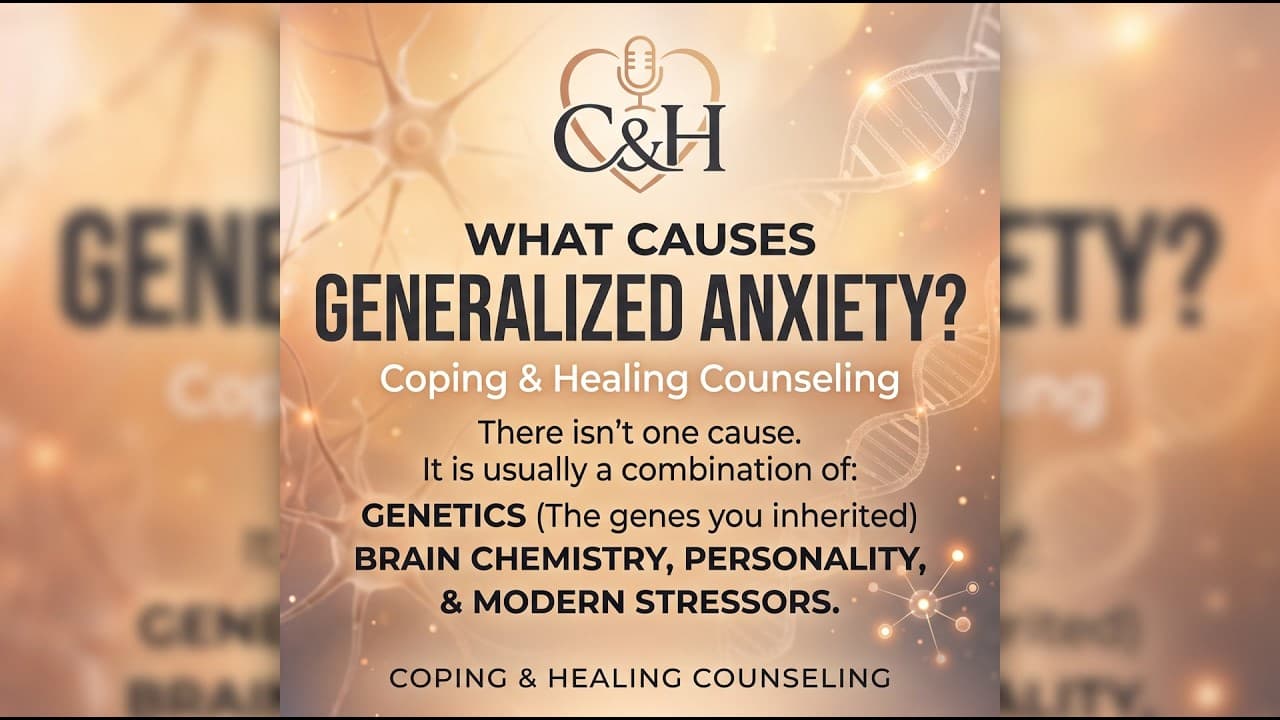
What causes generalized anxiety? — Full Episode | Georgia Telehealth Therapy
What causes generalized anxiety?
What are the 5 symptoms of major depressive disorder? — Full Episode | Georgia Telehealth Therapy
What are the 5 symptoms of major depressive disorder?

RSD and ADHD: Why One Short Text Can Wreck Your Whole Day | Georgia Telehealth Therapy
This one is for the friend who apologizes three times in a single text.
If this resonated, we have therapists who can help.
15+ licensed therapists, all 159 Georgia counties, telehealth-only. Medicaid covered at $0 copay.
Book a free consultation