
Let's bust a myth real quick: anxiety... | Georgia Telehealth Therapy
In this episode
Let's bust a myth real quick: anxiety isn't about being weak, dramatic, or 'too much.' It's a real, measurable physiological response — and it's incredibly common (19% of US adults). The good news: therapy works. The better news: finding out where you stand takes 2 minutes. Free GAD-7 test: chcthera
Generated from Coping & Healing Counseling: Accessible Telehealth for Georgia
#CopingAndHealing #GeorgiaTherapy #Telehealth #MentalHealth #Podcast
Transcript
If you are um sitting in a crowded coffee shop right now, just take a second to look around you. Yeah, it's a pretty wild thought experiment, right? Because out of every 20 people in that room, almost four of them are currently experiencing a like a biological misfire. It's so intense that their nervous systems are constantly preparing them for a life or death threat that just isn't actually there. And I mean, we all know what it feels like to be stressed, right? Your shoulders tighten up, your jaw clenches. Totally. Maybe you lie awake at 2 in the morning just, you know, overthinking an email you sent. Exactly. We just sort of accept that as the cost
of doing business in the modern world. We do. But today, we're doing a deep dive into the hard boundary line where that everyday stress turns into something else entirely. Yeah. Where it crosses over into a clinical physiological condition. And to find that boundary, we're using a really fascinatingformational brief from Coping and Healing Counseling or CHE for short. They're a teleaalth therapy practice based in Georgia. Right. And our mission for this deep dive is to basically unpack the truth about anxiety. We want to bust some of those common myths and separate everyday stress from actual clinical conditions and most importantly explore some really accessible evidence-based solutions. Because what's so great about the COPC brief is how
direct and practical it is. It really is. I mean, the internet is just full of like armchair psychology right now. Completely saturated. Everyone has a subjective life hack. Yeah. But looking at validated tools and hard physiological facts, it's just incredibly grounding. It really shifts the paradigm, you know, it takes the whole conversation out of this vague realm of how you feel and grounds it in objective biology. So, let's actually start right there with a biology because before we can even talk about treating anxiety, we really have to define what it is and what it isn't exactly. We have to tear down this really pervasive myth. There's this deeply ingrained societal narrative that having anxiety means
you are well weak, right? That you're just dramatic. Yeah. Or that you're too much for the people around you. Oh, and that narrative is not just wrong. It is actively harmful. I mean, it traps people in this massive cycle of shame. And what the source material points out is that clinically anxiety is not a character flaw. It's not a failure of willpower. No, not at all. It is a real measurable physiological nervous system response which affects like we said at the start a massive 19% of adults in the US. 19%. It's huge. So when we say measurable physiological response, what is actually happening under the hood? Because I mean to the person experiencing it, it
just feels like pure panic. It does. So think of your brain as having this highly evolved alarm system. It's primarily managed by a structure called the amygdala. Okay. The amydala, right? And when it perceives a threat, it activates your sympathetic nervous system. That's your classic fight, flight, or freeze response. Oh wow. So it's a full body reaction completely. It signals your adrenal glands to just flood your bloodstream with cortisol and adrenaline. The stress hormones. Exactly. Your heart rate skyrockets to pump blood to your muscles. Your breathing gets really shallow to take in more oxygen. Wait, and doesn't your digestion even shut down? It does. It shuts down to conserve energy. Biologically, your body is perfectly
prepping you to fight off a literal physical predator. But the misfire happens when your system triggers this massive response just because you're like looking at a spreadsheet. Yes. Or simply sitting in traffic. I love looking at it as an alarm system because if anxiety is a physiological nervous system response, then telling someone to just calm down is completely useless. It's worse than useless. Yeah. It's like telling a car's check engine light to just turn itself off. Yeah. You can't willpower a mechanical alert into shutting down. It's flashing for a reason. That check engine light analogy is absolutely perfect. I mean, you wouldn't judge a car for having a light on and you wouldn't judge yourself
for having a fever, right? that you just recognize it as an indicator of an underlying process. Which is why understanding the nervous system changes everything for a patient. It removes all the shame. It shifts the problem from a moral failing to a biological response that can actually be managed. But because of that shame, people usually do the exact opposite. Which brings us to the next big myth from the brief. The idea that toughing it out works. Oh, the push through it mentality. Yeah. We think if we just ignore the check engine light and keep driving, the anxiety will eventually just get tired and go away, which is biologically speaking the absolute worst thing you can
do for your brain. Because untreated anxiety compounds. Yes, it compounds. I want to pause on that word actually, compounding. When I think of that, I think of a savings account where interest builds on top of interest. How does a feeling compound? It comes down to neuroplasticity. Your brain is um constantly rewiring itself based on your experiences. Okay. The classic phrase in neuroscience is neurons that fire together wire together. So practicing a feeling makes it stronger. Exactly. If your nervous system is constantly stuck in a state of high alert and you just ignore it, you're essentially rehearsing that state of panic. Over time, the neural pathways associated with fear become thicker and faster. Your brain literally
gets better at being anxious. It builds a superhighway for the panic response, right? While the pathways for calming down get totally overgrown like an abandoned dirt road. That sounds incredibly exhausting. It is deeply exhausting and it damages systems over time. Chronic cortisol exposure can wreak havoc on your sleep, your immune system, everything. Which is exactly why clinicians draw a hard line between being just stressed and having generalized anxiety disorder or GE. The distinction matters clinically and the CHC brief actually gives a very specific diagnostic timeline. It says persistent anxiety lasting 6 months or more meets the threshold for GD. Yes, the six-month mark. But wait, I have to push back on this timeline a bit.
So, if I'm deeply stressed about work or maybe moving across the country for 3 months, that doesn't count. It's a great question. Like, what's the magic about that halfyear mark where the whole diagnostic picture changes? Well, the six-month mark isn't some magical switch that just flips at midnight. It's about establishing a pattern of persistence, right? If you are stressed about a cross-country move, that is an acute reaction to a temporary life event. You are actively dealing with a threat. And once the move is over, the threat is gone. Exactly. The check engine light turns off because the issue was resolved. But with G, it's different. Right. With generalized anxiety disorder, the anxiety is free floating.
It's persistent and completely disproportionate to the actual events in your life. So if your nervous system has been stuck in the on position for six months even as external stressors come and go. Yes. That indicates the anxiety has transitioned into a generalized default state. The brain has built that superighway. Precisely. And this is why early intervention is so crucial. You want to interrupt that compounding process before the pathways get deeply entrenched. But here's the real problem for you listening. How do you actually know? I mean, human memory is so flawed. We are notoriously bad at evaluating our own distress, right? If you're already overwhelmed, you might be like, "Have I felt this way for 4
months, 8 months?" We totally gaslight ourselves. When you're in the fog of anxiety, everything feels like an emergency. You can't step back and measure it objectively. Which brings us to the diagnostic tool mentioned in the text, the G87. Yes. And this isn't some like subjective internet mood quiz. This is a validated screening tool. That distinction is paramount. It's a psychometric instrument. It's essentially the difference between asking someone, "Hey, do you feel hot?" versus actually putting a thermometer in their mouth. I love that analogy. It's an objective measurement and it takes just 2 minutes. It gives you immediate scoring and points directly to whether a clinical evaluation is warranted. And it's highly accessible, totally free. You
find it at chc theapy.com/mental-health-ests. The immediiacy of it is profound, right? You don't need to wait weeks for an appointment just to find out if you need an appointment. You can find out where you stand in the time it takes to brew a cup of coffee. When you're dealing with a population that's already highly anxious, any logistical hurdle can be the reason they just abandon seeking help. It's too true. The G87 bridges that gap. If your score comes back high, it's external validation. It tells you your experience is real. The check engine light is on. So, say you take that two-minute test and you get a high score. The next logical question is treatment naturally.
And the immediate fear for most people is, "Oh no, does this mean I'm going to be on medication for the rest of my life?" It's a massive myth and it keeps so many people suffering in silence. But the brief is so clear on this. Medication is not the only option. In fact, therapy alone is effective for most people with G80. Yes. specifically cognitive behavioral therapy or CBT, which they highlight is the gold standard evidence-based treatment. And the stat they drop is wild remission rates for CBT are between 50 and 70%. It's incredibly effective. Wait, remission rates of 50 to 70% just from therapy alone. That is a massive success rate. It really is. So, what
makes CBT so much more powerful than, you know, just venting to a good friend over coffee? Well, if we go back to our neuroplasticity discussion, it makes total sense. Venting is great for social connection. Sure. Right. But clinically, if you spend two hours complaining about how terrible everything is, you are literally just retracing those anxious neural pathways. Oh, wow. So, you're confirming to your amygdala that there is a threat. Exactly. You are deepening the groove of that anxiety superighway. Venting can actually make the compounding effect worse if it turns into rumination. I never thought about it like that. But CBT is fundamentally different. It's a structured intervention. The therapist isn't just nodding. They are actively
helping you identify cognitive distortions. Okay. What does a cognitive distortion look like for, you know, an everyday person. Let's say you make a minor typo in an email to your boss. Your alarm system misfires and creates a catastrophizing pipeline. Like, I made a typo, so my boss hates me. My boss hates me, therefore I'm getting fired. Therefore, I'll lose my house. In a fraction of a second, your body is physically reacting as if you are already homeless. The cortisol just floods the system over a misplaced comma. Exactly. And what CBT does is interrupt that pipeline. The therapist uses targeted socratic questioning. So they don't just say, "Oh, you'll be fine." No. They ask, "What is
the empirical evidence you will be fired?" Has anyone ever been fired for a typo here before? It forces you to become an objective scientist of your own mind. Yes, you are opening the hood of the car and rewiring the sensor so it stops flashing the check engine light over every tiny bump. That is so empowering. A 50 to 70% remission rate isn't magic. It's just the biological result of rewiring the brain. Precisely. It's evidence-based. Okay, so we've established that anxiety is biological. You can test for it in 2 minutes. And CBT is a highly effective way to rewire the brain. But there's a massive reality check here, right? A highly effective treatment is useless if
people can't access it. Access is always the bottleneck in mental health care. Which brings us to how coping and healing counseling actually delivers this care. They operate as a 100% teleaalth IPA compliant practice and they serve all 159 Georgia counties. You really cannot overstate how important that is because if you live in a rural county, the nearest licensed CBT therapist could be a 2-hour drive away. And if you have clinical anxiety, just the thought of driving 2 hours, finding parking, sitting in a waiting room, that alone could trigger a panic attack. The logistical friction becomes a literal biological barrier. Exactly. Tellahalth completely removes geography from the equation. You can do this deep rewiring work from
your own living room where your nervous system already feels safe. And it's not just a small operation. They have a diverse culturally competent team of over 15 licensed therapists, licensed clinical social workers, professional counselors, marriage and family therapists, right? Handling individual, couples, family, and teen therapy starting at age 13. They cover anxiety, depression, trauma, PTSD, everything. And that cultural competency is vital. It's not just a buzzword. Why is that so important for CBT specifically? Because CBT requires immense trust. You're exposing your most vulnerable cognitive distortions. If you feel the therapist doesn't understand your cultural context or lived experience, the alliance just breaks down. That makes total sense. A diverse team massively increases the odds of
finding someone you can truly do the hard work with. And then there's the final barrier, the financial one. Yeah, therapy can be notoriously expensive out of pocket. It stops so many people right at the finish line. But CHC completely changes the math. For Medicaid, the co-pay is $0. Zero. That's incredible. And for major commercial insurancees like Etna, Sigma, BCBS, United Healthcare, Humanana, it ranges from a 0 to a $40 co-pay per session. A 0 to $40 co-pay delivered straight to your living room anywhere in Georgia. It completely changes who gets to heal. It does. And if you connect this back to the six-month threshold we talked about, early intervention is everything, right? To stop the
compounding effect. Exactly. If therapy is $200 out of pocket, you'll probably tough it out for years and let those neural pathways become super highways. But if it's accessible from your couch for 40 bucks or less, you are vastly more likely to intervene early by removing the financial and geographic barriers, they are making early intervention a literal reality. For anyone listening who is ready to read their own check engine light, you can bypass all that friction. You can reach them at area code 404-832102 or visit chuckze theapy.com. Yeah. Or email them directly at support at check theapy.com. Having a safety net like that just a click away, it really changes how a community approaches mental health.
So to summarize all of this for you today, the anxiety you might be feeling is not a weakness. It is a measurable biological nervous system response that affects 19% of adults. And ignoring it just makes it compound. Exactly. Taking the 2-minute GAD7 test is your first objective step. And if you need help, affordable CBT teleaalth through CHC provides a highly effective way out without necessarily needing a lifetime of medication. It is a completely demystified pathway to getting better. It really is. And you know, as we wrap up, I think there's a really compelling final thought here. Oh, I'd love to hear it. We spent all this time talking about how untreated anxiety compounds negatively within
one person, but think about the CHC model reaching all 159 Georgia counties with these immediate affordable interventions. Okay, imagine the compounding positive effect on an entire state if we shift away from toughing it out to early two-minute teleaalth interventions. Yeah. How much human potential, how much creativity, productivity, and just joy is currently trapped behind a wall of untreated anxiety just waiting on the other side of a two-minute screening. That is such a powerful perspective. It really changes how you think about your own internal alarms. It definitely does. The next time you feel your shoulders tighten up, remember, you don't have to yell at the dashboard. You just have to read the code and bring it
into the shop.
More episodes
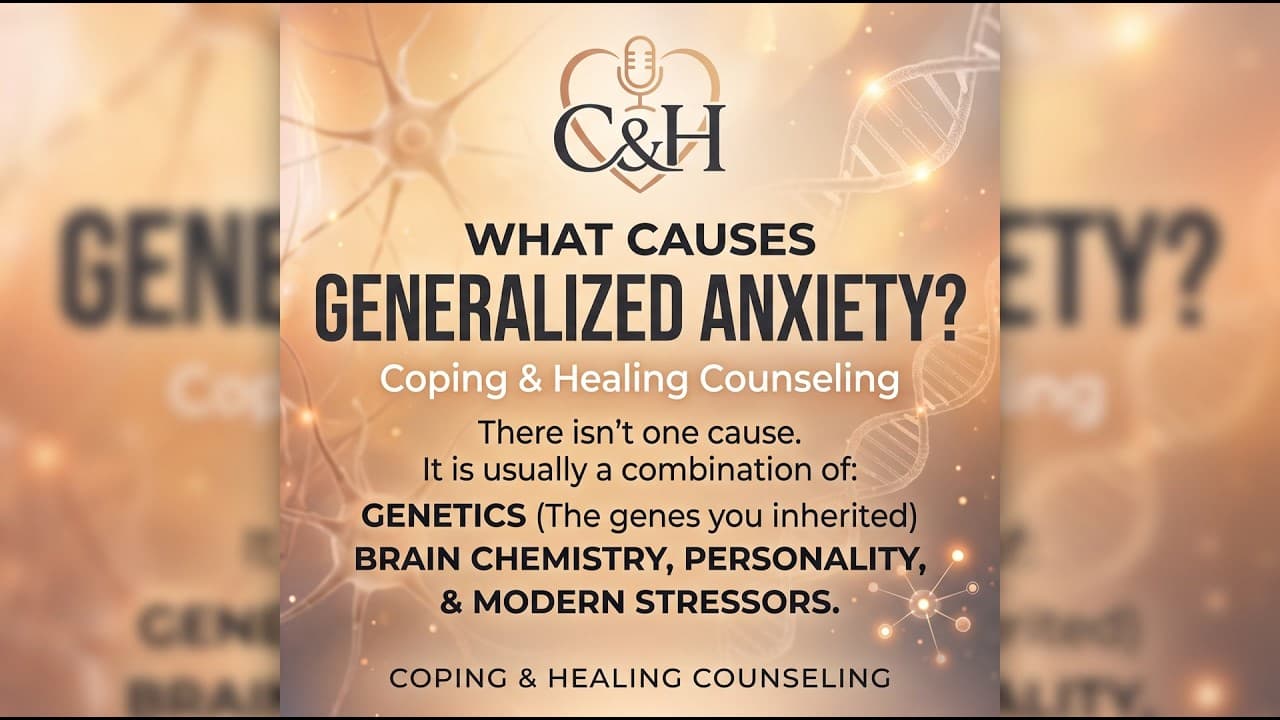
What causes generalized anxiety? — Full Episode | Georgia Telehealth Therapy
What causes generalized anxiety?
What are the 5 symptoms of major depressive disorder? — Full Episode | Georgia Telehealth Therapy
What are the 5 symptoms of major depressive disorder?

RSD and ADHD: Why One Short Text Can Wreck Your Whole Day | Georgia Telehealth Therapy
This one is for the friend who apologizes three times in a single text.
If this resonated, we have therapists who can help.
15+ licensed therapists, all 159 Georgia counties, telehealth-only. Medicaid covered at $0 copay.
Book a free consultation