
"I don't have time for therapy." | Georgia Telehealth Therapy
In this episode
"I don't have time for therapy."
Friend — you have 50 minutes. Once a week. Maybe once every two weeks.
The time you're already losing to overthinking, dread, sleepless nights, and snapping at the people you love? That adds up to a lot more than a session.
Transcript
We will spend um I mean literally three hours researching a $20 purchase online just to make sure we get free shipping. Oh, absolutely. We've got apps tracking every single latte, you know, right? Every subscription, every cent that leaves our accounts. We guard our financial currency like hawks. Yeah. But our other currency, exactly the one we can never earn back, our time. We don't track it. We barely audit it. And we are frankly remarkably blind to how much of it we are actively bleeding out every single day. Especially when it comes to like the ultimate time drain, which is unmanaged mental health. Yes, people will rigorously defend their schedules to avoid a 50-minute therapy appointment completely
ignoring the 10 hours they just lost that week to, you know, anxiety, dread, and exhaustion. And that profound blind spot is exactly what we are tearing into today. Welcome to the deep dive. Glad to be here. Our mission for this conversation is to well mathematically destroy the favorite excuse of the modern era. You know the one I don't have time for it there. That's the one. So we are pulling from a really fascinating set of operational documents and a super punchy thought piece published by coping and healing counseling. Right. Or CHC. Yeah. CHC. They're a teaalth therapy practice based out of Georgia. And reading through their materials, it's clear they aren't just trying to attract
patients. No, not at all. They are presenting a full manifesto on how modern mental health care can systematically dismantle like every single barrier we use to avoid getting help. It's a very compelling set of sources really because they don't just dismiss the excuses we make, they deconstruct them. Yeah. When you examine the operational model they've built alongside their written philosophy, you see this blueprint for treating mental health care not as a luxury or, you know, an added chore, but as a mechanism to actually reclaim your life. Exactly. We're talking about the real world return on investment of therapy, looking at time, accessibility, cost, and the actual scope of what gets treated. Because when you lay
it all out, the idea that we uh don't have time to fix the very engine that runs our lives, our own brain, starts to look completely absurd. It really does. So, let's start with their thought piece. It hits you right between the eyes. They write, and I'm paraphrasing a bit here, but essentially, you think you don't have time, but you actually have 50 minutes once a week or maybe once every two weeks. It forces a hard pivot in how we categorize therapy. Usually we view therapy as a calendar edition, like another chore on the list, right? It's another block of time, another meeting in a schedule that's already, you know, buckling under its own weight.
Well, for sure. But the text asks us to look at the invisible, unmanaged time sucks that are already on that same calendar. They specifically point out the hours lost to overthinking, the physical exhaustion of dread, the sleepless nights, and the time spent snapping at the people you love. Yes. Exactly. So, it's almost like, and tell me this makes sense, like a bad loan. Oh, I like that. How do you mean? I'm trying to picture how this actually works in practice. If unmanaged stress or trauma is the bad loan, then that daily dread, that overthinking, um, those are the interest payments, right? Oh, that's a brilliant way to frame it. Like, you're sitting at your desk
staring at an email for 40 minutes because your anxiety is paralyzing you. That's an interest payment. Yeah. You're lying awake at 2 a.m. playing out catastrophic scenarios, another interest payment. It's just draining your account drop by drop. That's a highly accurate way to visualize it. And biologically, those interest payments have a literal physical cost. Right. When you're lying awake at 2 a.m. catastrophizing, your body is pumping out cortisol. Your sympathetic nervous system is firing. So, you're not just awake. Your body is essentially running a marathon. Exactly. You aren't just losing sleep. You're actively degrading your cognitive performance for the entire next day. You're slower. You're more prone to mistakes. You're irritable. You're paying the interest
again the next morning. Yes. So, taking that analogy a step further, the 50-minute therapy session they're advocating for isn't an added expense. It's you finally walking into the bank and paying down the principle of that loan. Wow. Okay. I love that. Yes. It requires a lump sum of your time in that moment, 50 minutes, but it drastically reduces the daily exhausting interest payments moving forward. The text actually distills this into a really powerful thesis. They say therapy doesn't take time from your life, it gives some of it back. That's the ROI right there. You spend the 50 minutes and you buy back the entire Sunday afternoon you would have otherwise lost to a depressive fog.
And we also have to factor in the relational time loss they mentioned which is something we you know we rarely quantify right the snapping at loved ones partner. Exactly. When emotional regulation suffers due to unmanaged mental health conflict spikes. You snap at a partner or a colleague and then there's the fallout. Right. Think about the massive expenditure of time and emotional labor that follows. The apologies, the repair of the relationship, navigating the ensuing argument, just you know sitting with the guilt. All of that is preventable time loss if the root cause is addressed. 100%. Okay. So, the I don't have time argument is largely a psychological illusion. We were already spending the time. We're just
spending it miserably. Well said. But, okay, if I buy that, the very next wall I'm going to hit is the logistics. Ah, yes, the commute, right? Sure, I have 50 minutes for the actual talking part, but then there's the drive across town in rush hour traffic, sitting in a waiting room, reading a 5-year-old magazine, and driving back. It adds up fast. Suddenly, my 50-minute investment requires a 3-hour window. How does their model survive that reality? It survives it by entirely erasing the physical location. Okay. According to their operational documents, coping and healing counseling is a 100% teleaalth practice. Oh, wow. Yeah. They operate exclusively in a hyperaco compliant virtual space. So the commute isn't just
reduced. It doesn't exist. The text explicitly notes that you can do this quote from your couch. The couch commute. That definitely kills the traffic excuse. It really does. But wait, what does a hyperaco compliant virtual space actually mean for me sitting on my couch? Is it just like a fancy Zoom call? Cuz I know people worry about privacy when everything is online. It's a critical distinction actually. Hypo compliance intella health means the software uses endto-end encryption and secure data routing. Okay, so it's locked down. To give you the simplest explanation, think of it as a digital version of a soundproof room. In a standard video call, data might be stored or accessible on a server
somewhere which is terrifying for therapy. Exactly. But in a hypoco compliant environment, the platform is legally and technically engineered so that nobody, not the software provider, not a server host, can intercept or store the contents of your session. So it replicates the locked door of a physical clinic. That makes total sense. But let's look at the actual footprint of this digital clinic. The documents note that they serve all 159 counties in Georgia. Yes. Now, obviously being online makes that physically possible, but why is that specific detail so important to their overall mission? Because it addresses a profound systemic failure in how mental health care is distributed. The geographic lottery essentially. Exactly. Georgia, like a vast
majority of the country, suffers from a severe rural urban divide in medical infrastructure. Right. Atlanta has plenty of options, but out in the country, in a major city, you might have 50 licensed therapists within a 5m radius. In a rural county, the nearest clinical professional could realistically be a 2-hour drive away. That's a 4-hour round trip just to talk to someone, right? And why? Because clinics require a high population density to sustain a brick-andmortar business. By operating statewide via teleaalth, this practice is rendering geographic isolation completely irrelevant. problem. The quality of your care is no longer dictated by your zip game. So, they've essentially flattened the map. But I have to ask, um, does taking
away the commute and letting people stay in their living rooms fundamentally change the therapy itself? It's a great question because on one hand, yes, it's frictionless, but doesn't going to a clinic force you into a certain headspace? If I'm just opening a new tab on my laptop right after a stressful work call, am I actually doing therapy or am I just squeezing it in without transitioning my mindset? That is the double-edged sword of convenience. And it does require intention from the patient to create a mental boundary. However, clinically speaking, the couch commute actually offers a massive psychological advantage. Really? Yes. It taps into something tied to our sympathetic nervous system. Okay, walk me through that.
How does the nervous system care if I'm on a couch or in a clinic? Think about the traditional therapy model. You fight traffic. You're stressed about finding parking. You're rushing into a waiting room. Your body is flooded with adrenaline, right? You're already agitated. You sit down on the therapist's couch and it takes 15 or 20 minutes just for your physiological state to return to baseline. So, you can actually do deep emotional work. You're wasting half the session just calming down from the drive. Precisely. But when you are in your own home, wrapped in your own blanket, maybe with your dog asleep at your feet, you are already at baseline. Oh, that makes so much sense.
The environment cues your brain that you are physically safe. This can drastically accelerate emotional vulnerability. Wow. There is also the concept of state dependent memory. We often process and retrieve emotions better in the environments where we actually experience them. So dealing with marriage issues while sitting in the living room where those issues actually occur. Exactly. It can sometimes yield faster breakthroughs than discussing them in a sterile, unfamiliar office. I hadn't thought about the biology of it. So the convenience isn't just a perk. It's practically a clinical tool. It really is. We've got the time. We've got the secure digital room. And we don't have to drive. But you know, none of this matters. Absolutely none
of it. If the financial barrier is still standing, that's the big one, right? The geography excuse is gone. But if a therapist beans into my living room and charges me $300 out of pocket, the door is still slam shut for most people. What's the economic reality of this practice? This is where their model aggressively challenges the industry standard. Their documents outline their accepted insuranceances, and the most striking detail is their Medicaid option, which carries a Z co-pay. Wait, a Z co-pay? Yes, zero. That sounds way too good to be true. Usually, when mental health care is completely free, you're getting what, 15 minutes a month with a severely overworked intern. What's the catch here? That
skepticism is entirely warranted because historically, mental health care in America has been positioned as a luxury good, right? It's often out of network and paid out of pocket. Exactly. But the catch here isn't a drop in quality. It's a shield in the business model. They are choosing to navigate the bureaucratic red tape of state and major insurance systems to make the care accessible. Oh, so they take on the administrative headaches so the patient doesn't have to. Yes. And they are very transparent about who is providing the care. This isn't a textbased chat line staffed by volunteers. Right. The documents explicitly detail a team of over 15 licensed therapists. And look at the credentials they list.
LCSSWS, which are licensed clinical social workers, LPC's, licensed professional counselors, and LMFTs, licensed marriage and family therapists. Those are serious qualifications. To put that in context, achieving these licenses requires a master's degree, passing national board exams, and completing thousands of hours of supervised clinical work. These are highly educated, board-certified clinicians. Okay. So, the quality is there. And it's not just Medicaid. They list major private insuranceances, too, right? Yes. Absolutely. It's like Etna, Sigma, Blue Cross Blue Shield, United Healthcare, Humanana. The source notes that with these plans, the cost per session drops to somewhere between $10 and $40, which fundamentally changes the economic calculus of getting help. It really does. When therapy costs $200 a session,
you have to weigh it against your rent or your groceries. When it costs $20, it competes with ordering takeout for dinner. Wow. Yeah. It transforms mental health care from an elite privilege back into a fundamental accessible healthcare right. I want to look closer at the team they've built because the text adds another layer here. They don't just emphasize the licenses. They explicitly highlight that this is a diverse culturally competent team. That's a huge point. Now, cultural competence is one of those phrases that gets thrown around in corporate HR seminars a lot. But in the context of deeply personal one-on-one therapy, why is that specific trait so vital? Because cultural competence is the ultimate friction remover
in therapy. It goes right back to our earlier discussion about saving time. No, sir. Imagine stepping into a therapy session to process a complex family dynamic. But before you can even get to the trauma, you have to spend 20 minutes explaining your culture's baseline expectations around familial duty, right? or you have to educate your therapist on the specific racial microaggressions you deal with in your community. So, you're basically paying to be their teacher. Yes. You're burning your own 50 minutes trying to get the therapist up to speed on your lived reality before you can even be a patient. Exactly. And that is exhausting. When a patient feels fundamentally understood by their therapist regarding their race,
their background, or their cultural nuances, they bypass that exhaustion. That makes total sense. They don't have to translate their existence. Culturally competent care means the therapist already has the framework. You log on and you immediately begin the work of healing. It's all about stripping away the friction completely. So if we look at the scorecard so far, they've dismantled the illusion of not having time. They've erased the geographic and commute barriers with a statewide secure teleaalth model. Check and check. They've aggressively lowered the financial wall with zero Medicaid options and standard insurance acceptance. and they're providing licensed culturally fluent professionals. It's a robust system. So the final question is what exactly is happening in these digital
rooms? Who is this for? The scope of practice they outline is remarkably comprehensive. They provide individual couples and family therapy. But a particularly crucial detail is their focus on adolescent care. Okay. They specify that they treat teens from ages 13 and up. That feels incredibly urgent right now. I mean, being 13 has never been a walk in the park, but the modern adolescent experience is a completely different beast. Oh, without question. You're dealing with the pressures of a hyperconnected digital landscape, post-pandemic social anxiety, academic stress. It's a pressure cooker. It really is. Giving a teenager a dedicated 50-minute release valve with a neutral licensed professional could alter the entire trajectory of their life. Absolutely. And
whether they are treating a teenager or an adult, the specialties they list are tackling heavy complex issues. They highlight anxiety, depression, trauma, PTSD, grief, and severe stress, which ties this entire deep dive together perfectly. If they are treating severe trauma and complex grief, they are directly targeting the root causes of that lost time we talked about at the beginning. It's a closed loop. A person doesn't just spontaneously lose sleep or snap at their kids or stare blankly at a wall for two hours, right? There's a reason for it. They do those things because their nervous system is locked in a trauma response or because unprocessed grief is suffocating their daily functioning. Yeah. By providing specialized
treatment for PTSD and depression, this practice isn't just offering a place to vent. They are surgically addressing the infections that cause the fever. What I appreciate most about their approach is that they don't just drop this heavy realization on you and walk away. No, they give you the tools, right? The operational materials provide immediate frictionless pathways to start. I mean, it's right there. You can call 4048320102. You can go to cheat theapy.com or just email support theapy.com. The simplicity there is an intentional clinical choice. Really? How? So, we need to talk briefly about executive functioning. Okay. What is that? It's the brain's ability to plan, prioritize, and execute tasks. When someone is suffering from severe
depression or acute anxiety, the prefrontal cortex, the part of the brain responsible for executive functioning, is physically impaired. So, the very organ you need to navigate a complicated health care system is the one that's currently offline. Exactly. If finding a therapist requires making a dozen phone calls to see who is accepting new patients, figuring out out of network reimbursement forms, and organizing a commute, a person with compromised executive functioning simply will not do it. The cognitive load is too high. By making the contact methods immediate, and the pricing completely transparent upfront, coping and healing counseling lowers the cognitive barrier to entry to the absolute floor. They've effectively taken away our ability to say, "I can't."
They really have. So let's step back and look at the whole picture. We started this deep dive with a pervasive modern myth. The idea that we simply don't have the time to care for our own minds, right? But looking at the blueprint of this Georgia Teaalth practice, we've seen how every single excuse gets systematically dismantled. They flip the narrative on time, showing us that therapy is an investment that actually yields a surplus of functional hours. Yeah. They eliminate the commute and the geographic lottery, bringing highle care to all 159 counties. It's amazing. They shatter the financial barrier, bringing costs down to as low as 0 for marginalized patients. And they back it all up with
a diverse licensed team equipped to handle everything from adolescent anxiety to complex adult trauma. They basically replace the I can't with a very firm, very gentle you can and you must. We meticulously budget our finances, yet we freely bleed our time. We let anxiety and unprocessed dread tax our days and steal our sleep. But therapy, especially when it's made this accessible, offers a real way to balance that ledger. And that raises a critical question for anyone listening who still feels, you know, resistance to this idea. The source material fundamentally proves that leaning into the difficult work of therapy actually manufactures more freedom, more energy, and more peace in your week. the logistics and the costs
are solvable problems. Right? So, here's the thought I want to leave you with today. If we accept the premise that investing 50 minutes into your own healing actually saves you time in the long run, um what else are you hiding from? What other difficult conversations or necessary boundaries or hard personal pivots are you avoiding right now under the convenient guise of being too busy? Because the moment you stop using time as your favorite excuse is the exact moment you finally start owning it.
More episodes
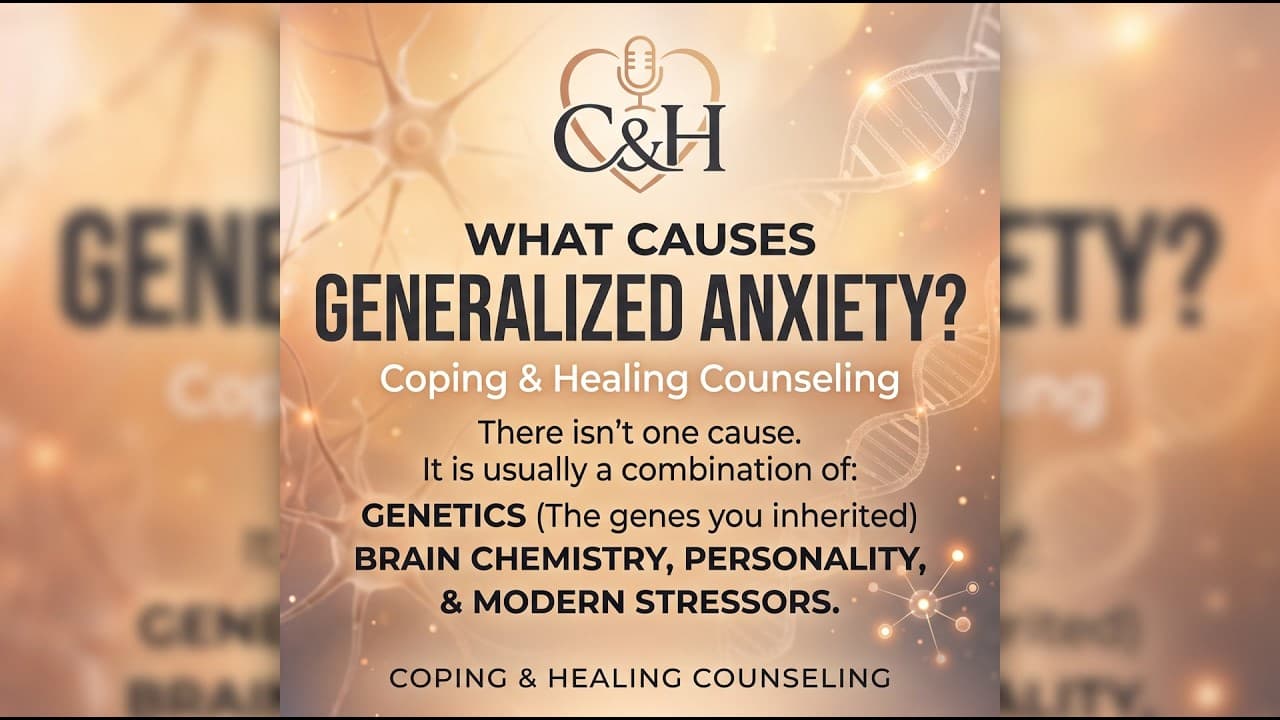
What causes generalized anxiety? — Full Episode | Georgia Telehealth Therapy
What causes generalized anxiety?
What are the 5 symptoms of major depressive disorder? — Full Episode | Georgia Telehealth Therapy
What are the 5 symptoms of major depressive disorder?

RSD and ADHD: Why One Short Text Can Wreck Your Whole Day | Georgia Telehealth Therapy
This one is for the friend who apologizes three times in a single text.
If this resonated, we have therapists who can help.
15+ licensed therapists, all 159 Georgia counties, telehealth-only. Medicaid covered at $0 copay.
Book a free consultation