
Coping & Healing Counseling — Educational Deep Dive | 2026-04-13
In this episode
3 signs your nervous system might be running on overdrive:
1. You're bone-tired but can't fall asleep 2. Little things make you snap — and then you feel terrible about it 3. You're constantly waiting for the other shoe to drop
This isn't weakness. It's your body stuck in fight-or-flight mode. It h
Transcript
Have you ever been told that you are just, you know, too much? Oh, I think a lot of people have heard that one, right? Or maybe you've had a moment where you expressed a really strong feeling, like maybe you got visibly frustrated in a meeting at work. Yeah. Or you teared up during a really difficult conversation and the immediate overwhelming reaction from everyone around you was that you were just wildly overreacting, like you're malfunctioning or something. Exactly. They look at you like you are a broken machine. And if you are listening to this right now, chances are you're someone who likes to learn. You're someone who seeks out those sudden aha moments that make the
world make a little more sense. Usually we look for those moments out in the world, right? Like in history or science. Yeah. But today we're going to look for one of those moments right inside your own head, which is arguably the most profound place we can start, honestly. I mean, we spend immense amounts of energy trying to decode the politics, the economy, the social dynamics of the world around us. Yet, we spend almost zero time decoding our own internal biological responses to those exact same external pressures. And that is exactly our mission for today's deep dive. We are exploring this concept of emotional literacy. I love that term. It's so good, right? And while we
do that, we are also decoding the very modern, very real landscape of mental healthcare accessibility. So to pull back the curtain on this, we are looking through a really fascinating stack of sources today. Yeah, these documents are really interesting. They are. We have a collection of internal clinical notes, some social media outreach strategies, and practice details from a group called Coping and Healing Counseling or CHC. And they are a teleaalth therapy practice based out of Georgia. Right. And you know, on the surface, these documents look like standard administrative materials, just insurance bullet points, service lists, a few motivational quotes for Instagram. But if you read between the lines, they are so much more than administrative
boiler plate. Oh, entirely. These sources actually contain this really comprehensive, highly intentional blueprint for how modern mental health care is actively dismantling historical barriers, things like stigma, geography, and cost. Yeah, it's really a very deliberate structural shift in how healing is both understood and delivered. Okay, so let's unpack this because to understand the mechanics of how they are delivering this care, we first have to understand why people so desperately need it in the first place, right? You have to look at the root cause. Exactly. We have to look inward at the foundational philosophy that CHC holds regarding how we interpret our own daily feelings. And the very first thing they establish in their educational outreach
is this incredibly bold statement. They say your feelings aren't too much. They aren't glitches in your software. They are actually trying to communicate crucial data to you. Which represents a massive psychological paradigm shift for the average person. I mean, from an evolutionary standpoint, our emotions were designed as survival mechanisms. They break it down in such a digestible way in these notes, too. Like, they point out that anxiety simply means something feels unsafe, right? Sadness means something or someone matters deeply to you. And anger, this is the one that got me. Anger means a personal boundary just got crossed. It's so clarifying when you put it like that. It really is. When I was reading this,
it immediately made me think of the dashboard warning lights in a car, you know. Yeah. You are driving down the highway and suddenly the check engine light flashes bright red. You wouldn't smash your dashboard with a hammer to make the light turn off. Exactly. You wouldn't just cover it with duct tape either. You would pull over, get out the manual, or go to a mechanic to read the diagnostic code because the flashing light isn't the actual problem. Right. The light is just the messenger trying to save your engine. That is a perfect conceptualization. The light is just raw data. And yet our cultural reflex is to well cover the light with tape. But I struggle
with that reflex. I really do. Like if these emotions, anxiety, sadness, anger are literally just harmless, helpful evolutionary signals, why is society's default reaction almost always to suppress them? It's a great question. Why do we demand that people shut these feelings down rather than actually listen to what the code is saying? Well, what's fascinating here is the sheer brutal efficiency of suppression in the short term. Oh, efficiency. Okay. Yeah, think about it. From a societal and economic standpoint, shutting down an intense emotion is infinitely faster than unpacking it. If you are angry because a boundary was crossed by a manager at work, corporate culture demands that you suppress that anger so the 2:00 meeting can
simply continue on schedule. Wow. Yeah. Society prizes frictionless functioning. Precisely. But CHC's educational approach fundamentally rejects that shortterm fix because the biological cost of suppression is devastating. The hyperarousal, right? Yes. When you constantly swallow anger or ignore anxiety, your nervous system remains locked in a state of hyperarousal. Yeah. You're essentially revving the engine while slamming on the brakes. That sounds exhausting. It is. CHC emphasizes that therapy isn't about learning how to shut those feelings down better. It's about finally understanding the language they are speaking. Right? True emotional literacy flips the script entirely. Instead of fighting our internal states as if they are a disease to be cured, we learn to translate them and translate them.
I love that. So sadness isn't a weakness or a character flaw. Not at all. It's a translation that says this thing you lost or this transition you were experiencing carries profound weight for you. Exactly. And anger isn't a lack of discipline. It's an internal alarm system shouting, "Your perimeter was just breached. Defend yourself." And once you begin translating those signals rather than suffocating them, you move from a state of constant internal conflict to a state of internal clarity. You stop fighting the dashboard. You stop fighting the dashboard. Yes. So, if we accept that our emotions are just data trying to warn us, the problem isn't our feelings. The problem is that most of us were
never handed the manual to read those warning codes. Which brings us to the actual physical mechanics of getting that manual, right? Where do you go to find a mechanic for your mind? Because looking at CHC's practice details, the logistics of how they actually operate are incredibly revealing. The structure of their practice is highly intentional. It's clearly designed to counter the historical gatekeeping of mental health. Let's look at what the sources tell us about the people running this. CHC was founded by Elias Joseph. She's a licensed clinical social worker. A great credential. Yeah. And she has built this remarkably diverse, culturally competent team of over 15 licensed therapists. That's a solid team size. It is. We
are talking a mix of LCSWs, licensed professional counselors, and licensed marriage and family therapists. But the detail that just jumps off the page is their delivery mechanism. The Tellah Health. Yes, they are a 100% teaalth entirely digital ipay compliant practice. And because they aren't tethered to a brick-and-mortar building, they are actively serving all 159 counties in the state of Georgia. The sheer scale of that geographical coverage is critical to understand here. Why is that so crucial? Well, historically, the mental health care system was designed almost exclusively for people living in affluent urban or suburban centers. Oh, sure. If you live in a city, you have options, right? But CHC is completely bypassing that legacy system.
The sources specifically highlight that they will meet you wherever you actually are. Yeah. They literally market the fact that you can log into a session from your couch, from your bedroom, or and this is the part I find fascinating, from your parked car. The parked car is a really important detail. I just have to marvel at that. It's like having a highly secure clinical confessional right in your pocket. That's a great way to put it. But here's where it gets really interesting. I have to wonder about the psychological environment. What do you mean? Well, traditional therapy is so deeply bound up in the physical space, right? You have the quiet waiting room, the white noise
machine outside the door, the specific comfortable chair, the whole aesthetic of therapy. Exactly. So, does doing deep, vulnerable trauma work or intense couples therapy from the front seat of a Honda Civic in a grocery store parking lot somehow dilute that sacred space of traditional therapy? I mean, does it make it less effective? If we connect this to the bigger picture, we really have to recognize who that traditional sacred space actually serves. Okay, fair point. That quiet waiting room requires immense privilege. It requires physical mobility. It requires proximity to a therapist's office and requires a lifestyle or a job that allows you to casually leave during normal business hours. Yeah. Which a lot of people just
don't have. Right. For decades, geography alone was a massive disqualifier. If you lived in a rural or underserved county in Georgia, the nearest specialist for severe trauma or complex grief might be a 2-hour drive away in each direction. Wow. 4 hours in the car just for a session. Exactly. So, by operating a fully remote model with culturally competent providers across all 159 counties, CHC is radically democratizing access. It's shifting the power dynamic. The therapist comes to you. Furthermore, it redefineses what a safe space truly is. Authenticity in therapy doesn't come from a leather couch or a white noise machine, right? It comes from the safety of the human connection. For many people, particularly those living
in multigenerational households, crowded apartments, or frankly abusive living situations, their parked car is the only truly private soundproof space they possess in their entire lives. Oh, wow. I hadn't thought about it like that. The car is their sanctuary. Yes. By validating that space, tellahalth makes the therapeutic process far more adaptable to the messy reality of the patients actual life. The car isn't a compromise. It is a vital feature of modern care. Oh, yeah. I totally see that now. It is meeting the patient in their actual reality. Location is no longer a barrier. You can be in the most remote rural county in the state and as long as you have a smartphone and a parked
car, you can access one of these 15 highly trained specialists. But then there's the next barrier, right? Let's look at the immediate next hurdle that any listener is going to point out. The wallet. Ah, yes. The financial barrier is undoubtedly the most formidable wall in the American health care system. Absolutely. And our sources pivot right into this. They directly address what CHC calls myth busting, the true cost of care. It's so necessary to talk about this. They tackle the phrase they hear constantly from prospective patients. I can't afford therapy. But the reality of their billing structure is pretty staggering. First of all, the sources explicitly state that for Georgia Medicaid patients, the co-pay is $0.
Wow. Not a sliding scale, not a reduced fee, completely unequivocally free. That distinction alters the entire trajectory of community health. 0 is a gamecher. It really is. And they don't just cater to Medicaid either. For major commercial insuranceances, the cost is remarkably low. The sources note they accept almost all the major players like who? Think your Blue Cross Blue Shields, your Sigas, United Healthcare, Etna, Humanana. basically the exact cards sitting unused in millions of wallets right now. Exactly. For those patients, the cost is usually between $10 and $40 per session. That's incredibly reasonable. But the notes also spend a lot of time outlining the hidden savings of their teleaalth model. They argue that because you
aren't commuting, you are saving money on gas, saving money on child care, and not taking unpaid time off work. Those hidden costs add up fast. So, what does this all mean? The sources claim the biggest barrier to therapy isn't the cost itself, but simply not knowing these low costs exist. But I have to push back a little on this hidden savings argument they make. Oh, why is that? Let's be real for a second. If you are having a mental health crisis or your marriage is falling apart, are you really sitting at home doing the math on three gallons of gas in an hour of babysitting? You'd be surprised. I mean, are gas and child care
really making or breaking the decision to get healthcare, or is that just an excuse people use because they are, you know, terrified to start therapy? It is not an excuse at all. It is an absolute quantifiable economic barrier. Really? Yes. We often fail to calculate the Yeah. When you stack it up, a $40 co-pay for an in-person visit might actually cost that patient over $150 in lost time, transit, and secondary expenses. Precisely. For a family living paycheck to paycheck, that hidden tax makes consistent weekly therapy mathematically impossible. So, it's not fear, it's just math, right? And that is why the stark reality of the numbers CHC provides is so transformative. A $0 Medicaid co-pay delivered
via a screen in your living room eliminates that hidden tax entirely. Yeah, it completely neutralizes it. You no longer have to choose between picking up an extra shift at work and processing your trauma with a licensed professional. The financial wall isn't just lowered. Structurally, it has been removed, which makes their central claim so devastatingly accurate. The biggest barrier really is just a lack of information. People just don't know what's an option. There are millions of people walking around right now assuming they are entirely priced out of emotional literacy. They assume they have to just live with the warning lights flashing red on their mental dashboard because they think the mechanic costs $200 an hour out
of pocket when in reality the mechanic is covered by their insurance for the price of a fancy cup of coffee. And that mechanic will literally video call them on their lunch break. It dramatically expands the demographic of who actually walks through the virtual door. It changes the face of who gets to be a patient. Which leads us perfectly into the final piece of the puzzle. Having dismantled the geographical walls of those 159 counties and breaking down the financial walls with 0 to $40 sessions, we have to look at the human element, the patients themselves, right? Who exactly are these 15 therapists treating? Who is doing the heavy lifting in these telealth sessions? The clinical notes
provide a very clear picture of their scope of practice and honestly it is impressively broad. We know they offer individual counseling, couples therapy, family counseling, and teen therapy for adolescence aged 13 and up along with general life coaching. They cover a lot of ground. They do. And their specialties cover the heavy hitters. Severe anxiety, clinical depression, complex trauma, and PTSD, grief, and relationship conflicts. But there's a specific group they target, right? Yes. And this is so interesting. Nestled in their social media outreach strategy is this very specific, incredibly evocative target audience they call the evening motivational demographic. Ah, the midnight scroller. Yes, the midnight scroller. The outreach text literally reads, "If you're scrolling tonight feeling
heavy, this is for you. You've been holding it together for everyone else. The late nights, the overthinking, the heaviness that just sits there." That is so relatable. It really is. It is speaking directly to the person carrying a massive invisible burden completely alone. But I see a real tension here. What kind of edge? Well, on one hand, this practice treats highly acute severe clinical issues like PTSD. On the other hand, they are explicitly targeting this high functioning overgiver who is just mindlessly scrolling their phone in the dark, feeling a vague sense of heaviness, right? Why is it often so much harder to convince the people who are holding it together for everyone else that they
actually deserve the Z support just as much as someone with a severe acute diagnosis? This raises an important question about the modern cultural normalization of burnout. We live in a society that frequently rewards self-sacrifice. We really do. We equate chronic stress with productivity and moral goodness. So the overgiver, the parent managing the emotional temperature of the household, the professional working late into the night, the eldest sibling absorbing the weight of their family, they often do not view their suffering as valid because they're still functioning. Exactly. They look at their life, compare their heaviness to someone else's acute trauma, and conclude that they simply aren't sick enough to require clinical intervention. They think, "Well, I'm still
getting up and going to work. The kids are fed, so I must be fine." Even though the check engine light have been glaring red in their face for five years. Yes, they assume therapy is a triage center meant only for a catastrophic crisis rather than a space for maintenance or untangling chronic heaviness which is such a dangerous misconception. It is what CHC is doing with that targeted evening outreach is profoundly validating. They are actively telling that high functioning person, you do not have to wait for your engine to explode to seek help. You don't have to hit rock bottom. You do not have to keep carrying the weight alone just because you are capable of
carrying it. Whether you are a 13-year-old teen navigating the crushing pressures of modern adolescence or a parent managing the invisible grief of a changing family dynamic, the support system is designed for you right now before the crisis hits. It's giving them permission to put down the luggage. It's a reminder that you don't have to wait until your car is entirely engulfed in flames on the side of the highway to finally ask a professional why the engine is smoking. Beautifully said. You deserve to get it looked at today. And by validating that everyday heaviness, by making it easy and cheap to address, the telealth model catches the symptoms while they are still just warning lights long
before they escalate into an acute breakdown. It really paints a complete fascinating picture of what this specific practice is actively achieving. When we step back and look at the entire journey we've taken through these sources today, it is incredible to see how interconnected all these seemingly separate logistical pieces are. They really feed into each other. They do. We started by fundamentally decoding our own biology, learning that sadness, anger, and anxiety are not glitches that make you too much. They are essential evolutionary translations trying to communicate what matters to you, what your boundaries are, and what feels genuinely safe, which is the vital foundation for any sustainable emotional growth. And from there, we looked at how
coping and healing counseling takes that empowering philosophy and actively bulldozes the structural walls keeping people from accessing it. It's the action behind the philosophy. Exactly. Eli Joseph and her diverse team of licensed professionals have utilized a 100% teaalth model to completely erase the geographical borders of Georgia, making care instantly accessible in all 159 counties. And they shattered the financial gatekeeping, proving that with Medicaid, the co-pay is exactly 0. And with major commercial insuranceances, it's widely accessible at $10 to $40 a session. No hidden gas taxes, no lost hourly wages. They have effectively engineered the logistical friction out of seeking mental health care. And that means the people who are just barely holding it together, the
ones scrolling late at night, feeling the crushing weight of the world, finally have a place to go that meets them exactly where they are, literally right on their living room couch or in the privacy of their parked car. It's a lifeline. If you are listening to this and recognizing your own reflection in that evening scroller, or if you just want to understand your own dashboard lights a little better and you live in Georgia, the sources make it very clear how to reach out. It's very straightforward. You can learn more, see the therapist and check your insurance coverage for yourself at chatapy.com. You can also reach their team directly via email at supportetapy.com or by calling
them at 404832102. The level of accessibility they are providing is truly unprecedented in the history of clinical psychology. But you know, as we consider everything we've unpacked today about breaking down these barriers, it leaves us with a much larger almost visionary implication to consider. Oh, where does this lead us? Well, it leaves you wondering if Tellaalth makes dealing with our mental health as frictionless and accessible as simply opening an app in the front seat of our cars, will emotional literacy eventually become as socially standard as physical hygiene? Oh, wow. Physical hygiene. Think about it. We don't wait for our teeth to rot out of our skulls before we brush them, right? We do it daily
as preventative maintenance. That's a great point. We don't even question brushing our teeth. Exactly. Imagine a future generation. or taking 40 minutes on a Tuesday to process a boundary violation with a licensed professional is as normalized, as cheap, and as routine is brushing your teeth. If we completely remove the barriers to understanding our own minds, we might just redefine what it means to be human.
More episodes
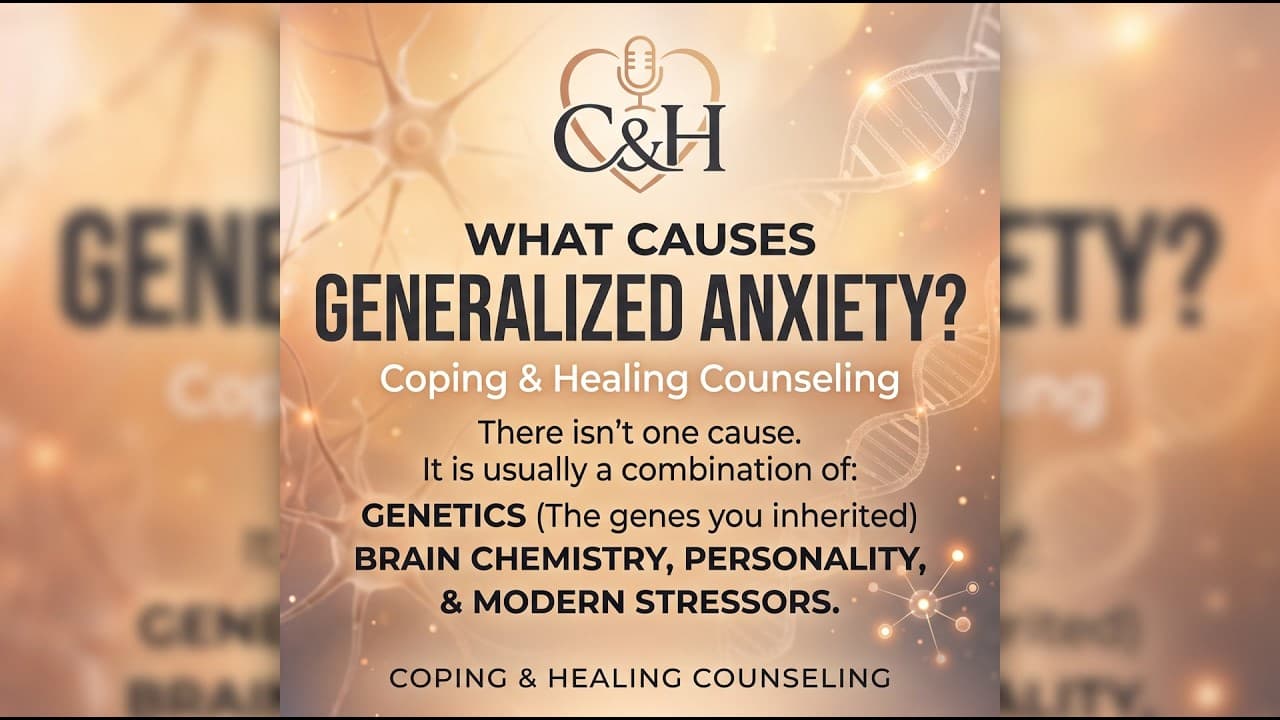
What causes generalized anxiety? — Full Episode | Georgia Telehealth Therapy
What causes generalized anxiety?
What are the 5 symptoms of major depressive disorder? — Full Episode | Georgia Telehealth Therapy
What are the 5 symptoms of major depressive disorder?

RSD and ADHD: Why One Short Text Can Wreck Your Whole Day | Georgia Telehealth Therapy
This one is for the friend who apologizes three times in a single text.
If this resonated, we have therapists who can help.
15+ licensed therapists, all 159 Georgia counties, telehealth-only. Medicaid covered at $0 copay.
Book a free consultation