
Coping & Healing Counseling — Community Discussion | 2026-04-13
In this episode
Can we bust a myth real quick?
"Therapy is only for people with serious problems."
That's like saying the gym is only for athletes. Or cooking is only for chefs.
Transcript
What if I told you that um the biggest barrier keeping people out of therapy isn't the cost, it's actually the fact that they don't realize their therapy is already fully paid for. It's wild, right? I mean, there is a massive disconnect between public perception and actual healthcare reality. Absolutely. We basically operate under this collective assumption that uh mental health support is inherently a luxury item. Welcome to today's deep dive. We are looking at the modern evolution of accessible mental health care and you know emotional literacy. Yeah. Which is such a vital topic for everyone right now. For sure. Our goal today is to unpack how the mental health field is actively dismantling the traditional barriers
to care. And that means both the internal emotional hurdles that stop you from reaching out and the very real uh logistical ones. Right. And to do that we are analyzing a really fascinating set of sources today. Yes. I love these sources. They're great. We have internal content notes, social media drafts, and practice overviews from a place called Coping and Healing Counseling or CHC. CAC, right? Yeah. This is a Georgia based therapy practice. And the documents are dated today, April 12, 2026. And these sources are just incredibly valuable because they offer a realworld blueprint. Like we aren't just looking at academic theory about how mental health care should work. No, not at all. We are looking
at exactly how a modern clinic communicates with you the patient right now. It shows this profound societal shift in how we define healthcare access. It really does. But you know to understand how people access therapy today, we have to first look at the shift and why they seek it out in the first place. Okay, so let's get right into that. That brings us to CHC's morning topic educational material. The core focus here is a transition away from the old model of emotional suppression and toward a new model of um emotional translation. Let's talk about that old model for a second because I think we all know it well. Oh, absolutely. For a long time, the
prevailing wisdom was basically to treat difficult emotions like an aggressive spam filter on your email inbox. That is a perfect way to describe it, right? If anxiety or sadness or anger popped up, the system automatically flagged it as junk and just sent it straight to the trash folder. You were just supposed to, I don't know, push through and keep your inbox looking clean. Keep it clean. Exactly. The spam filter is an excellent analogy. But the problem, of course, is that when you send all those critical alerts to the spam folder and you never check them, your system eventually crashes. Exactly. It crashes. You miss the vital notifications telling you that, you know, your metaphorical bank
account is overdrawn or that someone is actively trying to hack your system. Wow. Yeah. The old model really dictated that strong feelings were just an interruption, a problem to be fixed or quieted down. But the CHC text explicitly reminds the reader of a very different approach. They state that your feelings aren't too much. Right. Instead, they are messengers. They are actually trying to deliver a specific notification to you. Yes. And they break it down with some very specific translations. They write that anxiety says something feels unsafe. Sadness says something matters deeply. Anger says a boundary got crossed. Look at the underlying mechanism of that reframing though. It's brilliant. How so? Well, when you define these
emotions as data points, as neutral messengers, you completely alter the neurological and psychological response to the emotion. Oh, so you're changing how the brain actually processes it. Exactly. You move the patient out of the fear-driven center of the brain, the amygdala, and you engage the prefrontal cortex, which is the analytical part of the brain. Ah, so therapy then stops being about shutting those feelings down, and it becomes about well analyzing what they're actually saying. I see the logic there. But let me challenge that neutrality for a moment. Sure. Go ahead. Because if we validate anger as just data, that means a boundary got crossed. Aren't we risking giving people a psychological free pass? What do
you mean? Like it sounds like it could be used to justify bad behavior. Like someone saying, "I'm not yelling at you. I'm just listening to my messengers." That is a very common misconception about emotional literacy actually. But the CHC material is very careful to separate the messenger from the reaction. Okay. Separate the two. Yes. The emotion itself, you know, the flush of anger, the spike of anxiety is the neutral data. It is an involuntary biological response to a stimulus. Right. You can't control the feeling popping up. Exactly. But the action you take based on that data is entirely separate. Recognizing that your anger is telling you a boundary was crossed doesn't give you a license
to lash out. Oh. It gives you the specific information you need to calmly enforce that boundary. Okay. Let's unpack this with an analogy. It's exactly like the check engine light on your dashboard. Yo, I like that. Yeah. For decades, society basically told us to just put a piece of black tape over the blinking light and keep driving. Just ignore it. Right. But modern therapy is saying, "Hey, that light isn't the problem. It's just telling you to look under the hood." Yeah. So, it's about diagnosing the root cause rather than just treating the symptom. Precisely. And think about what happens to a patient's sense of shame when we use this translation method. Yeah. Shame is a
huge factor. Massive. If sadness simply means something matters deeply to you, then being sad about a loss or a transition isn't a personal failure. Oh wow. It is literal evidence of your values. By viewing emotions as data, patients move from being overwhelmed victims of their feelings to being uh active investigators of their feelings. A brilliant reframing. Yeah. But here is the friction point for me. Okay. Let's say you convince someone to become an investigator of their own mind. They're ready to look at the data. They still need a trained professional to help them interpret it. Right. Of course. And that leads directly to the CAC midday topic document, which is entirely focused on the phrase,
"I can't afford therapy." Yeah. Because cost is universally cited as the primary reason people do not seek mental health support. Exactly. The CHC text acknowledges that common refrain, but then it provides the hard numbers to bust the myth. Yes, it does. The text states that if you have Georgia Medicaid, therapy with coping and healing counseling is $0. And the source uses very specific phrasing to make sure there is absolutely no ambiguity. It says not reduced, free, no co-ay, no sliding scale, just zero dollars. And for major private commercial insuranceances, they list Etna, Sigma, Blue Cross Blue Shield, United Healthcare, and Humanana. The text notes that most people with these plans pay just $10 to $40
per session, which is basically the cost of a couple of coffees. Those numbers represent a fundamental disruption of the prevailing public narrative. I have to be skeptical here, though. Why is that? Because in almost every sector of the economy, if a service is advertised as literally zero dollars, it is usually a trap. I mean, that's a fair assumption, right? It usually implies bottom tier quality or hidden fees or a wait list so long that the service is functionally useless. If a highly trained professional is dedicating an hour of their time to you, how does a modern clinic survive by charging nothing? Well, doesn't that indicate a sacrifice in the quality of care? No, it's just
really important to understand the actual mechanics of the third party payer system. Okay, break that down for me. The service is not valueless. It's just that the cost is entirely absorbed by the state or the insurance provider. The clinic is still being compensated for their clinical time at a contracted rate. Oh, so they are getting paid, just not by you. Exactly. The therapist gets paid, the business keeps its lights on, and the patient receives full quality care without opening their wallet. That makes a lot of sense. It's not a discount bin of therapy. It's the exact same clinical hour you would get if you paid hundreds of dollars out of pocket. Here's where it gets
really interesting, though. If the care is literally 0 for Medicaid patients, why is this still a secret? That is the million-dollar question, right? Is the health care system just terrible at advertising? Or does the lingering stigma of mental health make people assume that help is just financially out of reach? It's a combination, but the historical legacy of therapy is incredibly pervasive here. What do you mean by legacy? Well, the cultural image of therapy was built on, you know, the Freudian psychoanalyst in a Manhattan high-rise catering exclusively to the wealthy. Oh, yeah. Laying on a couch staring at the ceiling. Right. Furthermore, the broader United States health care system is notoriously fragmented. We have all been
conditioned to fear surprise medical billing. Oh, absolutely. The anxiety of getting a bill in the mail 3 months later. Exactly. The cognitive load of navigating insurance portals, deducing in network versus out of network benefits, and understanding deductibles is exhausting for a healthy person. Yeah, I hate dealing with it. So, imagine someone actively struggling with depression or severe anxiety. That administrative hurdle is just insurmountable. That perfectly contextualizes a quote from the CHC text that really caught my eye. Which one? They write, "The biggest barrier to therapy is often just not knowing what's available." That is the crux of the issue right there. Ignorance of the available resources is functioning as the actual financial barrier. Well, people
are self- selecting out of care because they assume the door is locked when in reality they don't even realize there is a door. Yeah. They just walk right past it. Exactly. When CHC explicitly publishes those numbers, $0 for Medicaid, 10 to 40 for commercial plans, they are not just marketing their clinic. They're conducting a public education campaign to dismantle a systemic assumption. Okay, so the emotional barrier is reframed. Yeah, we are reading the data. The financial barrier is busted. We understand the mechanics of the payment system. But what about the logistics of daily life? So we move from the cost of therapy to the delivery of therapy. A patient still has to physically navigate their
life to get that care. Yes. And that is not easy. Finding the time, the geographic proximity, and the right specialist is a massive logistical puzzle, which is where the architecture of how care is delivered becomes just as important as the care itself. Definitely. Looking at the practice overview notes for CHC, we can see a structural model designed specifically to eliminate that friction. Let's detail that structure. The practice was founded by Elias Joseph, a licensed clinical social worker or LCSW. And the notes detail that they have built a team of over 15 licensed therapists and they use several acronyms here in the text, LCSSWS, LPC's, and LMFTs. Okay. Yes. Before we go further, we need to
clarify what those licenses actually mean because frankly, the alphabet soup of mental health credentials can be really intimidating for someone just trying to find help. It really can be, but it is a vital distinction because it shows the multidisciplinary approach of a clinic like this. Okay. So, what is an LCSW? An LCSSW, a licensed clinical social worker, approaches mental health by looking at the person within their broader environment. They consider how systemic issues, community, and social structures impact the individual's mental state. Okay? So, a very holistic environment-based view, right? Then you have an LPC, which is a licensed professional counselor. Their training is highly focused on mental health, emotional regulation, and traditional psychological counseling. Got
it. And the last one, the LMFT, that stands for licensed marriage and family therapist. Their expertise is centered on relationship dynamics. They view the patients struggles through the lens of their family systems and interpersonal connections. Okay. So, by housing all three of these disciplines under one roof, a patient isn't just getting a single therapeutic lens. Oh, no. Not at all. They have access to a whole ecosystem of expertise depending on their specific needs. Exactly. And the text also emphasizes that this group of 15 plus therapists is a diverse culturally competent team. Yes, that stood out to me. They treat ages 13 and up handling specialties from anxiety and depression to trauma, PTSD, grief, and just
basic stress management. I want to pause on that phrase for a second. How does cultural competence actively change the mechanics of a say 45minute therapy session? It changes the baseline of the entire conversation. Culturally competent care means the therapists are formally trained to understand, respect, and integrate the varying cultural backgrounds, racial experiences, and religious beliefs of their patients into the treatment plan. So, it's not a one-sizefits-all approach. Definitely not. Practically speaking, it means a patient doesn't have to spend the first 20 minutes of an expensive, timelmited session explaining their cultural context or justifying their family dynamics to a therapist who just doesn't get it. Oh, wow. Yeah. It accelerates the actual work. You don't have
to be your therapist's tour guide to your own culture. That's a great way to put it. It removes the exhausting burden of translation from the patient, allowing them to dive straight into the critical issues at hand. But having a perfectly matched, culturally competent therapist who takes your insurance doesn't help you at all if they're a three-hour drive away. Right? Geography is a huge barrier. And that brings us to the logistical breakthrough of this practice. The CHC text explicitly states that they are 100% telealth IPA compliant and they serve all 159 counties in the state of Georgia. The scale of that accessibility is staggering when you consider the geographic layout of a state like Georgia. Oh,
for sure. You have incredibly dense, highly populated urban centers like Atlanta, right? But they are surrounded by vast, deeply rural and remote agricultural counties. Historically, healthc care infrastructure is concentrated almost entirely in the cities. Right. So, if you lived in a rural county, finding a specialist might require a massive commute. Exactly. You are talking about someone who might already be struggling with severe anxiety having to add a 4hour roundtrip drive on a major highway just to talk to someone for under an hour. That just sounds impossible. It is. The friction of the commute becomes a barrier to adherence. People simply stop going. Yeah, I would. But a 100% telealth model democratizes that care. By utilizing
secure video sessions, a patient in a remote underserved farming community has the exact same access to this specialized diverse team of 15 therapists as someone living right downtown in the capital. That is incredible. And the CHC material points out the very specific practical savings of this model, too. Yeah, the everyday costs. They note that the patient is saving on gas. They're saving on securing child care. And perhaps most importantly, they are saving on time off work. You don't have to burn half a day of your paid time off just to make a standard medical appointment. Right? By removing the logistical friction of a commute in a waiting room, therapy stops being this overwhelming event that
you have to plan your entire week around. It becomes a tool that is integrated seamlessly into your daily survival. Which leads perfectly into the evening topic text in our sources. Oh, I really love this part. Yeah, this piece of internal draft material feels very different from the logistical overviews. It reads like a direct motivational call to action aimed at a highly specific demographic. It really does. It says, "If you're scrolling tonight feeling heavy, this is for you." Mhm. You've been holding it together for everyone else. The late nights, the overthinking, the heaviness that just sits there. It is speaking directly to the exhaustion of functioning. It targets the burnout of the caretaker, the parent, the
employee who is exhausted by the sheer act of keeping all the plates spinning day after day. Yeah, it's the people who look totally fine on paper but are running on empty behind closed doors. The text follows that up by saying you don't have to keep carrying it alone. Our therapists meet you from wherever you are, your couch, your bedroom, your parked car. A parked car. That specific location is profound. I have to admit that detail threw me. a parked car. Doesn't doing therapy in a minivan in the driveway strip away the sanctity of the medical space? What do you mean? Well, therapy used to be an intimidating leather couch in a stuffy downtown office. Now,
we're doing profound emotional processing next to a stray French fry in the cup holder. Does it lose its clinical weight? It's a fascinating shift, but no, it doesn't lose its clinical weight at all. It actually redefineses the power dynamic of the healthare system. How so? The system is finally bending to the reality of the patient's life rather than forcing the patient to bend to the rigidity of the system. Oh, I like that. Think about the reality of a parent who is holding it together for everyone else. Like the text says, a parked car in the driveway after work or maybe during a lunch break is often the single only private, quiet, controlled environment that person
has access to in a 24-hour period. It's like the transition zone. Yes. By allowing the clinical intervention to happen in that specific space, the therapist is meeting the patient at the exact point of their highest need and without demanding that the patient first navigate a maze of logistics. That makes total sense. You are bringing the sanctuary directly into the chaos. Exactly. So, if we look at the entire picture painted by these CHC documents, let's briefly recap what this means for you, the listener, we can clearly track a complete overhaul of how we approach mental health. Right. First, we are learning to translate our emotional messengers. We are taking emotions out of the spam folder and
analyzing them as neutral data, which strips away the shame of simply feeling something. Second, we have looked at the mechanics of the financial barriers and realize that for many, those barriers are an illusion based on outdated assumptions. Yes, it's a cost to myth, right? Coping and healing counseling shows us that with Medicaid care can be zero dollars and commercial insurance co-pays are vastly lower than the public assumes. The system is funded. The public just needs the education to access those funds. And finally, the architecture of teleahalth is completely rewriting the rules of geographic access. Utilizing culturally competent teams of LCSWS, LPC's, and LMFTs, clinics can now deliver specialized care to all 159 counties in a
state without a single patient having to find parking at a medical complex. It's a gamecher. And before we wrap up today's analysis, it is essential to share the actionable information provided in the source text. Yes, definitely. If you are listening in Georgia, coping and healing counseling can be reached through their website at shyotherapy.com via email at support@shurity theapy.com or by calling their office directly at 404832102. And I want to echo a specific quote from their material because regardless of where you live or what insurance you have, it's the core thesis of everything we've discussed today. Well, it's a quote. You deserve support, too. Yes. The mechanisms are in place so that you don't have to
keep carrying the heaviness alone. I want to leave you with a final thought to mull over as we close out this deep dive. We've established that the logistical barriers, the massive costs, the long commutes, the sterile waiting rooms are being stripped away by this new model of care. Therapy is now happening in our living rooms, our bedrooms, and yes, our parked cars. It is entirely integrated into our daily environments, right? But I wonder how that integration blurs the boundary between our designated healing spaces and our everyday stress spaces. That is an interesting point. Traditionally, you left your stress at home, traveled to a neutral clinical environment to process that stress and then returned home. Now
the clinic is literally in your pocket. It completely removes the physical separation between the trigger and the treatment. Which raises the question, if the logistical barriers are completely removed, does bringing therapy directly into the physical locations where our chaos actually happens make us better equipped to handle that chaos in real time? Oh wow. By removing the sterile doctor's office, are we actually learning how to heal right in the messy, loud, unavoidable center of our own lives? It's certainly something to think about. The next time you're sitting in your parked car, taking a deep breath before walking into the house, remember that those feelings aren't spam and you have the data you need to look under
the hood. Thanks for joining us on this deep dive. See you next time.
More episodes
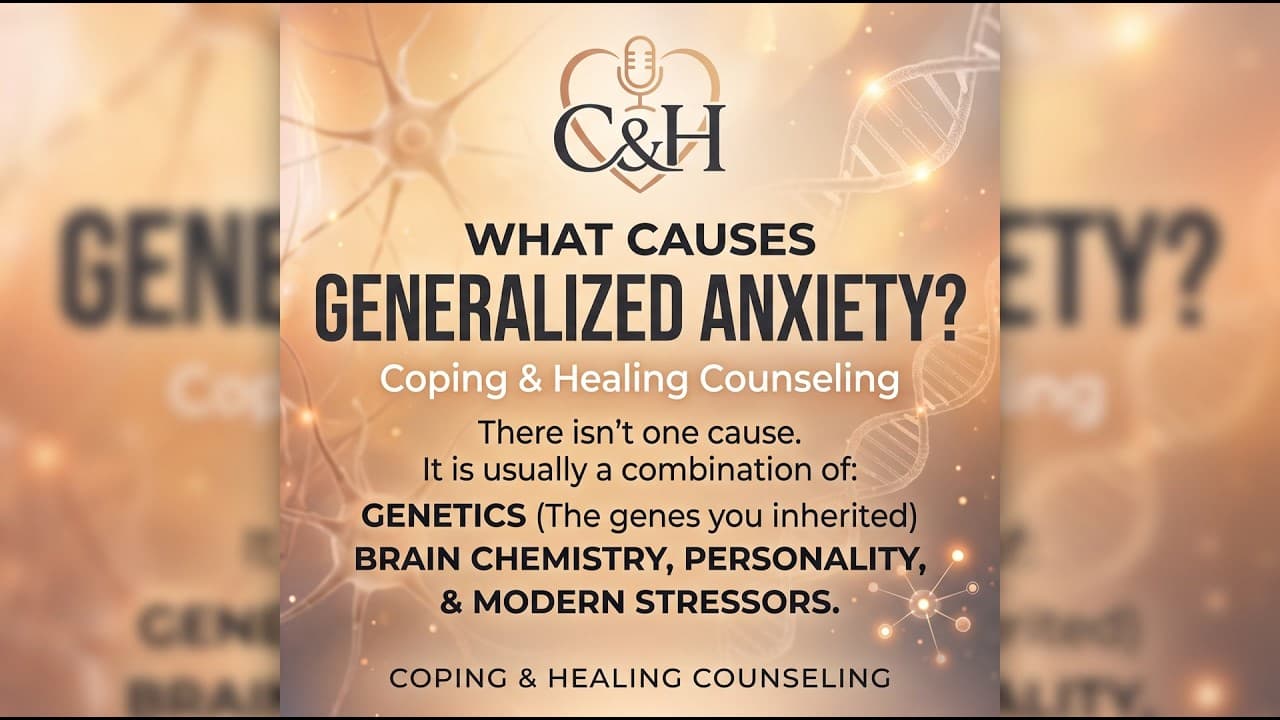
What causes generalized anxiety? — Full Episode | Georgia Telehealth Therapy
What causes generalized anxiety?
What are the 5 symptoms of major depressive disorder? — Full Episode | Georgia Telehealth Therapy
What are the 5 symptoms of major depressive disorder?

RSD and ADHD: Why One Short Text Can Wreck Your Whole Day | Georgia Telehealth Therapy
This one is for the friend who apologizes three times in a single text.
If this resonated, we have therapists who can help.
15+ licensed therapists, all 159 Georgia counties, telehealth-only. Medicaid covered at $0 copay.
Book a free consultation