
Coping & Healing Counseling — Action & Impact | 2026-04-13
In this episode
Just in case nobody told you today:
You are not behind.
Not behind on healing. Not behind on having it figured out. Not behind on life's invisible timeline.
Transcript
You know, it is so easy to fall into this trap where you just accept feeling overwhelmed as like your normal baseline. I mean, I am talking directly to you right now. If you're listening to this, there is a very good chance you know exactly what I mean by the modern struggle. Oh, absolutely. It is that constant information overload. Right. Right. Exactly. It is the late night overthinking when you were just staring at the ceiling. And I think most of all it is that incredibly heavy invisible feeling of just holding it together for everyone else. Yeah. You know, you hold it together for your boss, your kids, your partner. Yeah. And you just assume that this
low-level hum of exhaustion is well the unavoidable price of admission for being a functioning adult. We do not even notice how much energy it takes just to tread water until we are completely exhausted. We really don't. The pressure just slowly builds over time. And because everyone around us seems to be dealing with the exact same pressure, we normalize it. We just tell ourselves to push through, which is wild when you think about it. We tell ourselves to just keep swimming even when we are actively sinking. Yeah. I was actually thinking about this normalization and an analogy hit me. So imagine you are driving your car on the highway and the check engine light comes on.
It is glowing bright orange on your dashboard. You wouldn't just take a piece of black electrical tape, stick it over the light, and keep driving your car for another 50,000 mi. No, of course not. That would be insane. You know, the engine is going to blow eventually. Exactly. Yeah. But we do this with our minds every single day. We slap a piece of metaphorical black tape over our emotional check engine light, pour another cup of coffee, and just hope the engine holds together for one more commute. That analogy gets to the absolute core of the issue. I think the reason we reach for the tape instead of a mechanic usually comes down to two massive
barriers. Right. So what are those barriers? Well, first there is an internal misunderstanding of what that light even means. We just do not know how to read our own dashboard. Yeah. And second, there is an external dread of how difficult, expensive, and timeconuming it is going to be to get it fixed. Yeah. We look at the mental health system and just see a labyrinth of high costs and logistical nightmares. So for today's deep dive, we are going to explore how the modern mental health landscape is radically democratizing access by breaking down those exact barriers. And to do this, we are looking at a really interesting stack of internal materials. Yeah, these are weekend content updates
specifically dated April 12th, 2026. They are from a pioneering telealth practice in Georgia called Coping and Healing Counseling or CHC. We are going to extract the core insights from their model to understand the mechanics of how these twin barriers to therapy are actually being dismantled. I mean, analyzing CHC's model serves as a fascinating case study in system design. It shows us what happens when a healthcare provider decides to make mental health care genuinely accessible and culturally competent. Literally starting from the ground up rather than trying to retrofit an outdated system. So before we can look at the physical and financial access to care, I think we have to look at the psychological barrier. like why
do people avoid therapy in the first place? That is the big question. And looking at CHC's educational materials, the answer seems to be that we have been taught our entire lives that our negative emotions are just a nuisance. They're just something to be suppressed. Right. Because we live in a society that constantly pushes this sort of positive vibesonly narrative. Exactly. Any emotion that is uncomfortable is immediately categorized as a problem to be solved or hidden away. Well, CHC put out this morning educational topic that completely flips the script on how we view emotional data. They have this specific framework for emotional translation, which is super interesting. It really is. Their message is essentially that your
feelings aren't too much. They are messengers, right? Defining emotions as functional signals rather than character flaws is a profound reframing. It changes the entire relationship you have with your own mind. They break it down very clearly, too. They say anxiety is a signal that something feels unsafe. Okay? and sadness. Sadness is a signal that something matters deeply to you and anger is a signal that a boundary just got crossed. Wow, that is really practical. So, the core philosophy driving their practice is that therapy isn't about shutting those feelings down or numbing them out. No, not at all. It is about finally understanding what they are actually saying to you. What they are doing here is
shifting the individual from a state of judgment to a state of observation. Which makes a lot of sense because when you judge an emotion like thinking I shouldn't be angry or I am weak for feeling sad, you just add a secondary layer of suffering onto the original feeling. Exactly. You are fighting the data. But if you observe it as a data point, you can actually work with it. You can look at anger and say, "Okay, a boundary was crossed. Let me identify the boundary." I hear that. But I want to push back on the neatness of this framework for a second. Sure. Go ahead. Because you know it is a beautiful concept on paper, but
when you are in the middle of a spiraling panic attack or a moment of blinding rage, your anxiety does not feel like a polite messenger dropping off a little letter in your mailbox. Oh, definitely not. Right. It feels like a fire alarm going off inside a very small room. Yeah, it is deafening. So, how does simply rebranding these emotions actually help the person experiencing that level of sheer overwhelming intensity? Well, the fire alarm in a small room is exactly what it feels like. In the acute moment of a panic attack, your amydala is totally running the show. Yeah. It has completely flooded your system with adrenaline. Exactly. And your body believes it is in mortal
danger. But this is where emotional literacy, the kind practiced by CHC's licensed therapists, becomes a mechanical grounding technique, not just a philosophical rebrand. Wait, are you saying you can outthink the adrenaline? Not outthink the adrenaline, no, but redirect the brain's processing power by training yourself to ask, "What is this feeling trying to tell me?" You are forcing the prefrontal cortex to wake up and take the wheel back. Oh, I see. You are shifting the brain's focus from panic to curiosity. Right? Instead of sitting there thinking I am broken, something is physically wrong with me. You are empowered to ask what element of my environment feels unsafe right now to trigger this alarm. So it gives
your brain a concrete task. Exactly. It moves you from being a helpless victim of a chemical flood to an active investigator of a biological signal. It restores your agency in real time. So you are basically using curiosity as a circuit breaker to stop the panic spiral. It stops the secondary spiral. Yeah. The initial wave of panic might still happen, but the curiosity prevents you from feeding it more fear. You begin to trust the dashboard instead of taping over it. That makes a lot of sense. You have to believe the check engine light is giving you useful information before you ever agree to take the car to the shop. Precisely. But understanding your emotions doesn't magically
put money in your bank account, right? No, it sure doesn't. Once you realize you need help, the very first wall you hit is the price tag. We move instantly from the psychological dread to the financial reality. And the mental health care industry has historically failed people on this front. The traditional image of therapy is inherently tied to luxury. Right. It brings to mind a wealthy executive lying on a leather couch in a high-end office building, paying hundreds of dollars out of pocket for 50 minutes of talking. Yeah, but CHC released a midday content update that aggressively attacks this myth. I saw that the quote from their material that really stood out to me was this.
They said, "The biggest barrier to therapy is often just not knowing what is available." That statement shifts the blame away from the patients supposed lack of resources and points it directly at the health care system's lack of transparency. Let's look at the actual numbers they provide because this blew my mind. According to their documents, if a patient has Georgia Medicaid, the cost for a therapy session is literally $0. Yeah. And they make a point to specify that it is not a reduced rate or sliding scale. It is free, zero dollars. Seeing that advertised so bluntly is rare. And it doesn't stop there. They list major private insuranceances they cover like Etna, Sigma, Blue Cross Blue
Shield, United Healthcare, Humanana. And for most people with those insuranceances, the typical co-pay is between $10 and $40 per session. $10 to $40 is a complete paradigm shift from the out-ofpocket models most people assume are standard. It really is. I started comparing that co-ay to everyday incidental spending. $10 to $40 is, you know, the cost of a couple of streaming subscriptions that you forget to cancel or a single midweek takeout order when you are too tired to cook. We spend that money without thinking. Exactly. Yet, we will hesitate to spend that same amount on our mental health while simultaneously paying the massive hidden compounding costs of burnout. Right. We pay in sick days, lost productivity,
and the strain on our relationships. We think we are saving money by avoiding the co-ay, but we are paying it out with massive interest in every other area of our lives. It is the ultimate false economy. But let me push back on the business model for a second here. Go for it. If it is literally zero dollars for a Medicaid patient, how does a private clinic actually survive? I mean, is this financially sustainable or is it just a loss leader to get people through the door? It is highly sustainable actually, but it requires the clinic to do the heavy lifting that is usually pushed onto the patient. What do you mean by that? Well, with
Medicaid, the state and federal government reimburse the clinic directly for the services provided. The patient pays zero, but the clinic still gets paid by the government. Oh, okay. So, what is the catch? The catch is that Medicaid billing is notoriously complex. It involves mountains of administrative red tape, strict compliance rules, and sometimes severely delayed payouts. So many private therapists simply refuse to take Medicaid because they do not want to deal with the bureaucratic headache. Exactly. They just cater to the wealthy out-ofpocket clients because it is easier. That is so frustrating. It is. But what Eli Joseph, the licensed clinical social worker who founded CHC, did was build a practice infrastructure specifically designed to absorb that
administrative burden. Ah, so they handle the labyrinth of insurance billing on the back end so the patient doesn't have to deal with it on the front end. Precisely. By accepting a slightly lower margin per session from Medicaid compared to cash pay, but operating with a higher volume of patients who desperately need care, the clinic thrives. It is a missiondriven model backed by smart administrative systems. Honestly, looking at these numbers, it seems to me like the healthcare industry doesn't just have an affordability crisis. It has a massive PR problem. Yeah, it is an information gap masquerading as an affordability crisis. Think about the traditional healthcare billing experience in America. It is terrifying. It really is. You
go to a doctor, you have no idea what it will cost, you receive a maze of paperwork months later, and then an unexpected bill shows up in the mail. Right. And the ambiguity itself is a massive barrier to entry. People are paralyzed by the fear of the unknown invoice. But by transparently blasting these exact dollar amounts out to the public, CHC is removing the intimidating ambiguity. They are empowering you to realize that highquality professional care isn't just for the wealthy. The mechanic is actually in your network. Transparency builds trust before the patient even books a session. Yeah. When you know exactly what something costs, you can budget for it. You can make an informed decision
rather than a fear-based avoidance. No. True. So, we have solved the psychological dread. The emotions are messengers, not monsters. And we have solved the financial block. It might literally cost 0 or the price of a pizza. But what about time? Time is the ultimate luxury for a lot of people, right? Because you can't just pause a busy Tuesday. You can't always step away from your kids, or leave your desk at work, drive 45 minutes across town, sit in a waiting room, do a 50-minute session, and drive 45 minutes back. That is a three-hour disruption in the middle of a workday for a working parent or someone juggling multiple jobs to keep the lights on. A
three-hour disruption is a complete non-starter. Exactly. It does not matter if the co-ay is $0. If you lose half a day of wages to get to the appointment, the care is still inaccessible. And this is where the physical barrier drops entirely. Yes, according to their documents, CHC operates as a 100% high compliant teleaalth practice. They don't just serve one city. They serve all 159 counties in Georgia. That geographical reach fundamentally alters the landscape of care. Traditionally, there is a massive urban rural divide in mental health access. Oh, for sure. If you live in downtown Atlanta, you might have 50 therapists within a 5m radius. But if you live in a rural county in South Georgia,
the nearest specialist might be a 2hour drive away. Tellaalth instantly levels that playing field. The patient in the rural county has the exact same access to top tier professionals as the patient in the city center. And it is a robust team too. They have over 15 licensed therapists. Right? We are talking licensed clinical social workers, licensed professional counselors, and licensed marriage and family therapists. It is a diverse, culturally competent team serving everyone like teens from age 13 and up, adults, couples, and families. And the sources explicitly state they specialize in the heavy-hitting realities of life. They are not just acting as life coaches for minor stress. Yeah, they treat clinical anxiety, depression, trauma, and PTSD,
intense grief, and severe relationship stress. But the detail that really caught my attention was in their evening motivational content. Oh, me too. They have this call to action that highlights how tellaalth eliminates hidden logistical costs like gas, child care, and taking unpaid time off work. But the imagery they use is what stuck with me. They say they meet the patient exactly where they are, your couch, your bedroom, your parked car. Highlighting your parked car is an incredibly specific and revealing detail about their philosophy of care. is like having a world-class personal trainer willing to meet you in your driveway the minute you get a 45minute lunch bro. It really removes every single excuse you have.
It does. But I have to ask about the mechanics of this. Doesn't a car have terrible internet connection sometimes? And how do you do deep trauma work when someone might walk past your windshield in a parking lot? Those are very valid logistical concerns. Does doing a clinical session via secure video in a parked car fundamentally change the clinical relationship or make it feel, you know, less professional? Well, it comes down to how the practice manages the technology and the patients expectations. HIPPA compliant teleaalth platforms use end-to-end encryption, ensuring the data stream itself is secure, regardless of whether you are on Wi-Fi or a cellular network. Okay, but what about the environment itself? For the environment,
the therapist works with the patient to establish boundaries. They might ask the patient to park in a quiet corner of a lot or put up a sun shade. So, the therapist is actively helping them engineer a safe space in an unconventional setting. Yes. And that process actually redefineses what professionalism means in modern healthcare. Connect this back to the target audience from CHC's evening post. Right. The person holding it together for everyone else dealing with late nights and heavy overthinking. Exactly. True cultural competence, which CHC highlights as a pillar of their team, isn't just about understanding a patients ethnic background or language. It is about deeply respecting their daily reality. Meaning meeting them in the messiness
of their actual life. Yes. If a parked car during a lunch break is literally the only place a working parent has 50 minutes of unbroken privacy away from their boss and their toddlers, then that parked car is no longer just a vehicle. Wow, I never thought of it that way. It transforms into a highly effective clinical space for treating trauma or relationship stress. It doesn't dilute the professionalism. It enhances the efficacy of the treatment. But how does it enhance the efficacy? Wouldn't a quiet office still be better? Not necessarily. Think about the performative nature of traditional therapy. A patient dresses up, drives to a fancy clinic, sits in a sterile waiting room, and then tries
to act normal while discussing their deepest pain. Oh, I see. You are putting on a show before you even get into the room. Exactly. In the parked car or on their own living room couch. The therapist is seeing the patient in their natural environment. The patients defenses are often lower, which means they can get to the root of the issue faster. You are getting the real unfiltered person, not the version of them that performs for the public. Looking at this through the lens of coping and healing counseling and Elias Joseph's vision, we are looking at a blueprint for what modern mental health care is becoming. It is a complete structural overhaul of how we approach
well-being. It systematically dismantles every excuse a person might have for avoiding care. First, it teaches you to decode your emotions rather than fear them. It turns the terrifying fire alarm into a readable dashboard, shifting you from panic to curiosity. Second, it shatters the financial illusions that keep people away. By clearly advertising 0 Medicaid co-pays and $10 to $40 private insurance co-pays, it proves that the mechanic is actually affordable. It attacks the information gap. And third, it removes physical borders entirely. It reaches all 159 Georgia counties via secure video, even if the only private room you have is the front seat of your Honda. By removing the friction from the system, it allows the patient to
focus entirely on the healing process. rather than the logistics of getting to the appointment. For you, the curious learner listening to this right now, take this as a reminder that the systems around us are evolving to become more humanentric. If you have been carrying that heavy weight of overthinking or the stress late at night that just sits heavy on your chest, you do not have to carry it alone anymore. The tools to decode your emotional dashboard are literally sitting right in your pocket on your phone. If you are in Georgia, you can reach out to them directly at ghtherapy.com or simply call 404-832002. The care you need really is that accessible. I want to leave
you with a final concept to mull over that builds on everything we have explored today. We have talked extensively about removing the friction for the individual, but think about the long-term societal impact of scaling this model. That is a fascinating thought. If the logistical and financial friction of mental health care reaches near zero across the board, if having a secure therapy session from a parked car becomes just as cheap, normal, and accessible as scrolling social media on your phone, how might society fundamentally shift in a single generation? It makes you wonder how much collective anxiety we are currently holding on to simply because we think we can't afford to let it go. Exactly. If we
started treating emotional maintenance exactly like we treat brushing our teeth as a daily, universally accessible, completely non-stigmatized habit, what kind of world would we wake up in? Imagine how much untapped human potential we could unlock if millions of people weren't burning all their cognitive energy just trying to tread water in the deep end. We could finally see how fast the car could go if we actually read the check engine light instead of just covering it with tape. Take care of yourselves out there.
More episodes
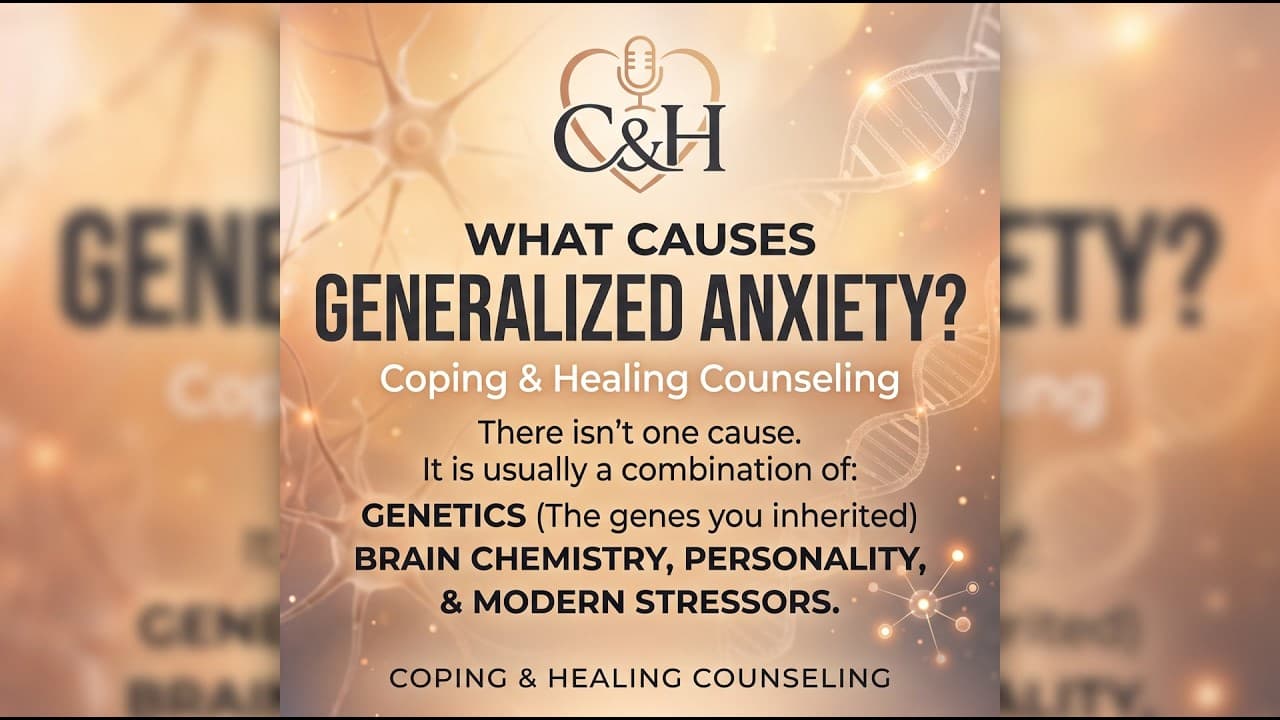
What causes generalized anxiety? — Full Episode | Georgia Telehealth Therapy
What causes generalized anxiety?
What are the 5 symptoms of major depressive disorder? — Full Episode | Georgia Telehealth Therapy
What are the 5 symptoms of major depressive disorder?

RSD and ADHD: Why One Short Text Can Wreck Your Whole Day | Georgia Telehealth Therapy
This one is for the friend who apologizes three times in a single text.
If this resonated, we have therapists who can help.
15+ licensed therapists, all 159 Georgia counties, telehealth-only. Medicaid covered at $0 copay.
Book a free consultation