
Between Two Worlds: When Immigrating Costs More Than Money | Georgia Telehealth Therapy
In this episode
A composite, but a familiar one: a woman moves to Gwinnett with her husband and two kids. Everyone says how well she's doing. Three years in, she's getting headaches every afternoon, snapping at her teenager, and crying in the car after work for reasons she can't name.
That's acculturative stress.
Generated from Coping & Healing Counseling: Accessible Telehealth for Georgia
Transcript
Okay, so picture this. A woman moves her family to Gwynet County, Georgia, right? She brings her husband. She brings her two kids. And um if you just look at her life from the outside, she is this absolute success story, right? The classic, you know, American dream scenario. Exactly. Everyone in her community is talking about how incredibly well she is doing. I mean, she has established a home, her family is functioning, she's holding down a job. It all looks great. But then you fast forward 3 years when the dust of that massive move has finally settled. Yeah. The dust settles and suddenly she is dealing with these intense, totally unexplained headaches. Every single afternoon she is
snapping at her teenager over just like the smallest things at the dinner table. And maybe the most telling part is she finds herself sitting in her car after work just crying into the steering wheel and she cannot even articulate the reason why which is such a powerful devastating image and it's exactly why we are looking at this today. Right. So today our mission for this deep dive is to look really closely at a set of notes provided by coping and healing counseling or CHC. They're a teleaalth therapy practice based right there in Georgia. We are going to decode this invisible battery draining phenomenon that's causing this woman so much pain. And we are going to
explore how modern clinical design is well entirely rethinking how to treat it because we are really exploring this profound intersection between clinical psychology and logistical healthcare design today which sounds intense but it is so important for you the listener to understand. It is because you know culturally when we think about stress or some sort of psychological breakdown we are conditioned to look for these very obvious theatrical signs of trauma like a huge traumatic event. Exactly. We expect a singular inciting incident. But the notes from CHC, they paint a much quieter and arguably much heavier picture of what carrying an immense psychological load actually looks like dayto-day. It's really a slow burn, not an explosion. Okay,
let's unpack this because that vignette from the clinical notes is just fascinating. It honestly reminds me of um an overloaded electrical grid or like a smartphone. Oh, a smartphone is a great way to look at it. Yeah. Like on the home screen, everything looks completely fine, right? The apps look normal, but there is this massive app running in the background and it is just draining your battery all the way to zero. The woman in this scenario looks like she is functioning perfectly, but there is this massive invisible surge happening in the background. And the clinical term for that background app or that underground surge as identified in our source notes is a culturative stress. A
culturative stress, right? It is defined as the cumulative psychological weight of rebuilding an entire life in a second language or a new culture while simultaneously carrying the expectations of the old one. That is just a massive amount to carry. It is an immense amount. It is not an acute trauma like we were saying. It is the exhaustion of like a thousand tiny daily cognitive calculations. So as you're constantly translating, translating language, analyzing really subtle social cues, navigating a completely new health care system or even just a new grocery store. Oh yeah. Just finding where the milk is can be stressful when everything is different, right? And all while desperately trying to maintain your core identity.
So, your processor is running at 99% capacity just to achieve a baseline level of what looks like normal functioning. Wow. And what is wild is the notes specify that this creates very specific flavors of guilt. We aren't just talking about generalized anxiety here, right? This is highly targeted circumstantial guilt. What's fascinating here is the specific breakdown of that guilt in the text. Yeah. Like the text highlights the guilt of leaving her home country in the first place. the guilt of wondering, you know, is she sending enough resources back to her extended family. And the one that really stands out the most is that crushing guilt of simply being exhausted when her surrounding community constantly tells
her she is supposed to be quote unquote grateful for being here, which is such a toxic expectation, honestly. Yeah, it is an immense burden. Society often dictates that if you have successfully immigrated or even just relocated to a so-called better situation, you essentially forfeit your right to complain. Like you owe everyone a smile all the time. Exactly. The culture demands that you perform gratitude. So when this woman feels isolated or exhausted, she internalizes those feelings as personal failures. She thinks, you know, I made it to Gwynet. I have a house. I have absolutely no right to be miserable, right? And that dissonance between how she feels and how she's supposed to feel, it just accelerates
the cognitive burnout. Okay. Which actually leads me to something I want to push back on or at least, you know, challenge the mechanism of. Sure. What is it? Well, if she is fundamentally grieving her old life and she's overwhelmed by her new one, why does this immense emotional weight show up as headaches and stomach problems? I mean, why isn't it just classic sadness? That is a really common question, right? Because if the core issue is grief, shouldn't she just present as clinically depressed? And that assumption right there is precisely why a culture of stress is so frequently misdiagnosed. What we are observing in these clinical notes is the mindbody rebellion. The mind body rebellion. Yes.
Resulting in sematic symptoms. Basically when the cognitive load is simply too high. Like when the processor is at 99%. Exactly. When you are spending all your mental bandwidth just surviving translating and masking your struggles to maintain that facade of doing well. The brain literally runs out of processing power for emotional grief. Oh well. Yeah. The tension cannot just evaporate. It has to go somewhere. So to go back to the smartphone or the electrical grid metaphor, the cognitive circuits are just overloaded with the voltage of adapting to a new culture. So the breaker trips and the brain routes that excess electricity right into the physical nervous system. That is the exact mechanism. Yes. Right. The brain
outsources the unprocessed trauma to the physical body. That is wild. It manifests as a physiological response. So you see the afternoon migraines, the gastrointestinal distress, the chronic muscle tension. The body sounds a physical alarm because the mind is actively ignoring the psychological alarm, right? Because she's too busy surviving. So the crying in the car isn't just a random emotional outburst. It is like a neurological dam breaking after holding back the floodwaters for 3 years. Exactly. Which reframes the entire concept of what a symptom actually is. It really does. But the source text points out another key symptom that isn't physical at all, and it happens right inside the home. The friction with her children. Yeah.
She is snapping at her teenager, which I mean, teenagers can be a lot, but this is different. It is. If we connect this to the broader sociological picture, this is a textbook example of the generational adaptation gap. So, it's not just your standard teenage rebellion. No, not at all. This is a profound cultural fracture happening in real time inside a single household. Because the children are absorbing the new culture like the American school system, the slang, the social norms, they are absorbing it at light speed compared to their parents. They are assimilating rapidly. And the notes specifically highlight the isolation this creates for the parent. Think about it. You uproot your entire existence to give
your children a better future, right? You sacrifice everything. But as a direct consequence of that sacrifice, your children adapt to a culture that you are still struggling to navigate. Oh man, they begin to adopt values, perhaps individualism over collectivism that violently clash with the core identity of the parents. The isolation in that dynamic is just tragic. The mother feels her sacrifice is resulting in losing her child to a foreign culture. And the teenager comes home speaking a social language the mother doesn't fully understand, which triggers the parents insecurity and exhaustion. Exactly. So, she snaps at the teenager. Then, the guilt kicks in again. She feels guilty for snapping, guilty for not being a quote unquote
good enough mother, and the internal grid overloads even further because the teenager is desperately trying to construct their own identity in a completely new environment while the mother is trying to maintain her authority and cultural connection. They are basically operating on two completely different cultural frequencies, right? And without intervention, that gap only widens into resentment. Okay? So we have established this massive complex knot of invisible stress, physical pain and family fracture, which naturally brings us to the clinical response. Because recognizing the problem is only half the battle. Exactly. Because if a woman carrying the weight of two worlds walks into a therapist's office and is handed vague platitudes like, "Oh, try to make time for
self-care or just practice positive thinking." That isn't just unhelpful. It is actively dismissive. It is vague talk therapy in these highly specific situations can actually induce further trauma. Wait, really? Induce trauma? Yes. Because if a clinician simply tells this mother to take a bubble bath or set better boundaries, it signals a complete misunderstanding of her lived reality. The patient will inevitably fail at that generic advice, which makes her feel like she is failing at therapy, too. That makes total sense. And here's where it gets really interesting. The notes from CHC detail specialized targeted therapeutic frameworks meant specifically for this kind of complex socioultural burden. It is not just talk therapy, right? They rely on culturally
adapted CBT. So, cognitive behavioral therapy. Now, we hear about CBT all the time, but the culturally adapted part seems like the lynch pin here. It absolutely is. Traditional CBT operates on the premise of identifying and changing cognitive distortions which are essentially irrational negative thought patterns. Like if I am terrified of a harmless spider. Exactly. If you have an irrational fear of something benign, traditional CBT helps you challenge that thought. But culturally adapted CBT recognizes that for a marginalized person or a recent immigrant, many of their anxieties are not distortions at all. They are very real. They are reality. That is such a crucial distinction. M so culturally adapted CBT doesn't pathize the patients reaction to
reality. It treats her worries as valid responses to objectively difficult circumstances. So if she is terrified about her family's financial stability back home, the therapist doesn't say, "Oh, that is an irrational anxiety. Let's change your mindset." No. The therapist says, "Your fear is a rational response to an incredibly heavy reality." Now, how do we process the weight of that reality so it doesn't manifest as a migraine? That is amazing. It shifts the entire clinical posture from correcting the patient to validating the patient. Exactly. And the second framework the notes highlight is ACT acceptance and commitment therapy. Okay. I need to push back on the core concept of ACT as it applies here because the notes
state its goal is to make room for grief without giving up either identity. Let's be real. Isn't that just a clinical way of telling people to surrender? It sounds like it, doesn't it? Yeah. I mean if you were accepting the pain, how is that actually different from just giving up and settling for a miserable reality? That is a very common misconception about acceptance and commitment therapy in ACT. Acceptance does not mean resignation or defeat. It is an active psychological stance. Active in what way? It is about building psychological flexibility. What ACT does is remove the feudal exhausting struggle of trying to eliminate the pain of leaving home. It stops the patient from fighting a war
inside their own head. Oh, I get it. So, instead of trying to force herself to feel 100% grateful American and 0% grieving immigrant, she stops trying to perform this impossible emotional balancing act. Precisely. ACT teaches the patient that they can hold two seemingly contradictory truths at the exact same time without the system shortcircuiting. Right. So the mother learns to say, "I am profoundly grieving the home and the identity I left behind, and I am fully committed to building a stable life here in Georgia." By diffusing the pressure to get over the past, the present becomes significantly easier to navigate. She doesn't have to choose between her old self and her new self. That psychological flexibility
seems like it would immediately reduce those sematic symptoms. I mean, if you aren't fighting the grief, your nervous system doesn't have to manifest it as a headache. It frees up so much cognitive bandwidth, but that still leaves the teenager at the dinner table. To address the generational adaptation gap, the text points to family sessions. Yes. And in a family session, the clinician's role shifts dramatically. You bring the parent and the child into a neutral environment. So, the clinician basically acts as a cultural translator between the two generations. A translator is a great way to view it. The clinician is there to ensure that both realities are articulated and heard without judgment because they're just talking
past each other at home. Exactly. They help the teenager comprehend the sheer magnitude of the mother's sacrifice and the invisible weight she carries daily. And simultaneously, the clinician helps the mother understand the intense sociological pressures the teenager faces just trying to assimilate and survive in a new school system. It dismantles the assumption that the other person is acting out of malice and reframes it as two people struggling with the exact same transition in very different ways. So we have these highly effective frameworks. Culturally adapted CBT for validating reality, ACT for building psychological flexibility and family sessions for translating the cultural divide. The clinical theory is robust. It really is. But here is the massive irony
of the traditional medical model. Let's take this exhausted, financially stressed mother in Gwynet. Okay, if you tell her, "Hey, we have the perfect target of therapy for you. You just need to take 3 hours off work on a Tuesday, move those wages, pay for gas, and drive 45 minutes through Atlanta traffic to sit in our waiting room." I mean, the logistics alone will induce the exact culturative stress we are trying to cure. Oh, absolutely. The traditional infrastructure of mental health care is historically the number one barrier to treatment, particularly for marginalized or transitioning populations. Right? So, what does this all mean for actually getting help? How has CHC redesigned the clinical model to avoid triggering
their own patients? Because before we look at their specific logistics, the source material explicitly highlights a rule about diagnosis that I want to mention. Yes, the notes are uncompromising on this point. A clinical diagnosis can only come from a licensed professional. It never comes from a deep dive, an article you read online, or a self- assessment on social media. Right. We could discuss the mechanisms of a culture of stress and sematic symptoms all day, but this conversation is an analysis of concepts, not a diagnostic tool for you. Exactly. Self-dagnosing based on a list of symptoms often leads people down completely incorrect and sometimes harmful treatment paths. Untangling the specific nuances of a person's lived experience
requires a licensed clinician. Which brings us directly to how coping and healing counseling has engineered their practice to actually put those licensed clinicians in front of the people who meet them. Right? The operational details. According to the notes, they have built a team of over 15 licensed therapists. But it is the specific qualifications that matter here. They have LCSSWS, which are licensed clinical social workers, LPC's, licensed professional counselors, and LMFTs, licensed marriage and family therapists. So, those acronyms represent diverse clinical specializations. Very diverse. And the notes say they offer individual therapy, couples counseling, family sessions, teen therapy for ages 13 and up, and life coaching. They specialize in the exact complex symptoms we just analyzed
like severe stress, anxiety, depression, trauma, PTSD, grief, and relationship issues. But the non-negotiable factor mentioned in the text is that they are a culturally competent team. Why is that so critical? When you are dealing with a culture of stress, having a clinician who intimately understands the socioultural nuances of your background is literally the difference between a successful intervention and a failed one. It goes back to what we said about not just handing out vague platitudes. Exactly. But the true clinical innovation here is their delivery method. CHC operates as a 100% teleaalth practice. 100%. Yes. It is completely highaya compliant ensuring medical grade privacy and they have scaled it to serve all 159 counties in the
state of Georgia. That structural choice completely changes the demographic of who gets to sit in the therapy chair. Yeah. Tellahalth is often framed as a convenience you know but for the demographic we are discussing it is a clinical necessity because it is conducted via secure video geographical isolation is no longer a factor right whether you are living in a rural county in South Georgia or the dense suburbs of Gwennet you have access to the same specialized culturally competent care the mother doesn't have to lose 3 hours of wages she can log into a session from her car during her lunch break or I don't know from her living room after the kids are asleep they
have systematically eliminated the barriers of time and distance. But the final and often most insurmountable barrier is financial. Let's examine the socioeconomics of your model because the insurance data provided in the notes is actually staggering. For patients covered by Medicaid, the co-pay is $0. By setting the Medicaid copay at $0, they're acknowledging a fundamental reality. Financial stress and acculturative stress are intrinsically linked. Oh, absolutely. You cannot effectively treat one while exacerbating the other. It shifts highly specialized mental health care from an elite luxury to a baseline accessible utility. And for patients with commercial insurance plans, the notes list of major providers like Etna, Sigma, Blue Cross Blue Shield, United Healthcare, and Humanana. And the cost
typically lands between 10 and $40 per session for those. They have managed to design a healthcare model that absorbs the financial friction so the patient can focus entirely on the psychological friction. If someone wants to reach out to them, what's the contact info? People can go to cheat theapy.com or email support theapy.com. Their phone number is 40483212. Awesome. So just to recap the journey here, we started by looking at a woman who to the outside world seemed to be doing perfectly fine only to uncover the hidden heavy voltage of a culturative stress overloading her system. Right? We broke down how that unagnowledged psychological weight bypasses the mind and attacks the body through sematic symptoms causing
migraines and family fractures. We explored how targeted frameworks like culturally adapted CBT validate difficult realities while ACT builds the psychological flexibility to hold competing identities together without breaking. And finally, we saw how a 100% teleaalth model structurally removes the barriers of time, geography, and cost. It is a holistic approach to healing that considers the patients entire reality, not just their symptoms. As we close this deep dive, I want to leave you, the listener, with a final thought to mull over. The source material reminds us that analyzing these notes cannot give you a diagnosis. But understanding these mechanisms allows us to re-evaluate our own environments. What should we be looking for? Look at your own life
or the lives of the people you work with, live next to, or care about. Even if you haven't crossed international borders and aren't dealing with a culturative stress specifically, what are the cumulative weights that you or they are carrying? Because we are so often blinded by the facade of success. Exactly. What burdens are you holding on to that look to the outside world like you are doing incredibly well, but are actually showing up in the quiet, unobserved moments as unexplained physical pain, chronic exhaustion, or snapped tempers at the dinner table. What is that massive application running in the background of your own mind? Completely draining the system while the surface looks perfectly organized. Acknowledging the
gap between your carefully constructed external facade and your internal reality is not a failure. It is simply the data you need to realize that the system is overloaded. Recognizing that gap is the crucial courageous first step toward seeking a secure culturally competent conversation that could rewire the entire grid. that completely reframes how we view success, stress, and the necessity of accessible care. Thank you so much for joining us on this deep dive. Take care of yourselves. Pay attention to the background apps running in your life, and we will catch you next time.
More episodes
What childhood trauma causes avoidance? — Full Episode | Georgia Telehealth Therapy
What childhood trauma causes avoidance?
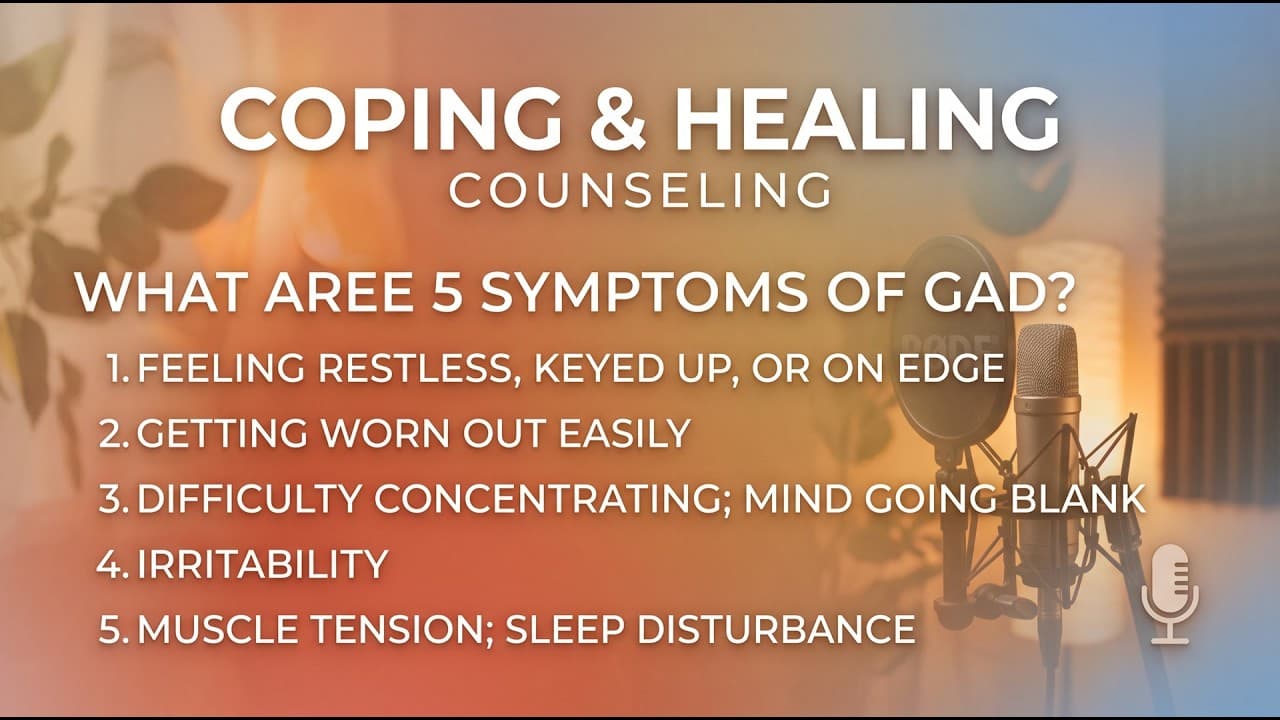
What are 5 symptoms of GAD? — Full Episode | Georgia Telehealth Therapy
What are 5 symptoms of GAD?
What is the main cause of panic disorder? — Full Episode | Georgia Telehealth Therapy
What is the main cause of panic disorder?
If this resonated, we have therapists who can help.
15+ licensed therapists, all 159 Georgia counties, telehealth-only. Medicaid covered at $0 copay.
Book a free consultation