
What childhood trauma causes avoidance? — Full Episode | Georgia Telehealth Therapy
In this episode
What childhood trauma causes avoidance?
There isn't one specific kind. Abuse, neglect, growing up around violence or addiction, losing a parent, a frightening medical experience, or being bullied for years can all teach a child that the safest thing to do is steer clear.
That lesson made sense at
Transcript
Imagine driving like 45 minutes out of your way every single day just to avoid one specific street in your hometown, right? And not because of traffic or or construction or anything like that, but because your brain treats that particular zip code or maybe even just a specific intersection like an active war zone. Exactly. It's exhausting. It really is. Today we are exploring the mechanics of trauma and avoidance and later we're looking at how a really specific telealth practice in Georgia coping and healing counseling or CHC is actually breaking down the barriers to treatment. Yeah, they're doing some incredible work down there. They really are. But to understand what they're doing, we have to start at
the absolute root of the issue. So I'm going straight to the core question here right from the jump. What childhood trauma causes avoidance? Well, the direct answer is that there isn't just one specific kind. I mean, it can be triggered by a really wide spectrum of experiences. Like what? It can be triggered by abuse, obviously, or neglect, but also growing up around violence or addiction or losing a parent at a young age. Oh, wow. Yeah, right. That makes sense. Or going through a profoundly frightening medical experience or even just facing years of relentless bullying at school. Any of those can vividly teach a young child that the absolute safest thing to do is it just
steer clear. Okay, let's unpack this because that list you just gave is incredibly broad. We're talking about everything from severe emotional neglect to, you know, a scary hospital stay. Yeah, it really runs the gamut. When you hear that spectrum, it makes you realize how many different ways a young developing brain can be pushed past its processing limits. So, we've established the varied causes, but we really need to understand the mechanism. Why does the mind choose avoidance as its primary defense? What's fascinating here is the sheer undeniable logic of it. If you look at it from the perspective of a child facing those traumas, learning to steer clear wasn't a mistake, right? It wasn't a malfunction
at all. It was actually the safest, smartest thing to do. That lesson made perfect sense at the time it was formed because they're just kids, right? Exactly. They don't have power. Exactly. When you are small, when you completely lack agency, you don't have the physical or financial power to stop the violence or the bullying or the scary medical procedures. So, you just run away. You retreat. You hide. You avoid the trigger entirely. Your brain basically wires itself to believe that distance equals safety. I really want you, the listener, to think about how logical that is in the moment. It makes me think of childhood trauma avoidance as a kind of outdated survival software. Oh, I
like that analogy. Right. Like imagine a piece of code written for a computer system 20 years ago. It was programmed to save your life back then under very specific, very dangerous conditions, but the conditions changed. Exactly. The hard part is that this survival software keeps running in the background into adulthood, long after the actual danger is gone. You're walking around in a totally safe environment today, but your internal operating system is still aggressively scanning for threats from two decades ago. It is. It's constantly looking for the danger. But wait, I need to push back on that because the human brain is an incredibly adaptable organ, right? We learn new languages. We adapt to new cities.
Sure. If the brain's ultimate goal is survival, why doesn't it just update the software when I move to a safe environment? Why is it so smart about learning danger but seemingly so dumb about recognizing present safety? That is the exact paradox of trauma. Now, the answer really lies in the mechanics of your neurology. Specifically, the relationship between your amydala, the alarm bell, right, the alarm bell, and your prefrontal cortex, which is your logical, rational command center. When you experience trauma, the amydala gets hypersensitized. It fundamentally alters its threshold for what constitutes a threat. So it's basically broken. Well, not broken in nature. From an evolutionary standpoint, a false alarm is always better than a missed
threat. If you think a stick is a snake and run away, you're fine. If you think a snake is a stick, you're dead. Ah, okay. So, the brain would rather you be anxious and exhausted than dead. Exactly. The brain's primary job is survival, not your comfort and certainly not your social ease. So, it holds on to that outdated software because from its purely biological perspective, that software has a 100% success rate because you survived. You are alive sitting here today. Therefore, the avoidance strategy worked. The amydala doesn't care that this strategy is now making your adult life miserable or isolated. It just knows it kept you breathing when you were 8 years old. Which brings
us to the reality of living with this day in and day out. Because since this outdated software is still running, how does it actually manifest in our daily adult lives? It shows up in so many ways. We move from the internal psychology to external behaviors. The sources give some incredibly specific examples of how this ghost in the room manifests. Let's start with leaving the room when voices get raised. Yeah. And this is where we really see that false alarm mechanism at work. We aren't just talking about fleeing from a screaming match or an abusive situation, right? It happens during normal stuff. Exactly. You could be sitting in the living room completely safe and two of
your best friends start passionately but happily debating a movie or a sports game or something. Yeah. Their voices get a little louder, the energy goes up and suddenly that outdated software kicks in. The amydala bypasses the logical prefrontal cortex entirely. It just says loud voices equal danger. We need to leave the room right now. It's like a smoke detector that was calibrated in a burning building and now it goes off every single time you make toast. That is exactly what it is. It's not completely broken. It's just overly sensitive to the point of being totally disruptive. You're making an excuse to go to the kitchen before you even consciously process why you're uncomfortable. It's a
hair trigger response. And that translates perfectly into the next major symptom, the automatic reflex of answering I'm fine to absolutely everything. Oh man, this one hits home for a lot of people. But what is the physiological how here? When someone says, "I'm fine." Even when they are clearly falling apart, what is actually happening in their nervous system? Well, it is a rapid deescalation tactic. When someone asks how you're really doing or tries to probe into your emotional state, the traumatized brain often perceives that inquiry as an interrogation, and an interrogation is a threat. Exactly. If you express vulnerability, you expose a weak point. If you show anger, you might provoke retaliation. So, the brain shuts
down the emotional expression and throws up a shield because if I'm fine, nobody looks too closely, right? There's no conflict, no risk of exposure. It's a way of verbally avoiding intimacy to quickly neutralize the perceived threat of someone getting too close. Wow. It's basically camouflage. That's a great word for it. And it doesn't stop at verbal avoidance. There is also geographical and chronological avoidance. This is what we were talking about at the very beginning with the 45minute detour. Yes. You literally route your entire life physically and conversationally around invisible landmines, refusing to drive a certain road, visit a certain town, or even refusing to talk about a specific year of your life. Think about the
massive amount of mental energy that requires on a daily basis. You are trying to navigate the present world while constantly, obsessively checking a map of past traumas just to make sure you don't step on a trigger. Exactly. And that sheer exhaustion leads right into the final example. The panicky feeling that arises when someone starts to get emotionally or physically close to you, like in a relationship. Yeah. The moment a romantic relationship or a friendship starts to deepen, the survival software recognizes closeness as a vulnerability. And vulnerability equals a threat. So panic sets in, right? To force you to back away and sabotage the connection before it can hurt you. So what does this all mean?
Seriously, if someone listening right now is checking these boxes, they leave the room during debates. They say, "I'm fine." Like it's a reflex. They panic when people get close. Yeah. If someone realizes their life is dictated by this, is it a sign they are fundamentally broken? No. If this is you, the most important takeaway from this entire discussion is this. Please go easy on yourself. You are not broken. That's a relief to hear. Avoidance is one of the most natural common ways that human beings cope with trauma. It is an evolutionary shield. It is a testament to your mind's incredible ability to adapt and protect you when you needed protection the most. It is absolutely
not a character flaw. I love that framing. It is not a character flaw. It is an evolutionary shield. Exactly. But if we acknowledge that avoidance is a natural coping mechanism, the natural next question is how do we safely uninstall that outdated software without completely crashing the system? That's the challenge. Because if the amydala is that sensitive, the idea of going to therapy to confront all of this sounds like it would instantly trigger the exact panic response we just talked about. Well, this raises an important point about how we view treatment itself and how the media often portrays it because the cruel irony of avoidance is that it forces people to avoid the very thing that
could heal them. Right. They avoid therapy itself. Exactly. People fear that going to a therapist means diving into their absolute worst memories on day one. They picture sitting on a couch and immediately being forced to vividly relive the darkest moments of their childhood, which is terrifying. If you're listening to this and thinking, "Okay, but therapy means I have to relive my worst nightmare with a stranger." That is exactly the myth we need to bust right now. Modern therapy does not do this. It really doesn't. You are not getting thrown into the deep end of the pool on the first day. So, what do they actually do? The clinical approaches used today are specifically built to
go step by step to prevent that kind of overwhelm. We're looking at modalities like trauma focused CBT, which is cognitive behavioral therapy. Okay, CBT, right, which focuses on safely recognizing and rewiring the negative thought patterns that stem from the trauma. There's also CPT, cognitive processing therapy, which helps you reframe the underlying beliefs you've developed about yourself. And the sources mention EMDR as well. EMDR is one of those acronyms you hear everywhere now, but no one ever explains it. What does it actually stand for? And mechanically, how does it work? It stands for eye movement desensitization and reprocessing. And mechanically, it's fascinating. It often involves the therapist having you track their hand back and forth with
your eyes or using tapping while you briefly focus on a specific aspect of a traumatic memory. Wait, so just moving your eyes back and forth actually does something? It sounds unusual, I know, but neurologically tracking that bilateral movement heavily taxes your working memory. Your brain simply doesn't have the processing power to simultaneously track the movement and fully experience the emotional intensity of the trauma panic. Oh wow. So, it distracts the brain. It dilutes the emotion, allowing the brain to finally take that memory and refile it from current active threat to past completed event. That is incredible. It's essentially a biohack for the brain to safely process a file without opening the full terrifying program. It's
uninstalling the software one small line of code at a time. Precisely establishing safety in the present moment long before you ever start gently processing the past. But there is a crucial medical caveat we must state clearly here. Oh, right. While you might recognize these symptoms of avoidance in yourself, only a licensed clinician can officially diagnose PTSD. Self-awareness is a fantastic first step, but professional assessment is the absolutely necessary second step. Right. And knowing that these step-by-step therapies exist is wonderful, but frankly, it means nothing if people can't actually access the care. Yeah, access is a huge issue. If you don't live in a major city or you don't have premium health insurance, getting consistent trauma
therapy has historically been almost impossible. Which brings us to the logistics of how coping and healing counseling or CHC actually delivers this care. Right. Here's where it gets really interesting because the scale of what they are doing is massive. They serve all 159 counties in the state of Georgia. All 159 counties. That is a massive geographical footprint to cover and they are doing it through a model that is 100% teleaalth and fully HIPPA compliant. Meaning whether you are sitting in downtown Atlanta or out in the most rural corner of the state, you have the exact same access to care. They've completely removed the geographic barrier. Exactly. You don't have to worry about driving 45 minutes
out of your way to avoid a trigger just to get to your therapist's office because the clinic is right there on your laptop or phone. And let's look at the team supporting that reach because the quality matters just as much as the access. They have a diverse, culturally competent team of over 15 licensed therapists, which is so important for trauma work. It's vital. You need to feel deeply understood on a cultural level before you can establish safety. The clinic is staffed with LCSWS, LPC's, and LMFTs. Let's break those down. That's licensed clinical social workers, licensed professional counselors, and licensed marriage and family therapists. Having that variety is huge. Yeah. They aren't just taking a one-sizefits-all
approach, right? They cover individual therapy, couples therapy, family and teen therapy for anyone ages 13 and up. They even offer life coaching. And their specialties range from anxiety, depression, and trauma like we've been unpacking to grief, relationships, and stress. If we connect this to the bigger picture, we have to talk about the final and often most insurmountable barrier, the financial one. Yeah, the cost is usually what stops people because the cost of therapy is actually a massive form of systemic avoidance. When the brain is looking for a reason to say, "I'm fine." Looking at a $150 price tag is the perfect excuse. Oh, absolutely. People look at the cost and to steer clear. But CHC's
insurance model directly attacks this dynamic. For Medicaid clients in Georgia, they pay a Z co-pay. Z. I want to pause on that because that is genuinely life-changing. For someone in rural Georgia on Medicaid, removing a massive co-pay is the difference between getting care and suffering in silence. It takes the financial excuse completely off the table. And for those with other insuranceances, they work with Etna, Sigma, Blue Cross Blue Shield, United Healthcare, and Humanana. The co-pays range from just $10 to $40 a session. That's incredibly accessible. When you analyze this from a psychological perspective, by removing the geographic barriers through teleaalth and the financial barriers with these 0 to $40 co-pays, CHC is directly combating the
avoidance we discussed earlier. They are clearing the physical path so you can clear the mental one. Exactly. So if you are listening to this right now in Georgia and you are realizing that your survival software is severely overdue for an update, we want to make sure you know exactly how to take that next step. Here is the vital contact information for coping and healing counseling. Yeah, this is important. You can reach them by phone at 404-832102. Again, that is 404-832102. Their website is chc theapy.com and you can email their team directly at supportcapy.com. And they also have a great resource online, right? They offer a free online PTSD test. It's a great starting point for
self-awareness and you can find that at chc theapy.com/assassessments/free-psd test hyphen online. Perfect. And of course, the most important crisis protocol. If you or someone you know is in crisis right now, please do not wait. Call or text 988 immediately. You know, we talked earlier about that reflex to just say, "I'm fine." to deescalate a situation. Yeah. The next time you hear yourself say that or the next time you find yourself avoiding a certain road or a certain conversation, I want you to consider viewing that moment differently. How so? Don't look at it as a failure of courage. Look at it as a map. That avoidance is simply a signpost pointing to a place where a
younger version of you had to learn how to survive. The question is, are you ready to finally tell that younger version that they are safe now? Wow, what an incredibly powerful note to end on. Thank you so much for joining us for this deep dive. We respect your time. We love your curiosity and we genuinely hope this conversation gives you some new tools to understand yourself and the people around you. Until next time, take care of yourselves and keep digging deeper.
More episodes
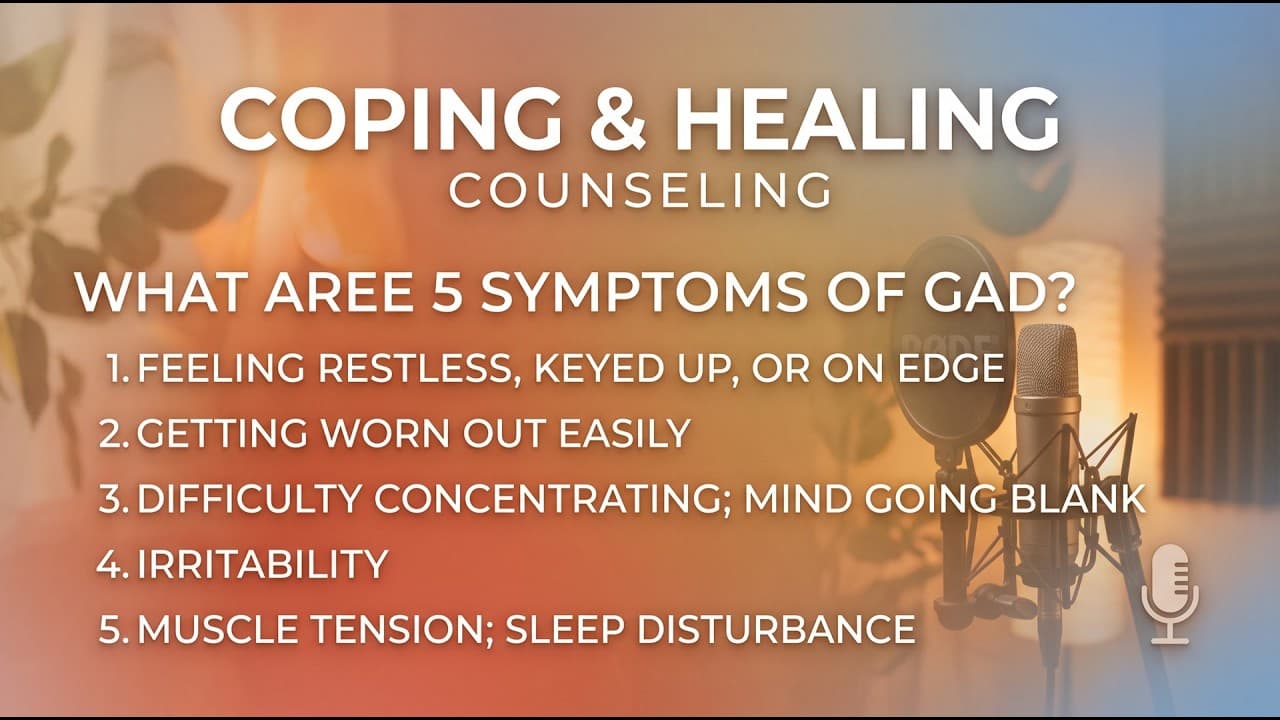
What are 5 symptoms of GAD? — Full Episode | Georgia Telehealth Therapy
What are 5 symptoms of GAD?
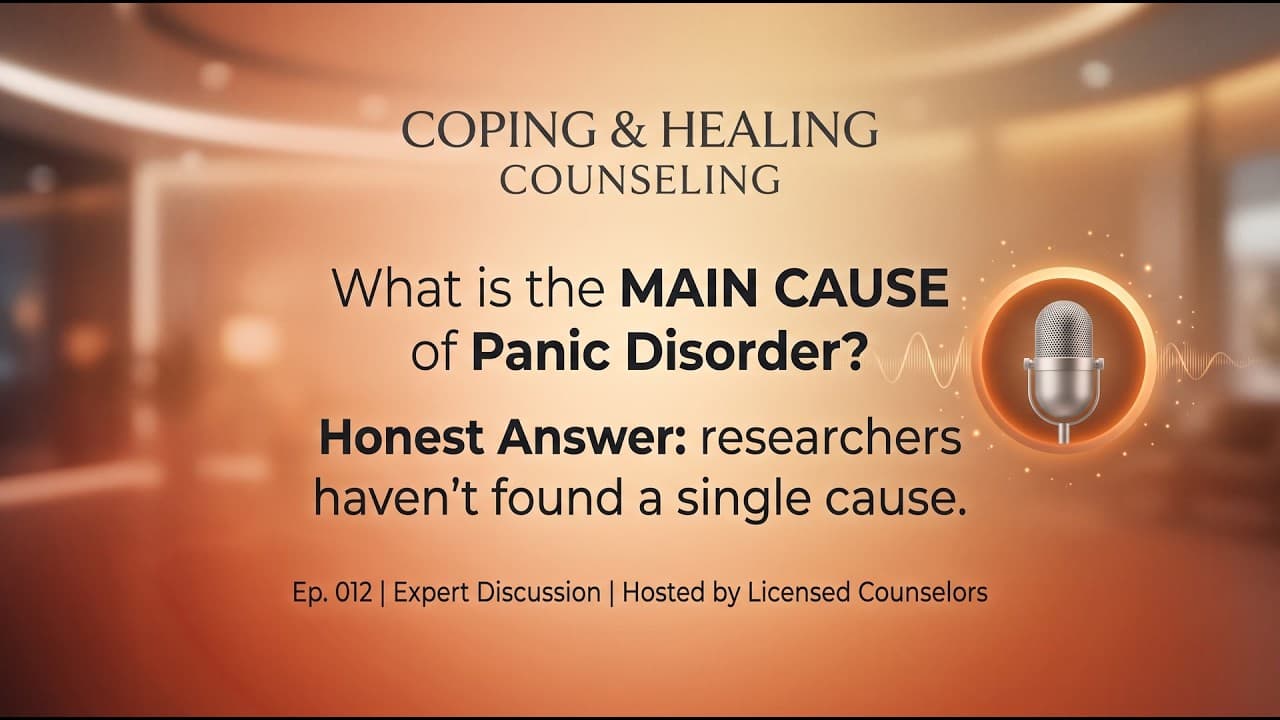
What is the main cause of panic disorder? — Full Episode | Georgia Telehealth Therapy
What is the main cause of panic disorder?
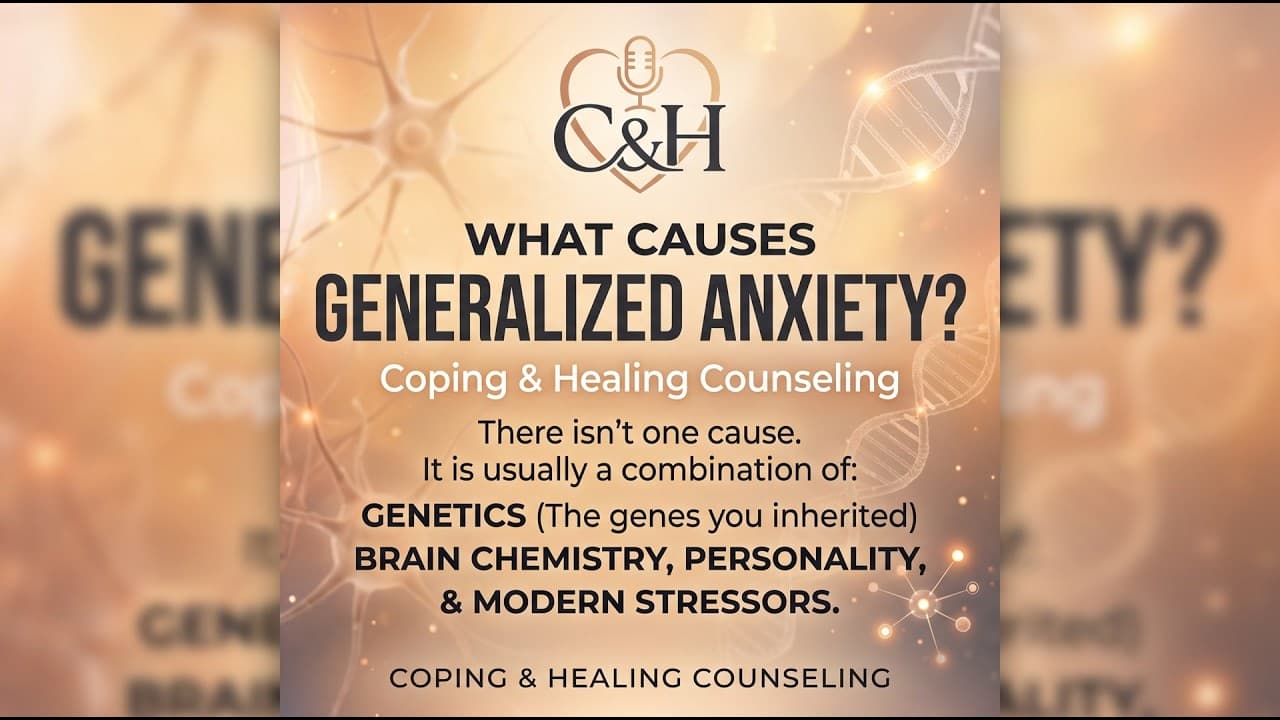
What causes generalized anxiety? — Full Episode | Georgia Telehealth Therapy
What causes generalized anxiety?
If this resonated, we have therapists who can help.
15+ licensed therapists, all 159 Georgia counties, telehealth-only. Medicaid covered at $0 copay.
Book a free consultation