
Real talk — sometimes the hardest part... | Georgia Telehealth Therapy
In this episode
Real talk — sometimes the hardest part of therapy is just figuring out how to fit it in. That's why telehealth changes everything. You can meet with a licensed Georgia therapist from your bedroom, your parked car, or your lunch break. No commute, no waiting room, no childcare scramble. If tonight fe
Generated from Coping & Healing Counseling: Accessible Telehealth for Georgia
#CopingAndHealing #GeorgiaTherapy #Telehealth #MentalHealth #Podcast
Transcript
I mean, I always think about traditional therapy a lot like a traditional gym membership. Oh, totally. That's a great way to look at it, right? Because, you know, when you actually break down the psychology of why people avoid getting in shape or why you might avoid it, the biggest hurdle isn't usually the workout itself, right? The heavy lifting isn't the actual problem. Exactly. The heavy lifting is fine. The real barrier is well, it's the friction surrounding the workout. The logistics. Yeah, the logistics. It's the 20 minute drive sitting in stopand go traffic uh hunting for a parking spot doing that awkward shuffle through a crowded locker room. Yeah. And by the time you actually approach
the weights, your cognitive load is already maxed out. Yes. You're exhausted before you even start. And for a massive portion of the population, that logistical friction is the exact reason the gym bag just, you know, stays in the trunk. It never makes it inside. Right. So today we are looking at how that exact same principle of friction applies to mental health care and specifically how tellahalth is entirely dismantling this common myth of uh I'm too busy for therapy which is something we hear constantly constantly. So, we're jumping into some excerpts from a source called the digital couch, accessible teleaalth for modern Georgian. And this text spotlights a specific clinical practice called coping and healing counseling
or CHC. Right? And the mission for this deep dive today is to really analyze the mechanics of how modern teleaalth dissolves those physical barriers. We want to show you how working people, people with your exact crazy schedule are taking on profound psychological care without ever leaving their own environment. And what's fascinating here is that we constantly treat time as this uh rigid fixed object. Oh, for sure. Like a brick wall. Exactly. We look at our weekly calendars as if they are brick walls, right? We just assume there's absolutely no negative space left to squeeze in something as significant as mental health treatment. Yeah. Yeah, you look at Tuesday and think I literally have zero minutes,
right? But when we analyze the actual data of daily routines, we find that the brick wall is mostly constructed of transit time. Transit time. Yeah, tellahalth completely changes the mathematics of a daily schedule. I mean, it strips away the whole infrastructure of the medical establishment and leaves only the cognitive work. So, let's actually look at those mathematics of time. Since we've established that the logistical friction is the primary barrier, you know, keeping people off the therapist's couch, we need to break down the literal minutes involved here. Let's do it. Because a traditional in-person therapy commitment is never just a 50minute clinical hour. Oh, never. Right. You have to factor in the hard stop at work.
Uh the commute to a specific medical zone, sitting in a waiting room. Yes. Sitting in a waiting room filling out clipboards with the tiny pens. then the session itself and then the commute back. It adds up fast. It really does. For the average working adult, a single in-person therapy session is easily a 90 minute to like 2hour roundtrip commitment right in the middle of a Tuesday, which is impossible for most people. Yeah. But the source material notes that tell slashes this commitment down to just 45 to 60 minutes total. That's it. You log on, you do the work, you log off. And that recovered hour of commuting, that is the precise tipping point of accessibility.
Wow. It represents the literal boundary between I can't fit it in and I can. Because when you shrink the temporal footprint to just the session itself, psychological care suddenly becomes viable for populations with highly demanding, you know, non-traditional schedules like the shift workers, the source highlights. Exactly. nurses, emergency medical technicians, restaurant managers, uh retail leads. These professionals operate in a state of chronic time scarcity, right? They don't have the luxury of a slow afternoon. No, they do not work a predictable desk job where an extended lunch break just goes unnoticed. I mean, if an EMT is coming off a grueling 12-hour rotation, asking them to drive another 40 minutes to a clinic is just an
insurmountable barrier. Yeah, it's not happening. Tellahalth removes that travel penalty and it also completely rewrites the complex algorithm of family logistics. Oh, the child care piece, right? For parents, attending a physical clinic has historically meant securing expensive child care, burning social capital with a partner for coverage or, you know, entirely disrupting a fragile household routine. It's a nightmare to schedule. It is. But practices operating in this modern framework offer evening and weekend slots, meaning the clinical work happens after the children are asleep. So you don't even have to leave the house. Exactly. Eliminating the need to leave the house at all. Okay. Let's unpack this though because I want to challenge this idea of seamless
integration just a little bit. Because if we are shrinking this time commitment down and just wedging it into the narrow gaps of a chaotic day, I have to question the psychological toll of that context switching. That's a fair point, right? Let's say someone is engaging in a deeply emotional 45minute trauma processing session on a tight lunch break or you know a parent is crying through childhood trauma in their home office. Is it actually possible for a frantic shift worker or a busy parent to successfully transition their brain that fast? You're asking if they need a buffer. Yeah. Because bypassing a commute sounds efficient on paper, but doesn't a patient need that physical drive home as
a buffer. Going straight from unpacking profound grief to um immediately running a cash register or making dinner, that seems incredibly jarring. It sounds jarring, but that immediate transition back to reality is actually a major area of study in modern psychology. Oh, really? Yeah. And the clinical experience actually contradicts the assumption that a commute is a necessary therapeutic buffer. Wait, it contradicts it. It does. Yeah. While the transition does require a deliberate brief routine, perhaps a physical reset, like walking around the building, or a focused breathing exercise, skipping the traditional drive home often leaves the patients nervous system far more regulated. Huh. I wouldn't have guessed that. Well, we romanticize the commute as this period of
serene reflection, right? Yeah. Staring thoughtfully out the window. Exactly. But that rarely aligns with reality. Think about it. You leave a highly vulnerable, emotionally raw session and immediately you are forced to navigate aggressive traffic, endure road rage, and make split-second driving decisions. Oh, that's true. Traffic is the worst, right? The external environment forces the autonomic nervous system right back into a state of hypervigilance, and that often undoes the sematic regulation you just achieved in the therapy room. That makes so much sense. So the commute is an active stressor that effectively overwrites the relaxation of the therapy. Exactly. But with teleaalth, the patient dictates the sensory input. When you close the laptop, you are already in
a familiar controlled environment. You're safe, right? Your brain does not have to expend energy defending against external threats, which allows the therapeutic processing to just continue passively. Wow. That fundamentally shifts how we view the geography of healthcare. I mean, if patients are now experiencing these 45minute windows of regulated calm within their existing routines, the physical location of the session has radically decentralized. Oh, absolutely. We've moved from the classic imposing leather couch in an austere doctor's office to well, wherever the patient happens to find an internet signal. And that shifting geography of access is arguably the most revolutionary mechanism outlined in this source material. Tell me about it. Well, we have to look at the stark
logistical reality in places like Georgia, which this text uses as its primary focus. Right. CHC is based there. Yeah. And Georgia has a massive, highly dispersed rural population. If you live in one of these rural counties, the nearest licensed specialist trained in your specific trauma might literally be a 90-minute drive away in one direction. So, a three-hour round trip. Exactly. A three-hour round trip renders specialized care impossible for the working class. You just can't do it. But Tellah Health alters the map entirely because it doesn't matter where you live, right? The CHC model serves all 159 counties in the state. The geographical penalty of living at the end of a dirt road is entirely erased.
That's incredible. And the actual locations where clients across this case load are choosing to take these sessions. It's just fascinating to me. It really is. It completely breaks the mold of what we consider a clinical space. We aren't just talking about dedicated quiet home offices here. No, not at all. People are taking sessions in parked cars between corporate meetings. Yep. In an empty break room during a lunch shift, out in unheated garages, um postshift hotel rooms for traveling nurses, anywhere they can find space. Exactly. The text even points out clients taking sessions sitting on the floor of their bathroom simply because it is the only room in a chaotic multi-generational household where they can lock
the door and guarantee absolute privacy. And that's a brilliant adaptation. It is. It's like the front seat of a parked car has essentially become the modern mobile sanctuary. That's a great way to put it. Yeah, because it's climate controlled. It's acoustically dampened. No one is going to interrupt you. It functions as this like private confessional booth on wheels. And treating the car as a therapeutic sanctuary is a vital psychological evolution. How so? Well, when we eliminate the physical waiting room and the imposing architecture of a medical building, therapy ceases to be a destination, right? It stops being this isolated clinical event that happens in a vacuum completely outside of your normal existence. Instead, it becomes
deeply integrated into the fabric of your actual environment. I see. Yeah. There is a psychological concept known as state dependent memory and learning. Oh, I've heard of that. Right. It means that when you learn to cope and heal in the very spaces where you live, work, and survive, the behavioral changes actually stick better. Oh, wow. So, because you're in the car, you are processing daily stress in the exact vehicle where you normally experience that stress. Yeah. You are learning to manage family dynamics while physically sitting inside the house where those dynamics actually play out. That is so powerful. But you know, unpacking complex trauma in the front seat of a Honda Civic or a master
bathroom definitely invites some skepticism regarding the quality and privacy of the medical care. Oh, sure. I think a lot of people listening would assume that an unconventional environment inherently degrades the safety of the session. Like if you don't have a soundproofed medical suite, how do you maintain the sanctity of the doctor patient boundary? It's a common concern, but privacy in a dense or shared living situation requires deliberate tactics. It doesn't require clinical architecture. Okay. Tactics like what? Well, the source provides highly practical solutions for clients navigating chaotic homes. Utilizing noiseancelling headphones creates an immediate isolated auditory environment. Right? So you only hear the therapist. Exactly. And placing a simple white noise machine or even just
a loud fan outside a bedroom or bathroom door scrambles the vocal frequencies so housemates cannot overhear the content of your conversation. Oh, that's such a simple smart hack. It works perfectly. And structurally patients adapt by scheduling around the natural rhythms of the household. You know, utilizing the windows when children are at school or roommates are commuting. So you just build it into the gaps. But what about the technology itself? Because there is this persistent myth that accessing medical grade tellaalth requires like a complicated multimonitor IT setup. Oh yeah. Or downloading clunky proprietary medical software that constantly crashes. Exactly. Is that still a thing? Not at all. The technological threshold is surprisingly minimal now. Really? Yeah.
The requisite hardware is merely a smartphone or a laptop equipped with a working camera, a stable internet connection, and standard headphones. That's it. That's it. Modern practices utilize secure browser-based video platforms. There is no software to download. Oh, nice. Yeah. The patient receives a link and that link opens a 100% IPA compliant end-to-end encrypted video feed. It is a legally protected medical environment that is generated in seconds. Okay. But I have to play devil's advocate here on the science of the treatment itself. Go for it. Because the encryption might be flawless. Sure. But I struggle to believe that staring at a two-dimensional webcam provides the same emotional breakthrough or psychological resonance as, you know, sharing
oxygen in a room with a human being. That's what a lot of people think, right? Does the clinical data actually support the idea that looking at a screen yields the exact same medical outcome? It absolutely does. The clinical data is unequivocal on this and it centers on a concept called teaalth equivalence. Tellahalth equivalence. Yes. Extensive peer-reviewed research demonstrates that video therapy outcomes perfectly match in-person outcomes for the vast majority of major clinical issues. Wait, really? Perfectly match. Perfectly match. Whether we are measuring the reduction of symptoms and generalized anxiety, major depressive disorder or PTSD, the quantitative healing is the same. That is wild. And the legal framework reflects this scientific consensus. The text highlights the
Georgia parody law. For example, does that a parody law mandates that insurance companies must provide identical coverage and reimbursement for teleaalth as they do for in-person visits. Oh, so they have to treat it the exact same financially. Exactly. What that legislation represents is a watershed moment where the state and really the broader medical establishment formally conceded that tellahalth is not a lesser alternative. It's not diet therapy, right? It is recognized functionally and legally as identical in its standard of care. Okay. So if the clinical outcomes are legally and scientifically indistinguishable and a patient can achieve major psychological breakthroughs from their garage, we really have to re-evaluate the entire aesthetic of traditional therapy. We do. I
mean it was the curated waiting room, the leather couches, the ambient lighting, the specific zip code of the medical building. Was all of that just a theatrical illusion of better care that society has been buying into for decades? Yes, it was absolutely the theater of medicine. Theater of medicine. And I love that phrase because humans naturally associate imposing physical infrastructure with clinical authority. We just assume a doctor in a high rent downtown high-rise is more capable than one operating out of a modest clinic. Right? We see a fancy building and think, "Oh, they must be good." Exactly. But evidence-based psychological care does not rely on real estate. The mechanism of healing, the actual reason therapy
rewires the brain relies entirely on the cognitive exchange and the therapeutic alliance between the provider and the patient. The connection. Yes, the connection. As long as the video feed is secure and the practitioner is highly trained, the expensive architectural shelf surrounding the session is medically irrelevant. And taking away that expensive architectural shell brings us to the financial reality of this model, which is huge. Yeah. Because if we are stripping away the real estate, how does that impact the economics for the patient and you know who exactly is on the other side of these secure video feeds, right? Who are you actually talking to? Exactly. If we look at coping and healing counseling as a case
study here, we can see exactly how the mechanics of a virtual practice operate. And analyzing CHC's structure reveals a lot about the modern psychiatric workforce. Like what? Well, they maintain a roster of over 15 licensed therapists, but the crucial detail is the diversity of the licensing. What do you mean by diversity of licensing? The staff includes licensed clinical social workers, licensed professional counselors, and licensed marriage and family therapists. Okay, that's a lot of acronyms. It is, but this variety is not just bureaucratic alphabet soup. It dictates the entire angle of treatment. Oh, okay. Break that down for me. So social workers are trained to analyze a patients systemic environment and community resources. Professional counselors focus
heavily on individual pathology and behavioral interventions. And marriage and family therapists approach issues through the lens of relational dynamics and family systems. Oh, I see. So it's different tools for different problems. Exactly. Having this diverse triage capability in one virtual hub ensures comprehensive care for individual couples, teen therapy for anyone 13 and up and complex issues like grief and severe stress. And the source also heavily emphasizes that this clinical team is diverse and culturally competent, which is so important. It's vital. Finding a specialist who fundamentally understands your specific cultural context, racial background, or systemic challenges is normally a needle in a haststack scenario. Oh, absolutely. Especially if you are geographically restricted to whatever clinic happens
to be within a 20 mile radius of your house, right? But by pooling talent across the entire state via teleaalth, the probability of finding an exact cultural and clinical match skyrockets. It makes perfect sense. And that matching process is vital for effective care. But I think the most disruptive element of the CHC case study is the economic accessibility. Here's where it gets really interesting. Yeah. The traditional expectation for a highly specialized, diverse team of 15 practitioners is, you know, a six-month weight list and an exorbitant out-of- pocket fee. Oh, yeah. Hundreds of dollars an hour, right? But the source indicates CHC offers same week availability across most major insurance panels. Same week. That's unheard of.
I know. And the financial breakdown challenges everything we assume about the cost of healthcare. They accept Georgia Medicaid with a $0 co-pay, right? Z and for commercial insurance networks like Etna, Sigma, Blue Cross, Blue Shield, United Healthcare, Humanana, the standard out-of- pocket cost typically ranges from just $10 to $40 per session. That economic shift is staggering. The idea that someone could secure an appointment with a fully licensed culturally matched trauma specialist within a few days and pay zero dollars on Medicaid or like the equivalent of a few cups of coffee on commercial insurance. Uh it feels almost impossible given the current state of American healthcare. It does seem too good to be true. Yeah. How
does the business model actually support that without going bankrupt? It comes entirely back to the elimination of physical overhead. The real estate again. Exactly. Operating a traditional brick-and-mortar medical clinic requires massive capital outlays, commercial leases, utility bills, maintenance, and administrative staff dedicated solely to managing the physical flow of a waiting room. Right. You're paying for the lights and the leather couches. Yep. By transitioning to a teleaalth model, those crushing overhead costs just vanish. Wow. And the practice can then redirect that saved capital into absorbing the lower reimbursement rates offered by state programs like Medicaid without sacrificing the compensation required to attract top tier therapists. Oh, that's brilliant. It is. It's a direct economic mechanism. Lower
physical overhead creates the financial margin necessary to democratize access for lowerincome populations while simultaneously expanding the talent pool of available doctors. It is a profound structural redesign of the health care system. Really to synthesize everything we've explored today from the source material. We are witnessing the systematic dismantling of every single logistical excuse we have historically used to avoid mental health care. Every single one. Tellahalth through case studies like CHC has erased the geographical penalty of living outside a major city. It has neutralized the chaotic schedules of shift workers and parents. It's completely bypassed that nervous system spiking commute we talked about. Yep. It's proved its scientific equivalence to in-person care, and it used the economics
of virtual overhead to drop the financial barrier to entry down to practically nothing. I mean, the clinical evidence is absolute. The legal parody is established, and the infrastructure has been streamlined to require nothing more than a smartphone and a quiet moment. Yeah. effective, culturally competent, psychological intervention is now entirely untethered from physical real estate. And the actionable takeaway from the text is incredibly clear. If you are listening to this deep dive right now and you're recognizing that the logistical hurdles keeping you from seeking help are no longer valid, the path forward is immediately accessible. It's right there. You can visit cheat theapy.com or dial 448320102 to secure a session that actually integrates directly into your
existing week. The tools for profound psychological growth are literally sitting in your pocket right now. It's a powerful realization. It really is. Yeah, but you know, evaluating this massive societal shift leaves us with a final thought to ponder because for years we have used our busy schedules, the long drive, and the cost of child care as perfectly valid shields to avoid the hard work of therapy. Oh, absolutely. They were great excuses. They were. But if healing can now happen in the front seat of your car on a Tuesday afternoon for the cost of a few cups of coffee, what is the real reason you're still waiting to start?
More episodes
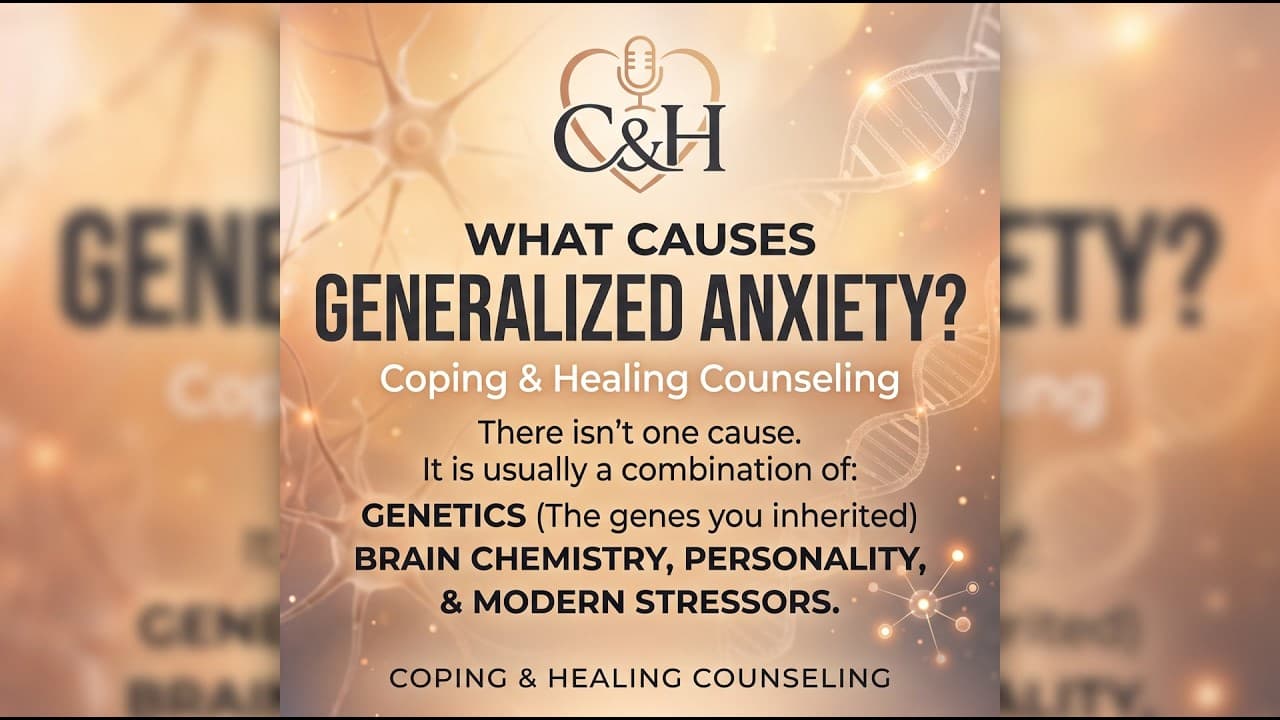
What causes generalized anxiety? — Full Episode | Georgia Telehealth Therapy
What causes generalized anxiety?
What are the 5 symptoms of major depressive disorder? — Full Episode | Georgia Telehealth Therapy
What are the 5 symptoms of major depressive disorder?

RSD and ADHD: Why One Short Text Can Wreck Your Whole Day | Georgia Telehealth Therapy
This one is for the friend who apologizes three times in a single text.
If this resonated, we have therapists who can help.
15+ licensed therapists, all 159 Georgia counties, telehealth-only. Medicaid covered at $0 copay.
Book a free consultation