
Quick myth-bust: therapy isn't only for... | Georgia Telehealth Therapy
In this episode
Quick myth-bust: therapy isn't only for people with money to spare.
✓ Medicaid? $0 copay. ✓ Aetna, Cigna, BCBS, UHC, or Humana? Usually $10–40 a session. ✓ Not sure what your insurance covers? We'll check for you.
Don't let the cost story you're telling yourself stop you from getting help. Call us
Transcript
You know that uh that physical tightening in your chest when your car starts making a weird aggressive rattling noise on the highway? Oh yeah, like immediate panic, right? And you haven't even taken it to the mechanic yet. You haven't had anyone look under the hood. No, but your brain is already convinced, like with absolute certainty, that it's going to cost thousands of dollars. Thousands. Your imagination just immediately writes up the absolute worst case scenario invoice complete with parts, labor, and uh totally ruined weekend. Exactly. And because of that fear, that massive impending invoice looming in your head, what do you actually do? You uh reach over and turn up the radio. You just turn up
the radio and try to drown out the rattle. You avoid it entirely. Yeah. Out of sight, out of mind or well, out of your shot, right? Well, today we are talking about a different kind of rattle and a very different kind of avoidance. Okay. We are looking at the world of mental health care. specifically the massive gap between what we assume therapy costs and what the actual numbers look like on paper. It is a uh it's a really profound gap and frankly it is keeping a lot of people from getting the support they desperately need. Yeah, it really is. So to guide us through this, we are looking at anformational brief from Coping and Healing
Counseling or CHC. Right. They're a therapy practice based down in Georgia. Exactly. Okay, so our mission for this deep dive is to investigate that financial gap using their operational model as our case study. I love that we are going to dismantle the financial myth surrounding mental health care. So to you listening right now, if you have ever talked yourself out of getting help because you just assumed it would drain your bank account, which so many people do, right? If you've done that, this deep dive is specifically for you. Okay, let's unpack this because there's a quote right near the top of the source document that absolutely stopped me in my tracks. Oh, I think I
know the one you mean. It says, "The fear of I can't afford it is almost always bigger than the actual number on the bill." Yeah, that sentence I mean that is the crux of the entire issue right there. It really hits hard. What's fascinating here is that they are identifying a psychological barrier that exists long before a patient even, you know, picks up the phone or opens a web browser. Right. The source actually calls this the cost story. And I want to spend some time exploring this because the brief specifically targets the myth that therapy is only for people with quote money to spare, which is such a pervasive myth. It is. They point out
that people are often genuinely shocked when they finally look at their actual co-ay. But like, why do we do this? Why do we let the assumption of a high price tag act as a gatekeeper before we even do the basic math? I mean, it's not like checking a price is physically dangerous. No, it's not physically dangerous, but uh the source text is highlighting human behavior under duress. Okay. Duress. Yeah. It's talking about the self-sabotaging narratives that prevent people from seeking care for heavy stuff like conditions like anxiety, depression, or severe stress, right? Think about cognitive load. When someone is already dealing with overwhelming stress or uh profound depression, their mental processing power is basically maxed
out. Okay? So it's an energy issue like a computer with way too many heavy applications running at once. Precisely. You have too many tabs open. Yeah. And the RAM is just completely eaten up. Right. Everything is lagging. Exactly. So the brain takes a shortcut to save energy. Instead of investigating the complex uh often confusing world of healthcare pricing, it relies on an outdated societal narrative. Which is what exactly? Well, historically, pop culture has portrayed therapy as a luxury item, right? like a plush leather couch in a Manhattan high-rise for people with just endless disposable income. Oh, yeah. The classic Freudian setup, right? So, the exhausted brain says, "Therapy is expensive. I don't have spare change
right now. Therefore, I cannot go." Wow. So, it just shuts the door before even knocking. Exactly. It creates a closed loop that protects the individual from the perceived pain of financial strain. But in doing so, it locks them out of the treatment for the very anxiety or depression they're suffering from. The narrative itself becomes the barrier. Yeah. The story we tell ourselves is what stops us. Which is exactly why the source argues we have to stop telling ourselves that story. We have to like look at the actual invoice, so to speak. Right. Turn on the light in the closet and look at the monster. Exactly. Because when you do, according to CS's data, the reality
is vastly different from the assumption. Let's run the numbers. Yeah. Let's look at the concrete data they provided to shatter this illusion. The brief gives a very clear co-pay breakdown for how it usually works in their practice. Okay, lay it on me. Let's start with Medicaid in Georgia. According to the document, the co-pay for in network behavioral health is $0 per session. Wow. Just zero. That is a staggering number to start with when you're talking about dismantling the luxury myth. It is. But uh I have to push back here or at least ask for a reality check. Sure. If the co-pay is literally $0, how does the therapist actually make a living? Isn't a $0
model just a fast track to bankrupting the clinic or burning out the staff? I get why you'd ask that. That is a very common and very valid misunderstanding of how the system works. Okay, so enlighten me. 0 is the co-ay, meaning that's the portion the patient is responsible for at the time of service. It does not mean the therapist is working for free. Okay. So, who pays them? Because somebody has to keep the lights on. Medicaid is a joint federal and state program, right? Specifically designed to provide health coverage to eligible lowincome adults, children, and people with disabilities. Right. Right. So, when a clinic like CHC is in network with Medicaid, it means they have
signed a contract with the state. Ah, yeah. The state reimbures the clinic at a pre-negotiated contracted rate for every single session. Ah, got it. So the therapist gets paid their contracted rate behind the scenes and the patient pays nothing out of pocket. Exactly. By definition, a Z co-pay for Medicaid means that access to mental health care is explicitly designed by the system to be available to those who absolutely do not have money to spare. That's incredible. It really proves that the framework, at least in theory, recognizes behavioral health as a fundamental necessity, not some premium add-on. That makes the cost story we tell ourselves seem even more tragic. Honestly, it really does. Like people who
are literally entitled to entirely free care might be avoiding it because they assume it's out of reach because of a cultural myth. But let's look at commercial insurance because the brief breaks that down too. Okay. What do the commercial numbers look like? So Etna is typically a $10 to $30 co-pay. Blue Cross Blue Shield is typically $15 to $40. Okay. and Sigma, United Healthcare, and Humanana are all typically 20 to $40 per session. Let's just uh let's contextualize that for a second. Yeah, please. If you are paying 20 to $40 for a session with a licensed medical professional, that is often less than what someone might spend on a single takeout dinner or like a
couple of streaming subscriptions for the month, right? It completely changes the scale of what we were talking about. Here's where it gets really interesting, though. There's another thing the document notes. Many plans cover 20 to 40 therapy sessions a year, and some are unlimited. Now, I want to play devil's advocate for a second. Go for it. If I'm paying my insurance premiums every month, why would my insurance company cap me at 20 or 40 sessions? If I have a chronic physical illness, they don't say, "Well, you can only see the doctor 20 times." Right. Right. Why the cap on mental health? It's an important question and it really comes down to the actuarial logic of
health insurance which historically has treated mental health differently than physical health which seems so backwards. It is. It's a concept called par. And while laws have definitely improved parody over the years, insurance companies still manage risk by standardizing care into what they call episodes. Episodes like a TV show kind of. Yeah. The logic they use is that 20 to 40 sessions, which is roughly 6 to9 months of weekly therapy, by the way, is generally sufficient to treat a standard episode of acute anxiety or mild to moderate depression, assuming you're using evidence-based modalities. Right. Exactly. Like cognitive behavioral therapy. So, they are building the coverage around the average timeline for an acute issue rather than a
lifelong chronic condition. Exactly. But even if we accept that limitation, let's look at the math you just laid out. Okay. Okay, let's say you just have the standard 20 to 40 sessions, that equates to almost a full year of bi-weekly therapy. Wow. Yeah. And at 10 to 40 bucks a pop, you are talking about a highly manageable reallocation of weekly funds, right? You aren't taking out a second mortgage to get help. Not at all. Okay. So, let's say you, the listener, hear these numbers. You realize the co-ay is totally manageable or maybe even zero. Feeling pretty good about it. You're feeling a huge sense of relief, but then you remember you have to actually deal
with your insurance company to confirm all of this. Oh, yeah. Yeah. And there is the next formidable barrier because navigating insurance is a notoriously frustrating, mind-numbing experience. Truly the worst. But the source material actually addresses this directly. It talks about the friction of simply getting through the metaphorical door. Okay. How does CHC handle that? CHC states that they will check your insurance plan for you. Oh, nice. For free prior to your first appointment. That's huge. They also note they have sliding scale options for the uninsured and they actively help patients explore their Medicaid eligibility. Wow. They really do the heavy lifting. Yeah. The explicit goal, and this is a direct quote from the source, is
to remove the cost barrier, not gatekeep behind it. If we connect this to the bigger picture, that is a very deliberate operational choice on their part and it addresses a massive flaw in healthcare access. I want to focus on that word gatekeep though because sure waiting on hold with an insurance company is annoying. We all hate it. Understatement of the year, right? But is it really a form of gatekeeping? Isn't that just standard adult administrative stuff we all have to do? Under normal circumstances, yes, you could argue that. But remember the population we are talking about here, the people seeking therapy, right? The source explicitly lists the conditions this practice specializes in. Anxiety, depression, trauma
and PTSD, grief, and severe stress. Okay. Right. That's a heavy list. Think back to our earlier analogy about the computer with too many tags open. Oh, the RAM being full. Exactly. When someone is in the depths of profound grief or navigating the hyperarousal of PTSD, their executive functioning is severely compromised. Executive functioning. Yeah. The part of the brain responsible for planning, organizing, and executing tasks. So, their RAM is just maxed out. The RAM is completely full. So asking that person to log into a complex, often adversarial insurance portal, decipher policy jargon about deductibles versus co-pays, and wait on hold for 40 minutes with awful elevator music. Exactly. You are putting a massive cognitive obstacle in
front of someone whose cognitive resources are already depleted. I never thought of it like that. The friction itself becomes exclusionary. That makes a lot of sense. If I'm having a panic attack, the last thing I can handle is a customer service rep asking for my group number. It's just not going to happen. But from a business perspective, how does a clinic afford to do that? What do you mean? Well, checking insurance for every single prospective patient requires administrative staff, and staff costs money. If the goal is to keep costs low, isn't taking on that free labor counterproductive? It might seem that way on the surface, but operationally, it's actually an investment that saves the clinic
money in the long run. Wait, really? How so? Imagine a patient books a session. assumes they are covered, but their specific plan doesn't cover that specific therapist. Okay, pretty common scenario, right? The session happens, the claim gets denied, and now the patient is hit with a surprise bill for, say, $150. Oh, they would be so mad. The patient is furious. They drop out of therapy immediately, and the clinic has to spend hours trying to collect a debt that likely won't ever get paid. Ah, I see. By doing the insurance check up front, the clinic drastically reduces their no-show rate, eliminates billing disputes, and builds immediate trust of the patient. It's proactive instead of reactive. Exactly.
It's good healthcare, but it's also really smart business. It bridges the gap between the realization that therapy might be affordable and actually getting the person into the virtual waiting room without a surprise bill. Spot on. Which brings up another thing you mentioned earlier, sliding scales. The source notes, they offer sliding scale options for the uninsured. Right? I feel like we hear that term a lot, but how does a sliding scale actually work in practice? A sliding scale is essentially a variable fee structure based on a patient's ability to pay. Okay. Instead of a flat rate of say $150 a session, the clinic uses a formula usually tied to the federal poverty level guidelines. This based
on income, they look at your household income and the number of dependents you have. If your income falls into a lower bracket, your fee slides down to a more manageable number, like maybe $60 or $40. Exactly. It's a way for private practices to offer equitable access to uninsured individuals while still covering their base operational costs. It's all about removing the invisible gates. Yes, precisely. Knowing the numbers is great. Having the administrative gates open is fantastic. But that brings us to the delivery mechanism. This is a crucial piece because once the gate is open, who is actually providing the care and how are they physically reaching these patients? The logistics of access are just as important
as the economics. You can have a 0 c-ay, but if the nearest therapist is a three-hour drive away, you still don't have access. Exactly. And according to the source, CHC operates on a 100% teleaalth EAA compliant model. 100%. Yep. Yep. and they use this model to serve all 159 counties in the state of Georgia. That's a massive footprint. They also boast a diverse team of over 15 licensed therapists. Now, the source lists out a veritable alphabet soup of credentials here. Oh, I bet it gets confusing. Yeah, they say they have LCSWs, LPCs, and LMFTs. Before we go further, can we decode that? Like, what is the actual difference to a patient? It's a great question
because those acronyms represent different clinical focuses and matching the right one to the patient is crucial. Okay, let's break it down. Start with LCSW. Let's do it. An LCSSW is a licensed clinical social worker. They are highly trained in psychotherapy, but their foundational training heavily emphasizes how a person's environment, community, and systemic barriers affect their mental health. Okay. So, zooming out to the big picture of a person's life. Exactly. They're often excellent at connecting patients with broader community resources. What about an LPC? An LPC is a licensed professional counselor. Their training is intensely focused on the individual's mental and emotional health. More internal then? Yeah. There are specialists in diagnosing and treating mental health disorders,
often focusing on cognitive and behavioral interventions to help a person navigate things like anxiety, depression, or personal trauma. Okay. And the last one, the LMFT, licensed marriage and family therapist. As the name suggests, their specialty is systems. They view the individual's issues through the lens of their relationship. So even if it's just one person in the room, even if they're treating an individual, they are constantly considering family dynics, marital discord, and communication patterns. Okay, I think I get it. So if I'm dealing with stress from a massive career change, I might want an LPC, right? But if my teenager is acting out because of a messy divorce, an LMFT would be the specialist to look
for. Precisely. And the source actually notes that this practice offers individual, couples, family, and teen therapy for kids 13 and up. So what does this all mean? If you combine that diverse roster of specialists with the 100% teleaalth model serving 159 counties. To me, it feels like they are completely eliminating what I call the geographical lottery. The geographical lottery. I like that phrase. Explain your thinking there. Well, historically, if you wanted specialized care, say you desperately needed a culturally competent LMFT for your family, you had to win the geographical lottery by living in a major metropolitan hub like Atlanta. Very true. If you lived in a rural agricultural county in southern Georgia, your options were
likely non-existent. You either settled for whatever generalized care was nearby or you had to drive hours every single week. And that brings us right back to a massive cost barrier. The cost of time, time off work, and gas money. Exactly. But with a teleaalth model serving the entire state, your zip code no longer dictates your quality of care. That is a brilliant way to frame it, and it really highlights how the evolution of cloud-based high-ay compliant video software has fundamentally rewritten the rules of healthcare delivery. It's a total gamecher. It is. But there's another layer to this. If you look closely at the source, you can see how the size and the diversity of their
team is directly connected to that geographical reach. Oh, how so? Think about the demographics of an entire state. Serving 159 counties means encountering a massive variety of cultural backgrounds, socioeconomic statuses, and community norms. Right. The lived experience of someone in downtown Atlanta is very different from someone in a small rural town in the Appalachian foothills. The cultural context is entirely different. Exactly. A therapist who is highly effective in an urban center might not have the cultural context to optimally serve a family dealing with grief in a deeply rural county and vice versa. That makes total sense. Cultural competence isn't just a buzzword. It's the ability to understand and communicate effectively with people across different cultures.
It directly impacts the effectiveness of the therapy. So having a diverse team of over 15 licensed professionals isn't just a marketing bonus for the clinic. No, it is a structural necessity. You cannot provide effective culturally competent care to families and teens across that vast of geographical and cultural landscape without a team that reflects and understands that diversity. Wow. Yeah. It ensures that when someone does finally overcome the cost story and they let the practice navigate the insurance hurdles, they actually connect with a professional who understands their specific lived experience. So, let me ask you this regarding the tellahalth model itself. Is logging into a video call actually as effective as sitting in a room with
someone, especially for the heavy stuff they list like trauma and PTSD. Don't you lose something when you aren't physically in the room? It's a debate the field has been having for a few years now. especially since the pandemic, right? But the short answer is for the vast majority of people, research shows teleaalth is just as effective as in-person therapy. Wait, really? Even for severe trauma? Yes. And sometimes, especially for trauma? I wouldn't have guessed that. When someone is working through severe PTSD, being in an unfamiliar clinical office can sometimes trigger hyper vigilance because they're in a strange place. Exactly. allowing that patient to do the deep difficult work while sitting on their own couch wrapped
in their own blanket with their pet next to them. Oh wow. It can create a baseline of physical safety that actually accelerates the therapeutic process. I hadn't thought of it like that. The comfort of your own environment becomes a tool for the therapy. Exactly. Now, is it a silver bullet for absolutely everyone? No. Some people lack privacy in their homes or they strongly prefer the physical separation of a clinical space. Sure, that makes sense. But as a mechanism for mass accessibility, tellahalth has proven to be incredibly robust. It really is a complete ecosystem of access. You look at CHC as a case study and you see the blueprint right there. You really do. They tackle
the financial myth with the data. They remove the administrative friction by doing the heavy lifting up front and then they deliver the customized care wherever you happen to be sitting with a specialist who actually gets you. It is an incredibly comprehensive approach to tearing down these barriers. It truly is a blueprint for modern accessibility. They've recognized that getting people well isn't just about what happens during the 15-minute session. It's about systematically dismantling every obstacle that prevents the person from showing up to minute one. Exactly. So, as we wrap up this deep dive, let's summarize the core insights we've pulled from the source material. Okay, let's review. First and foremost, the narrative that therapy is an
unaffordable luxury is largely a myth. A very harmful myth. Yes. Between contracted insurance rates, sliding scales, and programs like Medicaid, the actual out-ofpocket cost is vastly cheaper than the dominant societal narrative would have you believe. And secondly, innovative clinics are actively engineering their business models to take the administrative burden off the patient. Right. Checking the insurance for you. Yes. They are proving that you don't have to navigate the labyrinth of insurance portals alone. Exactly. I want to turn this directly to you, the listener, for a second. Take a moment today to examine your own life. It's worth asking yourself, what cost stories are you telling yourself right now? Where are you assuming a price tag
is just way too high without actually doing the math or checking your coverage? And how is that unchecked assumption preventing you from seeking improvement, healing, or just a little bit of support? That is the essential question to take away from this. It really is and it leaves me with a final lingering thought for you to ponder. What we started by talking about the fear of taking your car to the mechanic because of the dreaded rattling sound, right? Yeah. Turning up the radio to ignore it. exactly how we just turn up the radio to avoid the perceived cost. Well, if the primary barrier to mental health care isn't always the actual financial reality, but rather our
own unverified fear of the cost combined with our avoidance of administrative friction, what other vital life-changing services in our society are we entirely opting out of simply because we are too afraid to ask for the price tag?
More episodes
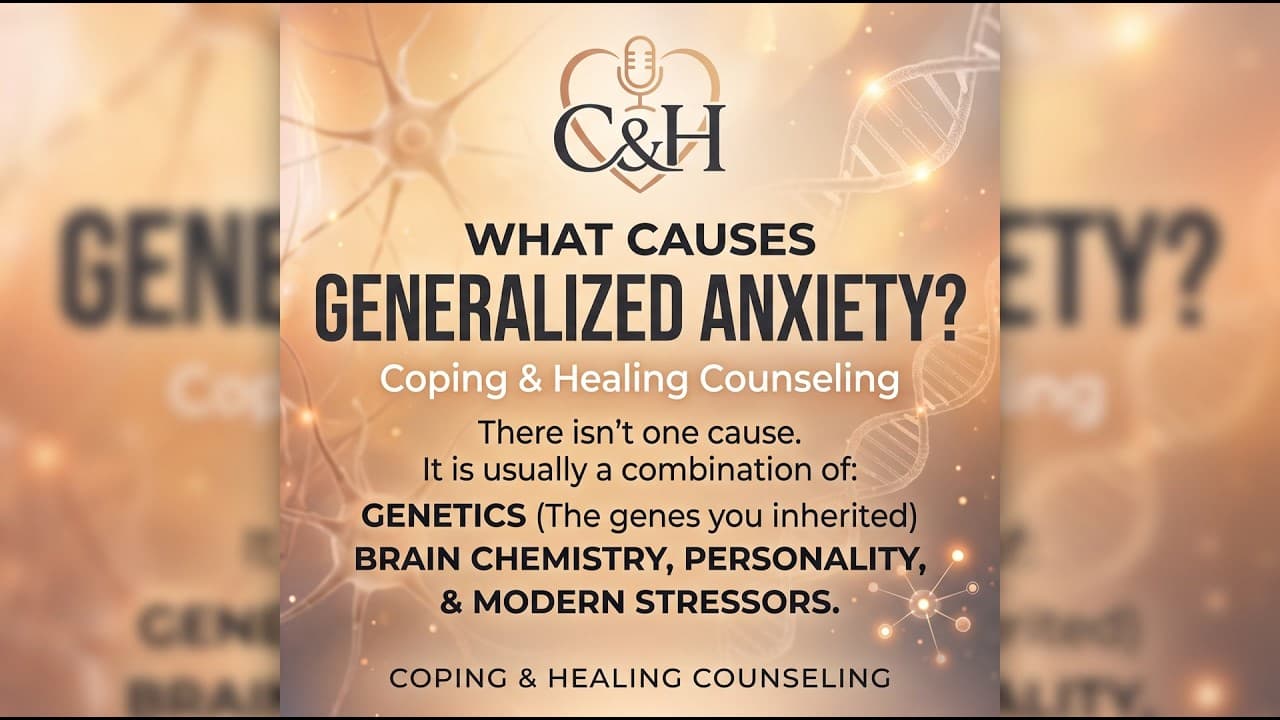
What causes generalized anxiety? — Full Episode | Georgia Telehealth Therapy
What causes generalized anxiety?
What are the 5 symptoms of major depressive disorder? — Full Episode | Georgia Telehealth Therapy
What are the 5 symptoms of major depressive disorder?

RSD and ADHD: Why One Short Text Can Wreck Your Whole Day | Georgia Telehealth Therapy
This one is for the friend who apologizes three times in a single text.
If this resonated, we have therapists who can help.
15+ licensed therapists, all 159 Georgia counties, telehealth-only. Medicaid covered at $0 copay.
Book a free consultation