
If your brain runs a worry loop most... | Georgia Telehealth Therapy
In this episode
If your brain runs a worry loop most days — finances, kids, the news, things that 'might' happen — and it's been going on for half a year or more, that may be more than stress. Generalized Anxiety Disorder shows up as muscle tension, sleep trouble, irritability, and a hard-to-quiet mind. The good ne
Generated from Coping & Healing Counseling: Accessible Telehealth for Georgia
#CopingAndHealing #GeorgiaTherapy #Telehealth #MentalHealth #Podcast
Transcript
Picture this scenario. Um, it's like 2:00 in the afternoon, okay? You pull your smartphone out of your pocket and the battery icon is inexplicably flashing red. It's at like 9%. The worst feeling, right? And you haven't even made a phone call today. So, you check your battery usage and you realize there's this single news app buried in the background just running constantly. Exactly. Completely invisible to you. And it has been autoplaying breaking news alerts for six straight hours. Wow. It's just draining your battery. And if you actually touch the back of the phone, the processor is hot. Right. It's physically burning up energy. Yes. It's burning up energy on a crisis you aren't even actively
engaging with. Welcome to today's deep dive. We are taking that exact phenomenon, you know, the invisible, exhausting background drain, and we're applying it to the human brain, which is such a fascinating way to look at it. It really is. Today's mission is all about dissecting what mental health professionals call a clinical worry loop. We're going to figure out how you, the listener, can tell the exact difference between normal everyday stress and a deeply entrenched cognitive loop because there is a very clear line there, right? And then more importantly, we're looking at how modern tellahalth is stepping in to make the solution to that loop radically accessible. Yeah, the access piece is huge. It is. So
to do this, we're analyzing clinical data and field insights from coping and healing counseling or CHC, right? They are a highly active telealth therapy practice based right in Georgia. And they see the real world mechanics of this mental battery drain like every single day. They really do. And you know to understand the mechanics of what the CHC team is treating, we kind of have to establish a baseline first. Okay. Because people throw the word stress around constantly, right? Like, oh, I'm so stressed. Yeah, absolutely. All the time. But human biology actually designed stress as a very specific temporary tool. Normal stress is acute, like a burst of energy. Exactly. It's a physiological spike designed to
help you deal with a direct challenge. you know, slamming on your brakes in traffic or um giving a high stakes presentation at work, right? Something right in front of you. Yeah. Your adrenal glands pump out cortisol, your heart rate elevates, you deal with the immediate threat, and then the system goes back to baseline. The background app closes. The app closes. But the clinical insights from CHC, they paint a very different picture of generalized anxiety disorder or GAD. Right? This isn't a passing reaction to a bad commute. Mhm. They define this worry loop as a persistent ongoing dread about multiple domains of life. So it's not just one thing. No, it's this anticipatory obsession with your
finances, your kids, uh the geopolitical news cycle. The news cycle is a big one. Oh, huge. And then just this nebulous category of things that might happen. It's essentially forecasting due. And the dividing line here based on the CHC data is the timeline, right? Yes. The timeline is critical because for this to move from everyday stress into an actual diagnosible pattern, this persistent worry has to occur on most days for six months or more. 6 months. That benchmark is the absolute cornerstone of the diagnosis. Yeah. And there's a biological reason for that. Which is what? Well, we talk a lot about neuroplasticity, right? The brain's ability to adapt and rewire itself. Sure. When you run
a worst case scenario program in your mind every single day for half a year, you are literally strengthening the neural pathways associated with fear and vigilance. Oh wow. So you're training your brain. Exactly. Yeah. The brain starts to just assume that danger is the default state of the world. It's no longer a reaction to your environment. It becomes a structural expectation. That sounds exhausting. It is. That constant vigilance requires massive amounts of cognitive energy, which perfectly explains the primary mental symptoms that CHC sees in their patients. Right. Things like a hard to quiet mind. Yes. A hard to quiet mind, profound difficulty concentrating, and really high levels of irritability. Well, I mean, that makes complete
sense. If your brain's processing power is secretly being hogged by some background loop calculating the odds of a financial collapse, you have zero cognitive bandwidth left, right? You have nothing left for the spreadsheet right in front of you at work. You snap at your spouse because your nervous system is already operating at maximum capacity. There's no shock absorber left in the system. Yeah, exactly. Which is why the clinicians at CHC emphasize that a licensed professional is really required to sort this out because we get used to it, right? We do. Human beings have this remarkable and honestly sometimes detrimental ability to normalize our own misery. We just adapt to the lowered battery life. We do.
We think, "Well, I guess I'm just an irritable person now, or I'm just a bad sleeper." Yeah. But a licensed clinician provides an objective diagnostic mirror. They're trained to evaluate the severity of that six-month timeline and see those cognitive patterns that you were just too close to recognizing yourself. I want to look a bit closer at what happens when that loop runs uninterrupted because it doesn't just stay trapped in the mind. No, it doesn't. It physically spills over. Diagnosing GAD in the real world is incredibly tricky because it often wears a physical disguise. It really does. The diagnostic manual used by mental health professionals, the DSM5, right? It requires that six plus months of excessive
worry. But it also mandates the presence of three or more somatic symptoms. And somatic simply meaning physical manifestations in the body. Correct. When your brain is constantly signaling that you're in danger, it floods your entire system with stress hormones just non-stop. Non-stop. And over time, that chemical flood causes severe muscle tension, major sleep disturbances, and chronic insomnia. The mind and the body, they're just a continuous feedback loop. I think a lot of people intellectually know that stress can make you tense, but the biology of it is just fascinating. The brain takes a purely abstract concept um like a fear of next year's inflation rate, which isn't even happening right now, right? And it translates that
into literal physical pain. Your shoulders seize up or you develop a tension headache over a hypothetical future event. Exactly. It's like your body is physically bracing for impact against a thought. That's a great way to put it. It's a profound demonstration of the gut brain access and our autonomic nervous system. Mhm. Your nervous system actually doesn't differentiate between a physical predator in the room and a perceived financial threat in your imagination. Wait, really? The physiological response is the same. The alarm bells ring just as loudly for both. Wow. So, how does this physical disguise complicate things for primary care doctors trying to screen patients? It creates a massive complication. The CHC data points out that
GAD frequently presents in primary care settings as purely physical ailments, just the symptoms, right? We're talking chronic fatigue, serious gastrointestinal issues, daily headaches. Because nobody walks into a doctor's office and says, "Hi, I have a six-month anticipatory worry loop." Exactly. They walk in and say, "I'm exhausted. My stomach is constantly in knots, and I have migraines." Yeah. So the primary care doctor or the pediatrician if it's a teen, they do exactly what they're trained to do. They look for a physical cause. They order blood work. They order blood work. They check thyroid function. They refer out to gastronenterologists to look for ulcers. And all those tests come back completely normal usually. Yes. Which leaves the
patient frustrated because they are in real physical pain. It's not in their head. Their stomach actually hurts. Exactly. And the doctor is stumped because the scans show a perfectly healthy body. Man, that's tough. It takes a highly astute primary care provider to sort of zoom out, review a stack of negative test results, and recognize the sematic disguise. They have to connect the dots, right? They have to realize that the stomach pain isn't a dietary issue. It's the physical exhaust of a psychological engine running too hot. I love that phrase, physical exhaust. Yeah. PCPs are often the crucial first line of defense in catching GAD, but only if they know to look behind that physical mask.
So, if a patient's stomach hurts because their brain is projecting financial doom, how do they actually stop the projection? That's the big question, right? Knowing what the loop is naturally leads us to how we dismantle it. And the clinical insights from HC point to firstline evidence-based treatments. Yes, we're looking at cognitive behavioral therapy or CBT, acceptance and commitment therapy, which is ACT, and the use of SSRIs. These aren't just experimental approaches, they are the gold standard for breaking entrenched cognitive loops. So, the text notes, they have strong evidence specifically for quieting that mental noise. Yes, very strong clinical evidence. Wait, so when you say therapy here, is this just venting to a therapist for an
hour? Or is there a specific science to this? Oh, that's a really important distinction because I imagine someone with severe insomnia and a six-month worry loop needs a much more active intervention than just a place to complain. Absolutely. Unstructured venting can actually reinforce a worry loop. Oh, interesting. Yeah. It just grooves the pathway deeper. CBT and ACT are rigorous, highly structured, evidence-based interventions. Okay, let's break those down. Let's look at the mechanics of cognitive behavioral therapy first. So CBT operates on the premise that your thoughts, feelings, and behaviors are all interconnected. Okay. A therapist actively trains the patient to catch the catastrophic thought in real time, examine the evidence for it, and then actively restructure
that neural pathway. So it's very hands-on, very if the mind is a tangled knot of false alarms, CBT is the systematic process of tracing the threads and untying the knot. And how does acceptance and commitment therapy or ACT differ from that? ACT takes a different but equally fascinating mechanical approach. Instead of trying to untie or change the anxious thought like CDT does, right? ACT teaches you to change your relationship to the thought. Oh, it utilizes mindfulness to help patients observe their worry loop without getting swept away by it. So, it's like the psychological equivalent of stepping out of a rushing river and just watching the water go by from the bank. That's a beautiful way
to visualize it. Yes. You accept that the anxious thoughts exist, but you commit to taking behavioral actions that align with your values anyway. Wow. You basically learn to carry the anxiety without letting it steer the car. That's powerful. And that makes the role of SSRI much clearer, too. It does because SSRIs, you know, they're a class of medication often used for anxiety and depression, right? And if a patient's baseline chemical noise is just so loud, like if they haven't slept properly in months and their body is flooded with cortisol, they can't focus on the therapy. Exactly. They might not have the cognitive bandwidth to step back and observe their thoughts. Right. So the medication lowers
the volume of the alarm bell enough so that the patient can actually do the rigorous work of CBT or ACT. Precisely. The medication provides the physiological stabilization required for the psychological reprogramming to actually take hold. So, it's a highly targeted clinical approach. Very much so. But, you know, knowing that CBT and ACT work is completely useless if the nearest specialist is a three-hour drive away. Oh, the access issue is huge or if the treatment bankrupts you, having the cure doesn't matter if it sits behind this massive geographic or financial wall. Absolutely. This is where the delivery mechanism really has to change. And it brings us to the realworld logistics of access via the model used
by coping and healing counseling. Right? Because mental health care access is historically just full of friction points. So many barriers. But the CHC model represents a structural shift in how care is delivered. They operate a 100% telealth practice. 100%. Yes. It utilizes secure IPA compliant video to serve patients across all 159 counties in the state of Georgia. Delivering evidence-based care across 159 counties via secure video. I mean, that essentially dismantles the rural healthcare desert. It completely overrides it. It's like beaming a top tier clinic directly into your living room. Yeah. A patient doesn't have to secure afternoon child care or lose half a day's wages just to drive to an urban center. The friction of
the commute is entirely erased. Exactly. And there brings a highly specialized team through that digital door. Right. The source outlines a really robust team. It's a diverse culturally competent team of 15 plus licensed therapists. And culturally competent meaning they have the background and awareness to understand the specific societal and cultural context of the patients they're treating which is absolutely foundational for building trust in therapy. Definitely. The text also lists a variety of specific licenses. Um, LCSSWS, LPC's, and LMFTs. Lots of acronyms. Yeah, lots of letters. For the listener who isn't steep in clinical acronyms, what is the functional value of a patient having access to all these different types of licenses under one roof? It
basically provides a comprehensive toolbox for the patient. Okay, so an LCSW is a licensed clinical social worker. They are brilliantly trained to look at the patients environment and connect them with community resources alongside providing therapy. That makes sense. Then you have an LMFT, a licensed marriage and family therapist. They focus on the family system, which is crucial because a severe worry loop doesn't just impact the individual. Exactly. It affects the entire household dynamics. Right. And finally, an LPC, a licensed professional counselor brings deep training in individual psychopathology. Wow. So having all of these disciplines available means the care can be highly tailored. Yes. Which explains their broad scope of services. They're treating individuals, offering couples
in family therapy, and working with teens ages 13 and up. And while we've focused intensely on anxiety today, this team treats a much wider spectrum. They do. They specialize in depression, trauma, and PTSD, grief counseling, relationship issues, and generalized stress, plus life coaching. It's a very comprehensive clinic. But you know, the true paradigm shift in their model is how they handle the financial barrier. This is the craziest part to me because the logistics of tellahalth are incredible. But if a session costs $200 out of pocket, it still remains a luxury service, right? But according to their clinical profile, CHC has structured their practice to accept Medicaid. And for those Medicaid patients, there is a Z
co-pay. I just want that to sink in for a moment. a Z co-pay for Medicaid patients. It's incredible. When you combine that financial structure with a 159count teleaalth reach, it acts as a massive equalizer. A total game changer. A single parent living in a remote rural county can open their laptop and receive the exact same evidence-based cognitive behavioral therapy as a highincome earner living in downtown Atlanta. Right. It completely levels the playing field for mental health access. It moves evidence-based therapy from a privilege to an accessible standard of care. And for patients who are not on Medicaid, CXC is strictly in network with most major commercial insurance plans. Yeah, they list Etna, Sigma, Blue Cross,
Blue Shield, United Healthcare, and Humanana. So, by staying in network with those major commercial plans, they are treating mental health care exactly the same as a standard visit to a physical doctor. For patients on those commercial plans, the out-ofpocket cost is typically between $10 to $40 per session, which is very manageable. So, if you're listening in Georgia or you have a loved one in Georgia and you recognize the signs of that invisible battery drain, the six-month loop, the unexplained physical tension, the irritability, the infrastructure is there to help. You can actually reach the CHC team by phone at 404832102. Their website is teacher theapy.com and their email is support theapy.com. Identifying the cognitive knot is
the first step, but having an affordable immediate mechanism to reach a professional who can help you untie it, well, that changes everything. It really does. So, to quickly recap the journey we've taken on today's deep dive, we started by pulling back the curtain on the clinical worry loop, learning that a six-month pattern of anticipatory dread actually rewires our brain's default state. It structurally changes things, right? Then we explored the fascinating, sometimes frustrating biology of how that mental dread physically floods the body, disguising itself as stomach pain and insomnia. Yeah. Just to confuse primary care doctors. And finally, we looked at how modern 100% teleaalth models like coping and healing counseling are utilizing Z Medicaid co-pays
and in network access to bring rigorous pattern-breaking therapies like CBT and ACT directly into people's homes. It is a profound shift. We're moving from merely surviving the anxiety loop to actively systematically dismantling it. Thank you so much for joining us on this deep dive today. We always like to leave you with something to turn over in your own mind. We've spent this time dissecting the intense exhausting power of the brain. So, if our minds can run a worry loop so powerfully that it creates actual physical pain like headaches and GI issues, what kind of profound physical healing might be possible in our bodies if we successfully train our brains to run a peace loop instead?
That is a fascinating thought. Think about how much battery life you could get back. Until next time.
More episodes
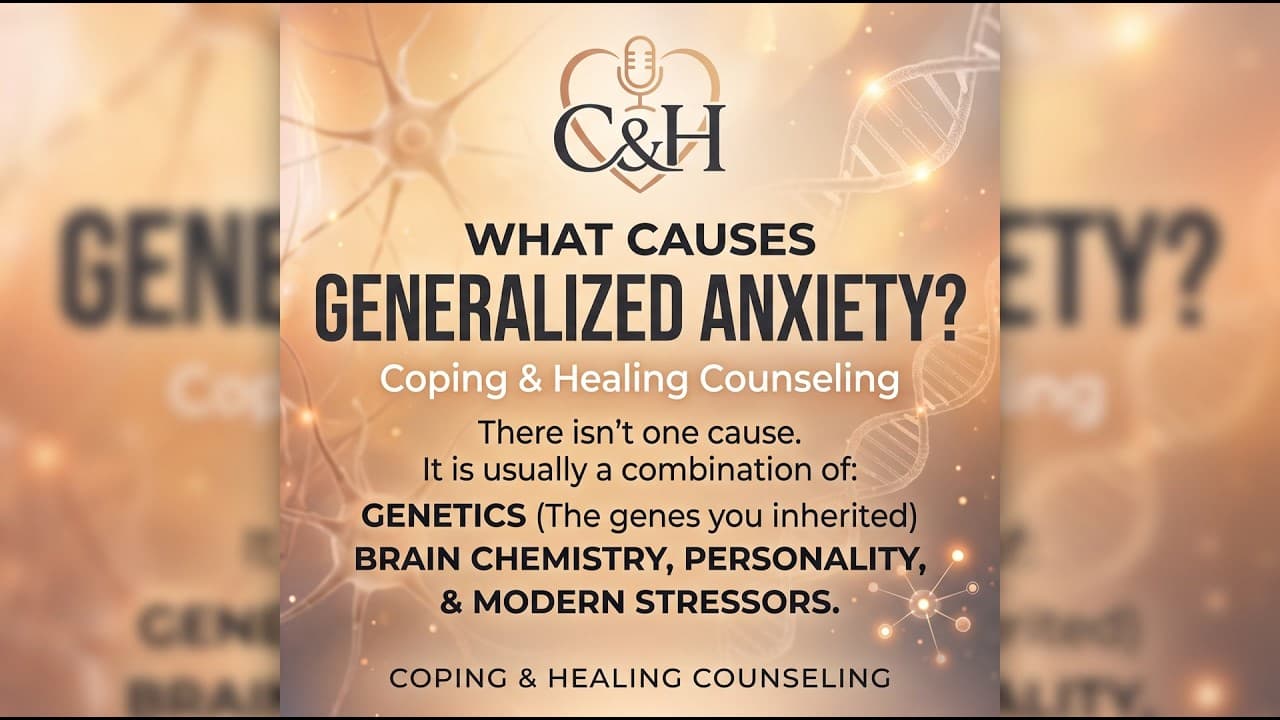
What causes generalized anxiety? — Full Episode | Georgia Telehealth Therapy
What causes generalized anxiety?
What are the 5 symptoms of major depressive disorder? — Full Episode | Georgia Telehealth Therapy
What are the 5 symptoms of major depressive disorder?

RSD and ADHD: Why One Short Text Can Wreck Your Whole Day | Georgia Telehealth Therapy
This one is for the friend who apologizes three times in a single text.
If this resonated, we have therapists who can help.
15+ licensed therapists, all 159 Georgia counties, telehealth-only. Medicaid covered at $0 copay.
Book a free consultation