
Hot take: finding the right therapist... | Georgia Telehealth Therapy
In this episode
Hot take: finding the right therapist matters more than finding ANY therapist. 💯 Which is why we don't just stick you with whoever has an opening. We actually match you based on what you're going through, who you are, and how you want to work. 15+ licensed therapists in Georgia. Take 3 minutes at c
Generated from Coping & Healing Counseling: Accessible Telehealth for Georgia
#CopingAndHealing #GeorgiaTherapy #Telehealth #MentalHealth #Podcast
Transcript
You know, it's funny how we approach finding a professional for like most things in our lives. Think about hiring a mechanic to fix your car's transmission. Right. You walk into that garage with a purely transactional mindset. You aren't, you know, evaluating whether you and the mechanic share similar hobbies or if they deeply understand your lived experience or or if you just naturally vibe with their communication style. Yeah, you don't really care about any of that. Exactly. The only question that matters is do you have the technical proficiency to fix my car? And like can you do it by Tuesday? It's a very clean exchange of services, right? You're paying for a specific mechanical outcome. Mhm.
And the relationship between you and the provider is, well, it's entirely incidental to that outcome. Mhm. The mechanic's tools work exactly the same way whether you're best friends or total strangers. Right. But then you take that exact same consumer mindset and you try to apply it to health care, specifically mental health care. And that's where it gets messy. So messy. You start looking for someone who simply has the right quote-unquote wrench. Maybe they have the right degrees on their wall or they happen to have an opening on a Thursday afternoon, and suddenly that transactional approach just completely breaks down. It totally falls apart. The outcomes are terrible. You find yourself sitting in a chair or
staring at a screen feeling completely misunderstood and realizing that, you know, checking the technical boxes wasn't nearly enough. Well, the breakdown happens because we misidentify what the tool actually is in mental health care. Oh, interesting. Yeah, the mechanism doing the fixing isn't a physical wrench. And it isn't even the specific psychological framework the therapist uses. The tool is the relationship itself. When a patient hits that wall of frustration you're describing, it's usually because they expected a mechanical fix for what is an inherently relational problem. Okay, let's unpack this. Because we often think finding any therapist is the hardest part of the journey. I mean, we've all heard the stories of people waiting months just to
get off a clinic's waitlist. Oh, absolutely. The access problem is real. It is. But the operational model we are looking at today from Coping and Healing Counseling or CHC, it flips that entirely on its head. Their internal framework reveals something pretty profound, which is merely getting in the door means nothing if the alignment is wrong. Finding the right therapist is actually the entire ballgame. It was the single most critical variable. If you have ever felt, you know, entirely disillusioned by the health care system or if you've tried therapy and walked away feeling like it just didn't work for you, unpacking CHC's model is going to be incredibly validating. Yeah, for sure. Because what we're really
looking at here is an organization that has recognized that success in mental health care requires engineering the science of human connection just as rigorously as the clinical treatment itself. But to understand how they engineer that connection, we kind of have to look at the landscape of care they've built because obviously you can't have a connection if the infrastructure doesn't even allow you to get into the room in the first place. Right. The logistics matter. They really do. So, CHC operates as a 100% telehealth fully HIPAA compliant practice. And the immediate impact of that digital model is how it completely shatters traditional geographic boundaries. I mean, they are serving all 159 counties in the state of
Georgia. Which consider the massive logistical shift that represents. Historically, mental health care was dictated by your zip code. Yeah. If you lived in a rural area, your options were severely constrained. You were essentially at the mercy of whatever provider happened to have an office within a reasonable driving distance. Right. And if they weren't a good fit, you were just out of luck. Exactly. If that one local provider didn't specialize in your specific need, say, uh complex trauma or a specific family dynamic, you were fundamentally locked out of effective care. So, a purely digital model doesn't just add convenience, it democratizes access to specialized care across an entire state. It's essentially putting a comprehensive multidisciplinary mental
health clinic directly in your pocket. As long as you have a phone or a computer, you have access to their entire roster. And looking at their team, they have over 15 licensed therapists deliberately structured with a wide mix of clinical lenses. Yeah, that diversity is key. They aren't just hiring one type of professional. They have a deliberate blend of LMFTs, LCSWs, and LPCs. Which is a crucial operational choice. Mhm. The diversity in those credentials means the practice can tackle an issue from multiple angles. How so? Well, an LMFT is trained to look at problems through the lens of family systems and relational dynamics, whereas, say, an LPC might focus more heavily on individual cognitive pathways.
Oh, I see. Having that variety under one digital roof means they can offer a holistic umbrella of services from individual and couples therapy to family counseling, teen therapy for ages 13 and up, and even life coaching. They're equipped to handle acute crises like trauma and PTSD, but also, you know, chronic stressors, grief, and relationship navigation. But here is the friction point that usually stops people dead in their tracks regardless of how great the access is, the financial barrier. Yeah, the big cost. Right. Even with a clinic in your pocket, the out-of-pocket costs for therapy often make it a luxury service. But what CHC has done with their financial accessibility is pretty remarkable. For Medicaid patients,
they have structured it so there is a zero-dollar copay. We really need to emphasize the gravity of a zero-dollar copay for Medicaid patients. It removes the absolute largest systemic hurdle for some of the most vulnerable populations. It's huge. It is. When you're operating on a tight margin, a 30 or 40-dollar copay every single week isn't just a nuisance, it's a structural impossibility. Totally. And then add to that their integration with the major commercial networks, so Aetna, Cigna, Blue Cross, Blue Shield, United Health Care, and Humana, where patients are paying between 10 and 40 dollars a session. That's incredibly accessible. Yeah, they have effectively cleared the logistical hurdles of geography, scheduling around a physical commute, and
exorbitant out-of-pocket fees, but and this brings us back to our core premise, clearing those hurdles just gets you into the digital waiting room. Right. Once that video connects, the infrastructure fades away and it's just two people looking at each other. That is precisely the moment we shift from the logistics of care to the psychology of healing. And CHC points to a very specific metric that determines what happens next. It's a foundational concept called the therapeutic alliance. Yes. The therapeutic alliance is arguably the most researched variable in clinical psychology. At its core, it is the quality of the collaborative bond between the client and the clinician. Okay. It's questions like, do you feel a sense of
psychological safety? Do you trust this person's competence? Are you mutually aligned on the goals and the tasks of your treatment? So, this is where I have to push back, though. What does this all mean? Cuz I am struggling with this concept a little bit. hear it. If I have a complex physical issue, say, I need spinal surgery, I want the most ruthless, technically proficient surgeon on the planet. I don't care if we have nothing in common. I don't care if they're completely unapproachable or if we lack a bond, I just want their unmatched technical skill. Right. So, why is the human mind the only place where that logic completely falls apart? Are we really saying
that feeling a good connection actually matters more than the specific evidence-based techniques a therapist spent years mastering? What's fascinating here is that you're falling into the exact trap of the mechanical mindset we discussed earlier. analogy. Exactly. You are viewing the mind as a passive object waiting to be operated on. But the mind is highly active and its primary function is to protect you. Think of the therapeutic alliance not as a warm fuzzy feeling, but as the psychological equivalent of anesthesia. Oh, wow. Okay, I'm listening. The alliance is the anesthesia. Yes. You can have the sharpest scalpel in the world, which in therapy might be highly technical modalities like EMDR for trauma or dialectical behavior therapy.
Those are powerful, scientifically backed interventions. But if the patient isn't anesthetized, if their psychological defense mechanisms are wide awake and on high alert, they're going to fight the surgery. That makes so much sense. If there is no trust, the brain will literally not allow access to the most painful, sensitive memories or the deeply entrenched behavioral patterns that need to be addressed. The technical modality is useless if the patient's neurological defenses are blocking it. That reframes it entirely. The clinical technique can't bypass the brain's security system, only trust can do that. Exactly. Because if I don't feel entirely safe, I'm going to unconsciously withhold information or, I don't know, I'm going to perform for the therapist
instead of actually doing the work. Precisely. In therapy, the patient is required to be an active participant in their own surgery. The therapeutic alliance is the mechanism that lowers the defenses and creates the necessary condition for vulnerability. Without it, you are just two people having a polite conversation that goes nowhere. Which makes total sense of the data CHC relies on. Because if this therapeutic alliance is the ultimate gatekeeper to healing, you cannot leave it up to chance. No, you can't. You can't just cross your fingers, throw a random patient and a random therapist into a Zoom room, and hope they magically achieve a state of deep psychological safety. Leaving it to chance is exactly why
so many people drop out of therapy after two sessions. CHC addresses this by operationalizing the search for the alliance. They don't just assign you to whoever has an empty slot on Tuesday at 4:00 p.m. Right. They use a highly structured matching protocol at intake. It's built on four distinct pillars to actively engineer that perfect match before the video call even begins. Let's dig into how they actually build this alliance. So, pillar one is presenting concern and clinical specialty. This is the baseline technical requirement. We are pairing the specific pathology with the specific skill set. If a client is coming in to work through severe PTSD, they absolutely must be paired with a trauma-informed clinician. Because
it's dangerous otherwise, right? Yes. Treating complex trauma requires a very specific understanding of pacing, somatic grounding, and nervous system regulation. If a therapist without that specialized training tries to push a client too fast, they risk actively re-traumatizing them. So, pillar one ensures the clinician actually has the tools required for the job. Okay, so they establish the technical competence first. But, here's where it gets really interesting. Pillar two aggressively shifts away from the textbook and focuses on identity and lived experience. CHC operates on the philosophy that cultural competence is foundational, not optional. And that philosophy directly addresses the cognitive load of being a patient. For decades, the psychiatric establishment operated on the myth of the blank
slate therapist. slate? Yeah, the idea that a well-trained professional could universally treat anyone regardless of their differing backgrounds. Which completely ignores the reality of how exhausting it is to constantly explain your existence to someone who doesn't share your context. Exactly. Identity shapes how we experience systemic stress, how we navigate family dynamics, and even the vocabulary we use to express our emotions. Imagine a scenario where a client has a 50-minute session, but they have to spend the first 25 minutes just explaining the basic cultural context of the microaggressions they face, or the unspoken obligations within their community structure. They're wasting half the session. They're burning half their session and a massive amount of emotional energy just
to establish a baseline of understanding. It's like having to teach the surgeon anatomy before they can start the operation. That's a great way to put it. By matching lived experiences, they are creating an immediate shorthand. The patient can log on, take a breath, and immediately get to work because the person on the other side of the screen inherently gets it. And that shorthand accelerates the trust required for the therapeutic alliance. It dramatically lowers the defense mechanisms we talked about earlier. So, we've secured the clinical skill and the cultural context. Pillar three is therapeutic style. CHC explicitly asks the client what kind of environment they actually thrive in, contrasting highly structured CBT with more exploratory psychodynamic
work. Which is brilliant because it empowers the patient as an active consumer of their own health care. People process information differently. Some clients walk into therapy wanting a manual to fix their brain. Give me the homework. Right. They want worksheets, they want to meticulously track their thought patterns, and they want highly structured, goal-oriented sessions. That is where a CBT framework shines. But, if you take a patient who wants worksheets and you pair them with a therapist whose style is to, like, sit in silence, explore childhood attachments, and analyze dream journals, the patient is going to feel completely unsupported. It's a fundamental mismatch of operating systems. Even if the therapist is brilliant, the alliance will fracture
because the client's expectations of what therapy should feel like are being violated. Right. By asking the patient up front how they want to be engaged, CHC ensures the delivery method matches the patient's learning style. Love that. And finally, pillar four brings the entire theoretical framework back down to reality, and that's logistical fit. This is the practical alignment of schedules, session cadence, and the very real constraints of everyday life. We cannot ignore the impact of logistics on the nervous system. Oh, for sure. Traffic alone. Right. If the process of attending therapy is inherently stressful, if you're constantly battling traffic to get to an office, or scrambling to find child care every Tuesday afternoon, your sympathetic nervous
system is activated before you even begin the session. By leveraging telehealth and matching schedules perfectly, you remove the logistical friction that so often derails long-term care. So, CHC takes the specific clinical needs, the lived experience, the preferred communication style, and the schedule, and they engineer what should be a mathematically perfect match. In theory, yes. It's a completely multi-dimensional approach. But, I mean, human beings are messy. We are incredibly unpredictable. You can look perfect on paper, pass all four pillars with flying colors, log into the session, and the vibe is just incredibly off. What happens when this perfectly engineered protocol still fails in practice? Well, a robust health care model has to account for the unpredictable
variables of human chemistry. A failure to connect isn't a failure of the patient, it's just a statistical reality. And CHC builds a very explicit safety net for that exact scenario. If the initial match isn't clicking within the first two to three sessions, they will rematch the client at absolutely no cost. That is so important. But, let's look at the human behavior side of this. Telling a mental health professional, "Hey, um your personality is really grating on me. I want to see your colleague instead." is an agonizing conversation for most people. awful. The vast majority of patients would rather just ghost the clinic entirely, block the phone number, and abandon their mental health journey just to
avoid that awkwardness. If we connect this to the bigger picture, ghosting is the default human response to therapeutic friction. What CHC is doing with this explicit two to three session rematch policy is brilliantly normalizing the shopping process. How does that change the dynamic for the patient? By declaring up front, before the first session even starts, we expect you to evaluate this fit, and we will rematch you for free if it's not perfect, they're completely removing the guilt. Ah. They're telling the patient that having personal preferences is not a failure. It turns the awkward search for a connection into a built-in, expected feature of the clinical journey. The patient doesn't have to carry the burden of
a confrontation. The system is already designed to catch them and pivot. It radically lowers the stakes of those initial sessions. You aren't locked into a marriage, you are just testing the alignment. And this entire philosophy culminates in an equation CHC uses, which essentially acts as the thesis statement for everything we've discussed today. The equation is fit drives adherence, and adherence drives outcomes. It's an elegant chain reaction that maps the entire clinical journey. The first link is fit. That is the therapeutic alliance, actively engineered by the four pillars, and protected by the rematch policy. When you achieve that fit, you feel deeply understood, respected, and psychologically safe. And because you feel safe, you don't look for
excuses to avoid your appointments. Precisely. That is the second link, adherence. In medical terms, adherence simply means sticking to the prescribed treatment plan. In therapy, adherence means you actually log on for your sessions, you do the difficult emotional processing between appointments, you don't conveniently forget your appointment because the thought of talking to your therapist exhausts you, you consistently show up to do the work. And when you continuously show up and do the work alongside a professional you inherently trust, you inevitably reach the final link in the chain. Outcomes. Meaning, symptom reduction, better emotional regulation, and improved relational dynamics. The clinical outcome is entirely dependent on the adherence, and the adherence is completely impossible without the
initial fit. It takes this historically murky, subjective concept of human connection and maps it out mathematically as the undisputed engine of clinical health care. It's a brilliant way to operationalize empathy. That really is. Well, we have covered some serious ground on this deep dive. We started by examining how a purely digital telehealth model completely erases the historical, geographic barriers to care across Georgia. We tackled the psychological reality that the therapeutic alliance is the critical mechanism that allows clinical techniques to actually work. Right. And we explored the meticulous four-step protocol lining clinical need, cultural identity, therapeutic style, and logistics designed to actively engineer that vital connection. And crucially, we saw how normalizing the process of rematching
ensures that finding the right fit remains the central focus of the entire enterprise, rather than a hurdle the patient has to overcome alone. To make sure you have the actionable details from our source material today, CHC notes that their initial matching process takes just about 3 minutes to complete on their website, which is 2 8 she therapy.com. Once that's done, their intake team takes over the logistics. If you prefer to reach out directly, their contact number is 404-832-0102, or they can be reached via email at support@she8therapy.com. You know, this raises an important question that I think we should all take a moment to chew on. Yeah. We have just spent this time establishing that the
therapeutic alliance, pure, mutual, authentic human connection, is undeniably the strongest predictor of clinical outcomes. But, we are talking about this profound connection happening in a 100% digital, remote health care environment. Through a screen. Right. It's happening without two people ever sharing the same physical room. So, I want to leave you with this final lingering thought to mull over. If we can mathematically prove that the undeniable human need to feel understood is the absolute key to success in digital medicine, how might this need reshape how we approach all the other highly technical digital spaces in our modern lives? If a clinician must actively engineer empathy through a screen in order to heal you, what does that
mean for how we build digital communities, structure remote workplaces, or even design artificial intelligence? Ultimately, no matter how advanced the technological delivery system gets, are we always just looking for someone on the other end who gets us? That is a fascinating thread to pull on. We might have dropped the geographic barriers and digitized the waiting room, but the fundamental human need for a reliable, empathetic co-pilot hasn't changed one bit. Thanks for joining us on the Steep Dive. We'll see you next time.
More episodes
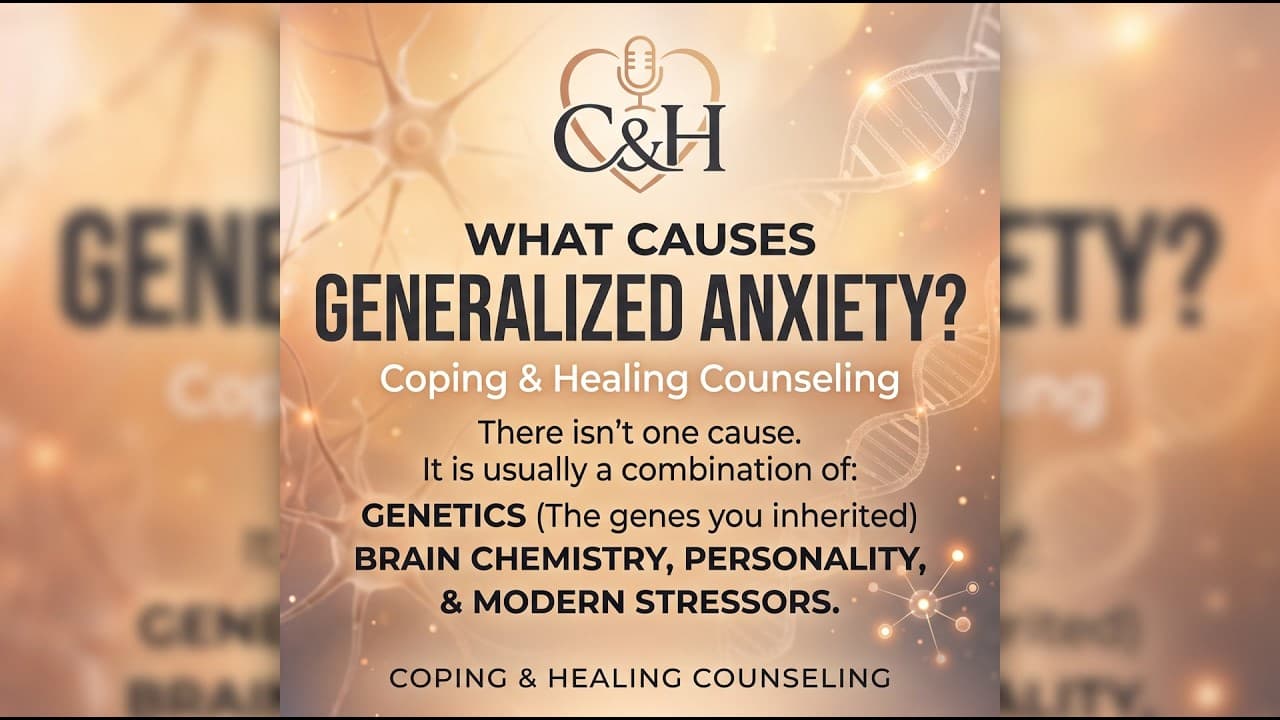
What causes generalized anxiety? — Full Episode | Georgia Telehealth Therapy
What causes generalized anxiety?
What are the 5 symptoms of major depressive disorder? — Full Episode | Georgia Telehealth Therapy
What are the 5 symptoms of major depressive disorder?

RSD and ADHD: Why One Short Text Can Wreck Your Whole Day | Georgia Telehealth Therapy
This one is for the friend who apologizes three times in a single text.
If this resonated, we have therapists who can help.
15+ licensed therapists, all 159 Georgia counties, telehealth-only. Medicaid covered at $0 copay.
Book a free consultation