
Heard someone say 'therapy is just... | Georgia Telehealth Therapy
In this episode
Heard someone say 'therapy is just paying to talk to a stranger'? I get it — that's what a lot of us were taught. But modern therapy is actually a structured, skills-based process. Your therapist might use CBT to help you reframe negative thinking, DBT for emotional regulation, or EMDR for trauma. I
Generated from Coping & Healing Counseling: Accessible Telehealth for Georgia
#CopingAndHealing #GeorgiaTherapy #Telehealth #MentalHealth #Podcast
Transcript
So, uh, what if I told you that fixing a severe psychological trauma has way more in common with like rebooting a frozen computer server than crying on a leather couch. Welcome to the deep dive. Glad to be here for this one. Yeah, today we are targeting a very specific audience with this topic. The skeptics. You know exactly who you are out there. the engineers, the data scientists, the executives, basically the people who uh measure twice and cut once, right? Because for decades, pop culture has fed that exact audience a highly specific and honestly highly inefficient image of what taking care of your mind actually looks like. Oh, absolutely. It's always the same trope, right? Exactly.
You picture walking into this dimly lit room, lying back on a Sha's lounge, and just complaining about your childhood while a stranger nods slowly, right? offering absolutely nothing in return and you know charging you an exorbitant hourly rate for the privilege. Okay, let's unpack this because if you are a systems thinker, paying someone to just sit there and absorb your venting sounds like a terrible investment of time and capital. It sounds completely illogical. Yeah. But the stack of research and clinical data we are exploring today. It completely shatters that trope. The hard reality of modern clinical practice looks absolutely nothing like those old movies. Not at all. We are going to look at specific evidence-based
protocols today that produce actual measurable changes. Measurable changes. I love that because it is a highly structured datadriven skills-based system designed to actively retrain the hardware of your brain. Isn't it precisely? We aren't discussing abstract theories or uh open-ended invented venting sessions here. These are mechanical interventions. They're designed and proven to produce physiological and psychological changes in how your nervous system responds to stress. Okay. But before we get into the actual mechanics of how they rewire the brain, we need to address who is running the system. Because that image of the passive nodding observer, that's dead. Oh, it's completely dead. Far from passive. The practitioners executing these modern protocols are required to have intense, rigorous
clinical backgrounds. We're talking about those acronyms you always see on business cards, right? Yeah, exactly. licensed clinical social workers, licensed professional counselors, licensed marriage and family therapists. And you know, those acronyms represent a massive barrier to entry. It's not just an online certificate. No, not at all. These are professionals holding master's degrees, but honestly, the academic credential is just the baseline. It's the practical application that stands out in the material we read. Precisely. Because before they can even legally practice independently, they're required to complete over 3,000 supervised clinical hours. 3,000? Wow. 3,000. And the training never actually stops. They have to maintain ongoing continuing education units specifically focused on the latest evidence-based protocols. Right. So,
they are continuously updating their clinical toolkit as the neuroscience evolves. Exactly. That is essentially a medical residency for the mind. But uh I have to push back here a little bit on behalf of the analytical listeners out there. Go for it. You used the phrase measurable change a moment ago. I did. If I go to a cardiologist, right, they can measure my lipid panels. If I hire a personal trainer, they track my lifting volume and my heart rate. How on earth do you measure a conversation? That's a very fair question because assuming talk therapy is scientific feels like I don't know assuming a personal trainer is improving your fitness just by watching you carry groceries
out of your car. Like how do you measure a feeling? Well, the personal trainer analogy is actually the perfect way to look at this because a good trainer doesn't guess. Right. Right. They have a clipboard. Exactly. They establish a baseline and they track progressive overload. And modern therapy does exactly that for your psychological baseline. Okay, I'm listening. It relies heavily on validated outcome scales mentioned throughout our sources. We aren't relying on a patient just sitting down and offering a vague like, "Uh, I think I feel a little better today." So, what does that actually look like when you log into a session? How are they extracting that data from you? So, you are typically handed
a standardized diagnostic tool, things like the PHQ9, which tracks the severity of depression, or uh the G87, which assesses generalized anxiety. Oh, so it's a formalized quiz. Yes. You don't just talk about feeling sad. You have to numerically score your sleep patterns, your appetite, your energy levels, and your cognitive concentration over the past two weeks. Wow. And then the clinician takes that raw data and graphs it session by session. You're essentially getting a scatter plot of your nervous system. That is wild. It really is. That instantly changes the paradigm from tell me your deepest secrets to let's look at the metrics. So if you are tracking the data over a month and the numbers aren't
moving, what happens? The treatment protocol changes. Just like that. Just like that. Just like a physical therapist would adjust your exercises if your shoulder mobility wasn't improving, a clinical therapist adjusts the psychological intervention. That makes total sense. Okay. Now that we've established we have a way to track the data, I really want to understand the actual interventions. Let's do it. Like how did these structured conversations physically rewire the hardware of the brain? Let's start with cognitive behavioral therapy or CBT because that seems to be the foundational operating system in all of this literature. Yeah, CBT is definitely the foundation. It's built on the biological premise that our brains are essentially efficiency machines. They automate repeated
processes to save energy, right? Like driving a car on an empty highway. You just zone out. Exactly. But sometimes they automate a highly efficient neural pathway to a terrible, wildly inaccurate conclusion. Give me an example of that. Okay. So, say your boss sends a brief, ambiguous email. Your brain instantly routes that signal to, "I made a mistake. I'm going to get fired. I'm going to lose everything." Oh, man. A completely automated catastrophic loop. You don't even choose to think it. The brain just fires the sequence. Exactly. And CBT is a mechanical intervention designed to interrupt that automated loop. You learn to identify the cognitive distortion, which is basically the error in the metal code, and
consciously force the brain to evaluate the evidence and take a different route. So, you're manually overwriting the autopilot. Yes. And over time, thanks to neuroplasticity, that new, healthier, rational route becomes the default pathway. The brain literally physically changes. Okay, so the documentation highlights a specific CBT tool called a thought record. And I'll be honest, on paper, doing a thought record sounds incredibly mundane. It sound pretty basic, right? Wait, doing a thought record sounds like middle school homework? You're literally just writing down the triggering event, the emotion you felt, and the automatic thought. How does literally writing down a thought physically rewire a neural pathway? Because the act of writing forces a physiological shift in your
brain's processing centers. Really, just from picking up a pen. Yes. When a catastrophic thought is just echoing in your head, it's fast, emotional, and highly reactive. It is being driven largely by the emotional centers of the brain. So, the panic button is just being held down. Exactly. But by yourself, pick up a pen, write down the trigger, and then rationally document empirical evidence that either supports or contradicts that thought, you are demanding energy from the prefrontal cortex. Ah, and that's the logical higher order processing center, right? You are literally pulling the neurological activity away from the panic button and forcing the logical brain to take the steering wheel. Do that enough times and the brain
learns the new route. That's amazing. It's like paving a new highway so the traffic doesn't keep getting funneled into a swamp. That's a great way to look at it. But CBD relies heavily on logic and rational evidence, right? What happens when someone's system is so flooded with panic that logic goes completely out the window? That's the limit of CBT. Because you can't ask someone in the middle of a massive emotional spiral to casually fill out a thought record on a piece of paper. What's fascinating here is how the clinical field recognized that exact limitation. That is why dialectical behavior therapy or DBT was developed as the next evolution of skills training. Okay, let's get into
DBT. If CBT is about restructuring your logic, DBT is heavily focused on managing how you intensely feel and react. It is about surviving a nervous system meltdown. The literature breaks DBT down into four very specific pillars. Let's dig into how they actually stabilize someone because this is where the whole therapy is skills training concept really crystallizes for me. The four pillars are mindfulness, distress tolerance, emotion regulation, and interpersonal effectiveness. Let's start with mindfulness. Mindfulness is the anchor. It's about staying rooted in the present physical moment rather than dissociating into a spiral. Okay, but distress tolerance that sounds like the emergency break. It is arguably the most critical for what you just described. These are hard
actionable skills to survive an immediate crisis without making it worse. Like forcing the body to physically reset when the mind is racing. Exactly. It might involve specific breathing mechanics or uh temperature changes to literally force the nervous system to decelerate like splashing cold water on your face. Oh wow. So very physical. Very physical. And once the immediate crisis is survived, you utilize emotion regulation, which teaches you how to identify, label, and gradually change intense emotional responses over time. And the fourth one, interpersonal effectiveness. That's the mechanics of setting boundaries, asking for what you need, and communicating without burning down your relationships in the process. Honestly, these sound like high-level corporate leadership skills just as much
as psychological interventions. They are deeply practical and exceptionally powerful. The clinical data shows DBT is specifically applied for some of the most challenging conditions we face like what things including severe chronic anxiety, borderline personality disorder, suicidality, and profound emotional dysregulation. So, it provides a concrete step-by-step framework for people who feel completely overwhelmed by their own biology. Exactly. Okay. So, we have CPT to debug the logic and DBT to extinguish the emotional fires. But here's where it gets really interesting. Oh, I know where you're going with this. Yeah, because the source material issues a pretty stark warning for a specific subset of patients. It notes that if you have severe deep-seated trauma, simply rationalizing it with
CBT or trying to regulate it with DBT might not be enough. Not nearly enough in some cases. In fact, it explicitly warns that simply talking through trauma can sometimes be actively dangerous. like it can retraumatize you. Without proper protocol, just talking is bad. Yes, this represents one of the most significant paradigm shifts in modern mental health care. Break that down for me. Well, for a very long time, the prevailing assumption was catharsis. Right. If you just sit in a room and talk about the terrible thing that happened to you, the pressure of I will release and you will heal. The old Freudian idea. Exactly. Yeah. But modern trauma-informed care in 2026 recognizes a stark biological
reality. Trauma isn't just a bad memory stored in your mind like a video clip. Where is it stored? Traummit is stored in the nervous system. It is physical. Which explains why trying to lodge your way out of it with a thought record doesn't work. The body is still keeping the score. Exactly. When you sit and verbally recount a traumatic event without the proper clinical grounding, your body doesn't know you are safe in an office in the year 2026. Oh, it thinks the event is happening right now. Yes. Your nervous system thinks it is happening all over again. You experience the spiked heart rate, the cortisol dump, the hypervigilance. The brain isn't processing the memory. It
is just reliving the terror. Man, so this is where the modern landscape incorporates sematic approaches. Yes. Sematic therapies focus directly on the physical sensations and the nervous system first. There are also frameworks like internal family systems or IFS. I've seen IFS mentioned. What is that? It's an approach that helps clients safely navigate the different protective parts of their psyche without triggering that overwhelming systemic flood we just talked about. Okay. And when it comes to actively targeting that stored trauma, the clinical records highlight one specific protocol that stands out as the absolute heavyweight champion for PTSD, EMDR, eye movement desensitization and reprocessing. Yes, this is the one that sounds the most counterintuitive at first glance. It
really does because it operates on a completely different mechanical level than traditional talk therapy, but it's widely considered the gold standard protocol for trauma. It is. And the core engine of EMDR is something called bilateral stimulation. Right? That's the technique where the clinician has you follow their fingers back and forth with your eyes or uh uses alternating tapping on your left and right sides or even alternating audio tones. Right. Correct. It is a highly rigorous eight-phase protocol. The clinician helps you target a specific traumatic memory, but instead of just talking about it endlessly, you hold a fragment of that memory in your mind while simultaneously engaging in that bilateral stimulation. Okay, let me try another
analogy here. Going back to the computer systems, tell me if this tracks. Let's hear it. So, an unprocessed trauma is essentially a corrupted file. It's too big. It's broken. And it's constantly trying to execute in the background. It's eating up all the systems RAM and it's freezing up the whole operating system. So the alternating bilateral stimulation, the eye movements or the tapping is essentially forcing the brain's processor to finally digest, compile, and archive that corrupted file so the system can run smoothly again. That is a brilliant way to conceptualize the dual attention mechanism. That's exactly it. Really? Yes. Trauma stalls the brain's natural information processing system. The memory gets frozen in its raw, unprocessed, highly
emotional state. Frozen style. Yes. And engaging in bilateral stimulation while holding the memory taxes, the working memory, just enough that it jumpst starts that stalled processor. So you aren't like Men in Black flashing a light and erasing the memory. No, not at all. You still remember the event, but you take the debilitating emotional sting out of it. It transitions neurologically from a present tense physical threat in your body to a past tense historical fact in your mind. That is incredible. The mechanics of that are just fascinating. But okay, let's say you've done that work. The trauma is processed. The corrupted files are archived. The RAM is freed up. The ideal outcome, right? But you still
have to wake up the next morning and go to work and live your life. You still have daily stressors. How did these modern protocols handle forward momentum? That brings us to acceptance and commitment therapy or ACT. And ACT is entirely about forward momentum. How so? Well, it achieves it by completely shifting the goalposts of what success looks like. CBT tries to change your difficult thoughts. ACT says, "Let's stop trying to eliminate or control the difficult thoughts and feelings altogether." Wait, I I want to make sure I understand this. Why would I spend the time and effort to go to a professional if not to get rid of the anxiety or the sadness? Because often the
true suffering doesn't come from the negative feeling itself. It comes from the exhaustive, relentless effort of fighting against that feeling. Think of it like being caught in quicksand. Okay, I'm tracking. CBT tries to help you map a logical way out of the quicksand. But ACT teaches you that the harder you thrash, panic, and fight against the sand, the faster you sink. Your struggle is the very thing pulling you under. No. If you stop fighting the sand, spread your weight, and accept the reality of where you are, you stop sinking. ACT calls this psychological flexibility. So ACT isn't about getting rid of the bad feelings, but just carrying them better. You are expanding your container so
the anxiety doesn't take up the entire space. Exactly. It focuses heavily on values clarification. You define exactly what you value in life like your family, your career, personal growth. Yes. And you commit to taking behavioral action toward those values even when anxiety or sadness are sitting right there in the passenger seat. You just stop letting the negative emotions drive the car. That is a huge shift in perspective. It really is. Yeah. And it is proven to be an absolute gamecher for conditions like depression, OCD, and chronic pain where the pain might not entirely vanish, but the suffering can be drastically reduced. And if someone wants an even more direct tactical approach, say an executive who
just needs to fix a specific dynamic and doesn't want to dig into the philosophical weeds, there is another option in the source material, right? Yes. Solution focused brief therapy, right? Solution focused therapy. It's highly pragmatic and relentlessly goal- directed. It spends almost zero time dissecting the past or analyzing the root causes of a problem. Purely forward momentum. Yes. Instead, it asks, "What does your preferred future look like? And what exact micro steps are we executing this week to get there?" Wow. If we connect this to the bigger picture, all of these modalities, CBT, DBT, EMDR, ACT, solution focused therapy, they completely dismantle that midentury venting myth we started with. Therapy is about building a toolkit.
Absolutely. Modern therapy is fundamentally about building a personalized toolkit. It is about acquiring the neurological and behavioral levers to navigate the present reality. Which leads us to the final and arguably most practical question, the logistics. Exactly. So, what does this all mean for the listener who actually wants to try this out? If I am a skeptic listening to this and I am finally convinced that this hardware level intervention is legitimate, how do I actually access it? Right? Because the health care system itself is notoriously difficult. It's bureaucratic and full of friction. Yeah. The clinical data provides a really excellent structural analysis of how modern access is being revolutionized. Actually, they point to a specific practice
model called coping and healing counseling or CHC. Right. The CHC blueprint. Yes. It serves as a perfect case study for how the traditional friction points of health care are being systematically dismantled. Let's analyze that CHC blueprint because traditionally finding specialized care meant getting on a six-month wait list, driving 45 minutes across town in the middle of a workday and sitting in a waiting room reading outdated magazines. Not anymore. The CHC model eliminates the geographic friction entirely by operating 100% via teleahalth. 100%. Yes, it is a fully virtual IPA compliant infrastructure that blankets all 159 counties in Georgia. That is massive. Tellah health is far more than just a convenience. It is a massive accessibility lever.
It means a rural patient has the exact same access to a top tier EMDR specialist as someone living in a major metropolitan center. And the analysis notes their team is quite large, right? Yes. The CHC structure utilizes a team of over 15 licensed professionals, ensuring that clinical depth is available on demand. Over 15 culturally competent licensed therapists, and they treat individuals, couples, families, and teens from age 13 up, while also offering life coaching. They cover a lot of ground specialties like anxiety, depression, trauma, PTSD, grief, relationship issues, and stress. But here is the critical variable. We can talk about neuroplasticity and psychological flexibility all day long. If the intervention costs $300 out of pocket every
Tuesday, it is completely useless to the average person. Financial friction is the final boss of healthcare access. The cost barrier has always kept the most advanced protocols out of reach for many. So, how does CHC solve that? This is where the CHCK study really proves its modern viability. They have integrated deeply into the major insurance networks to drive out-ofpocket costs down. Looking at the list, they accept Etna, Sigma, Bluec Cross, Blue Shield, United Healthcare, and Humanana. Which means for a patient with standard commercial insurance, an hour of targeted brain rewiring care typically costs between $10 and $40 in co-pays. Yep.$10 to $40 out of pocket. That is less than a single specialized fitness class for
access to gold standard medical care. And crucially, they accept Georgia Medicaid, which drops the financial barrier to a Z co-pay for those patients. Zero dollars. It completely democratizes the science. It really does. If you are listening to this and you want to stop guessing with your own psychological baseline, you can bypass the traditional runaround entirely. You can look at their platform at siliche therapy.com or just call 4048320102. It's that easy to start. And what I appreciate about this model is they start with a free 15minute consultation. You don't have to commit blindly. You talk to a professional. Figure out if your specific system needs the logical debugging of CBT, the processing power of EMDR or
the flexibility of ACT and find the modality that actually fits your goals. Exactly. Again, that's chahotsish theapy.com or to book that free 15minute consultation. It allows the patient to approach their mental framework with the exact same strategic care they applied to their physical health. So, what does this all mean? Let's zoom out and look at the journey we've taken today. We started by confronting a dusty, outdated stereotype, the letter couch, the passive nodding stranger, which we know is just a myth now. And we replaced it with the reality of a rigorous data driven science. We explored how CBT actively builds new neural pathways, how DBT equips you with physical crisis survival skills, how EMDR processes
trauma out of the body using bilateral stimulation, and how ACT builds measurable psychological flexibility. This raises an important question about how we allocate our resources, especially for the skeptics we addressed at the top of the deep dive. Let's hear it. Well, as a society, we demand empirical data for everything else. We wouldn't accept guesswork from a cardiologist and we want our personal trainers tracking our biomechanics. That's very true. Yet, for some reason, we stubbornly hold on to outdated stereotypes and hesitate when it comes to the complex, incredible machinery of our own minds. It is the ultimate double standard. And that is exactly what I want to leave you, the listener, to mull over today. Look
at your own daily routines. If you track your daily steps, your sleep cycles, your macros, and your resting heart rate with extreme obsessive precision, why are you still relying on total guesswork for your brain's operating system? A great question. What if you started measuring your psychological flexibility the exact same way you measure your physical fitness? Because that leather couch and the nodding stranger, they belong in the movies. The science of modern healing is right here, and it is ready to be put to work.
More episodes
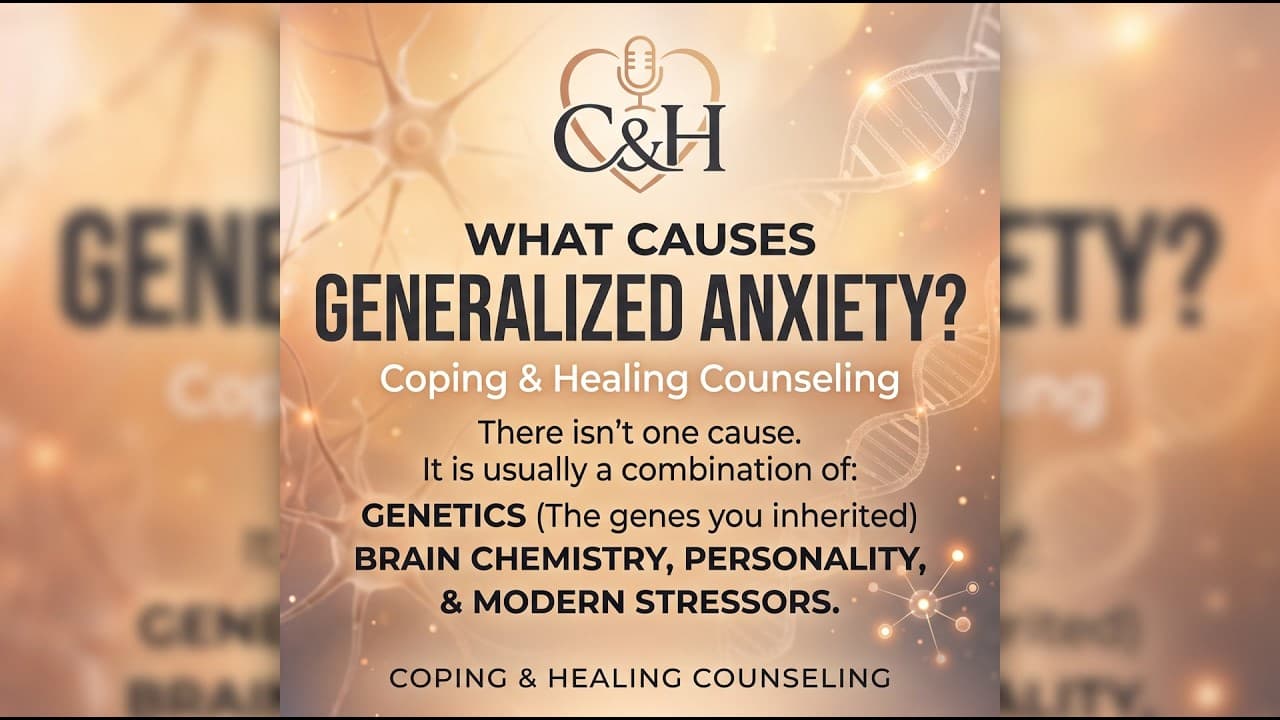
What causes generalized anxiety? — Full Episode | Georgia Telehealth Therapy
What causes generalized anxiety?
What are the 5 symptoms of major depressive disorder? — Full Episode | Georgia Telehealth Therapy
What are the 5 symptoms of major depressive disorder?

RSD and ADHD: Why One Short Text Can Wreck Your Whole Day | Georgia Telehealth Therapy
This one is for the friend who apologizes three times in a single text.
If this resonated, we have therapists who can help.
15+ licensed therapists, all 159 Georgia counties, telehealth-only. Medicaid covered at $0 copay.
Book a free consultation