
Friday night education — Body Dysmorphic... | Georgia Telehealth Therapy
In this episode
Friday night education — Body Dysmorphic Disorder (BDD) is much more than 'low body confidence.' Clinically, BDD is preoccupation with one or more perceived defects in physical appearance that are NOT observable to others or appear only slight, plus repetitive behaviors (mirror checking, excessive g
Generated from Coping & Healing Counseling: Accessible Telehealth for Georgia
#CopingAndHealing #GeorgiaTherapy #Telehealth #MentalHealth #Podcast
Transcript
If you walked into a cosmetic surgeon's waiting room like right now, up to 15% of the people sitting in that room are trying to surgically cure a condition that well it doesn't actually exist on their face. Right. Yeah. It exists entirely in their neurological wiring. Exactly. And that is why we are pulling from a massive stack of clinical perspectives today along with some structural models from a really highly specialized teleahalth practice in Georgia to totally shatter a pervasive cultural myth. It is a big one too. It really is. Our mission today is to understand why body dysmorphic disorder or BDD is radically I mean fundamentally different from just having a bad body image day. Oh,
totally. Okay, let's unpack this. Yeah. Because what we're looking at it isn't vanity, right? Not at all. It isn't just a desire to look good for an Instagram post. It is a severe, really debilitating glitch in human cognition. Yeah. And to set the baseline for you listening right now, I want to share probably the single most surprising fact from all of our clinical sources. When you actually map the neurological mechanics of body dysmorphic disorder, you find it shares far more similarities with obsessivempulsive disorder. You know, OCD. Wait, really? Yeah. OCD? Yes. It is way closer to OCD than it is to vanity or uh or even eating disorders. Wow. Yeah. And that completely reframes how
we need to look at the symptoms here. We are talking about a severe preoccupation with one or more perceived defects in a person's physical appearance. Okay. But the clinical lynchpin, the really important part is that these perceived defects are completely unobservable to others like completely invisible, right? Or you know if there is a slight physical variation, it is so minor that literally no one else in the world would ever register it as a flaw. So to the outside world, the flaw is just I mean it's invisible. It's just a normal human nose. Yeah. normal nose or an average patch of skin. But to the person experiencing BDD, to them that feature is glaring. It is
grotesque and it is allconsuming. The clinical sources actually outline common focal points for this preoccupation. What are people usually fixating on? Patients routinely fixate on their skin, their hair, maybe the shape of a specific facial feature or just their general body shape. Right. And the sources explicitly highlight muscle dysmorphia in men. Oh, I'm so glad you brought up muscle dysmorphia. That's a huge issue. It really is because that completely breaks the cultural stereotype. Mhm. I feel like society tends to lump the word dysmorphia into the exact same bucket as eating disorders, you know? Well, absolutely. They code it as just a pursuit of thinness, right? But muscle dysmorphia proves this is an equal opportunity distortion.
I mean, you could have a guy at the gym who is objectively massive, just a huge guy. Yeah. But he looks at the mirror and genuinely sees a puny weakling. Mhm. And he might like drink protein shakes to the point of actual kidney damage or skip his best friend's wedding because he feels too small to be seen in public. Yeah. The distress from those thoughts triggers massive massive behavioral responses. Right. Because they have to do something about the anxiety. Exactly. And this is where that connection to OCD really starts to show its teeth. The distress triggers two distinct types of symptom responses. Okay. What's the first one? The first are repetitive physical behaviors. And we
aren't talking about like checking your hair in the rearview mirror once, right? Normal stuff. Yeah. No, we are talking about obsessive mirror checking that lasts for hours, excessive grooming, skin pickicking that leads to actual literal tissue damage. Oh wow. Or constantly asking friends and family for reassurance. And the second type, the second type involves mental acts like constantly and obsessively comparing one's appearance to every single person they pass on the street. That sounds exhausting. It is. The diagnostic criteria requires that these behaviors cause significant distress and daily impairment. I mean, people lose their jobs because they are trapped in front of the mirror. They lose their jobs over this jobs, marriages, you name it. Okay.
So, to help you visualize this, if you're listening, it sounds like having a glitch in your brain where your internal reality acts like um like a funhouse mirror. A funhouse mirror. Yeah, that's a great way to put it. Like it zeros in and distorts one tiny feature, say the bridge of your nose or just a single pore in your cheek, right? And it does that until it is so magnified it takes over your entire field of vision. Like the rest of you disappears and this one localized flaw becomes your whole reality. What's fascinating here is that your analogy of the funhouse mirror glitch captures the exact clinical mechanism. Really? Yeah. That localized distortion is exactly
why BDD is clinically distinct from eating disorders. How so? Well, an eating disorder typically involves a broader generalized distortion of body weight and shape. Right. Usually tied to a drive for thinness or control over intake. Right. Throughout the whole body. Exactly. BDD however is a cognitive processing loop that locks onto specific localized features. It is a hyperfocused neurological misfiring. Why? So the person cannot simply use logic to you know think their way out of it because their actual brain is feeding them distorted visual data. But recognizing that BDD is a brain glitch creates a super dangerous gap in treatment. Right. Oh absolutely. Because the patient doesn't feel the glitch in their brain. They see it
on their face. Yes. And that disconnect is driving a hidden crisis in the medical field. I mean, if I genuinely believe my nose is hideously deformed, I'm not going to call a psychiatric clinic. No, of course not. Going to call a plastic surgeon. Yep. Which explains that massive statistical discrepancy we found in the sources. Yeah. The numbers reveal how BDD moves through our health care system completely silently. It's wild. What were those numbers again? So in the general US adult population, the prevalence of BDD is about 1.7 to 2.4%. Okay? So a relatively small but significant slice of the population, right? However, when you look at patients in cosmetic surgery and dermatology clinics, that number
dramatically spikes issues way up. Way up in those specific waiting rooms, 10 to 15% of the patients have BDD. That is just wow. You have this highly concentrated population of people experiencing immense psychological distress. Right. Yes. And they are seeking relief in purely physical medical environment. Exactly. But I want to play devil's advocate here for a second because logic dictates a seemingly simple solution to this. Okay. Let's hear it. If the profound distress comes from a perceived physical flaw like a bump on the nose or a receding hairline, why wouldn't getting a rhinoplasty or a hair transplant just solve the problem? Doesn't fixing the physical feature cure the mental anguish? You'd think so, right? I
mean, if the funhouse mirror is the problem, just change what you're holding up to the mirror. Well, this raises an important question and it is the exact logical trap that makes BDD so insidious. It is known as the cosmetic paradox. The cosmetic paradox. Okay. According to the clinical sources, cosmetic procedures rarely satisfy patients with BDD. In the vast majority of cases, they actually worsen the psychological condition. Wait, worsen it? Yes. How does having the feature surgically corrected make the obsession worse? Because the problem isn't the nose. Oh. The problem is the cognitive processing loop. If you surgically alter the nose, the loop doesn't just stop, it adapts. So, just find something else. Well, sometimes a
patient might wake up from a perfectly executed surgery, look in the mirror, and feel the surgeon didn't do it exactly right. Oh, wow. Which leads to devastating despair, anger, and often a spiral of multiple unnecessary revision surgeries. That sounds like a nightmare. Or, and this is very common, the brain's hyperfocus simply migrates. migrates like moves to a new spot. Exactly. Suddenly the nose is fixed, but the software bug immediately latches onto the chin. Oh man. Now the chin is the unbearable glaring flaw ruining their life. You cannot use a scalpel to fix a cognitive loop. You cannot use a scalpel to fix a cognitive loop. I mean, it's like trying to fix a software bug
by replacing your computer monitor. That is the perfect analogy. The new monitor might be pristine, but the moment you boot up the computer, the exact same error message flashes on the screen. Right. And this is why the sources stress that routine BDD screening is highly highly recommended before any elective cosmetic procedure. Do they have a specific test for that? Yes, there is a clinical tool called the BDDQ. It stands for the body dysmorphic disorder questionnaire. Clinicians in dermatology and plastic surgery are urged to use this to actively identify that 10 to 15% of their patient base because operating on them is a bad idea. Operating on a patient with BDD is fully contraindicated. It will
not heal their distress and it places both the patient and the surgeon in a really volatile unwinable situation. Okay. So if the scalpel is off the table, what actually interrupts this cognitive loop? We know cosmetic interventions do real harm. So, we have to look at what successfully rewires the brain to escape that funhouse mirror. Well, the clinical evidence points to a highly effective two-pronged psychiatric and psychological intervention. Okay, two prongs. What's the first? First, cognitive behavioral therapy specifically tailored for BDD. They often refer to it as CBT BDD. Got it. And the main engine of this therapy is a technique called exposure and response prevention or ERP. Okay. But practically speaking, you can't just tell
someone with BDD to stop looking in the mirror. No, definitely not. Their brain is literally screaming at them that something is disastrously wrong with their face. How does a therapist safely intervene with ERP without just causing an immediate panic attack? Well, ERP is all about systematically building neurological tolerance. Think of the obsessive loop like a deeply carved, perfectly paved highway in the brain. Right. It's the easiest route. Exactly. The person's thoughts travel down it instantly. ERP forces the brain to carve a new path through, say, a dense, overgrown forest. That sounds hard. It is. The therapist gently helps the person face situations that trigger their distress. Like what? Like going to the grocery store without
perfectly applied makeup or taping over all the mirrors in their bathroom. Oh wow. Then comes the really critical part. Actively preventing the compulsive response. So they just sit there. They sit with the skyrocketing anxiety without checking the mirror, without picking their skin, without asking their partner if they look okay. They just have to endure that massive spike in panic. Yes, but only temporarily because what happens neurologically is profound. Over time, the brain learns that the anxiety will peak and then naturally subside on its own without having to perform the compulsion. The brain figures out it's actually safe. Exactly. The brain realizes, I went to the store without makeup. I felt terrified, but I survived and
no one starred at me. Right? So, the dense forest path gets a little clearer. The paved highway of obsession gets a little weaker. It literally rewires the neural pathways through neuroplasticity. It basically starves the loop of the behavioral energy it needs to keep spinning. Yes, exactly. But therapy is only one half the equation, right? Because the sources also dig pretty heavily into pharmarmacology. They do. The second part of the evidence-based treatment is medication, specifically SSRIs, which are selective serotonin reuptake inhibitors. Okay. But the crucial mechanism to understand here is the dosing. Oh, so the sources note that these SSRIs must be administered at higher doses, typical of OCD range dosing. Interesting. Yeah. Standard doses used
for general depression often completely fail to touch BDD. Wait, why is that? Why does a standard depression dose fail but an OCD range dose works? What is the serotonin actually doing in the brain at that level? Well, standard depression doses primarily work to elevate generalized mood and energy. Right. Right. But at higher OCD level doses, the serotonin acts differently. It functions almost like a chemical lubricant for the brain's stuck cognitive gears. A chemical lubricant. I like that. It gives the patient the mental flexibility and just that microscopic pause needed to step away from the mirror. Just enough room to breathe. Exactly. It turns the volume of the obsessive thoughts down just enough so that the
CBT and the exposure therapy can actually take hold. If we connect this to the bigger picture, it reiterates why BDD must be treated as a serious treatable neurological condition. It is a brain chemistry and habit issue. Okay, here's where it gets really interesting. Oh yeah. Because understanding the clinical theory of unsticking cognitive gears is great, right? But treating this takes significant time, specialized expertise, and a lot of money. The barriers to entry are huge. Exactly. Knowing the treatment exists is useless if the barriers keep you out. Right. But the source material actually points to a specific model in Georgia. It's called coping and healing counseling or CHC. And it serves as this structural blueprint for
how modern healthcare is attempting to bypass those exact barriers. Yeah, geography and cost have historically been the two massive roadblocks for BDD treatment. Finding a specialist who actually understands exposure and response prevention is incredibly difficult, especially in rural areas. Right. But CHC operates as a 100% teleaalth IMA compliant practice serving all 159 counties in Georgia, which is an absolute paradigm shift. It really is. Providing statewide teleaalth means someone living in a rural farming community literally hundreds of miles from a major urban medical center has the exact same access to specialized neurological rewiring as someone living in downtown Atlanta. So, Geography is no longer a disqualifier. Not at all. And it's not a tiny operation either.
CHC boasts a team of 15 plus licensed therapists. That's a solid roster. We're talking licensed clinical social workers, licensed professional counselors, and licensed marriage and family therapists. And a vital detail the sources highlight about this specific team is that it is a diverse culturally competent team, right? Which is huge. It is not just a buzzword. It has profound clinical implications for body dysmorphia. How does that play into BDD? Well, cultural standards of beauty, body image, and even skin tone deeply influence how these disorders manifest. Oh, that makes total sense, right? If a therapist doesn't understand the specific cultural context and pressures a patient is facing, they might misinterpret a symptom or they just might fail
to build the trust necessary for exposure therapy to work. Exactly. You need a therapeutic match where you feel truly seen, you know, not just clinically analyzed against some generic baseline. Precisely. And their scope at CHC is incredibly broad. They treat teens from age 13 and up, adults, couples, and entire families, which makes total sense when you look at the symptoms we discussed earlier. Yeah, that reassurance seeking behavior we talked about, like, do I look okay? Is my skin terrible today? That falls so heavily on spouses and parents. BDD absolutely holds entire families hostage. It really does. The family often gets pulled into the compulsive loop. They provide reassurance just to calm the patient down, which,
you know, inadvertently feeds the disorder, right? It's enabling. Yeah. So, the family needs therapy just as much as the individual. They have to learn how to lovingly support their family member without enabling the BDD behaviors. So CHC's ability to address the family dynamic alongside specializing in things like anxiety, depression, trauma, PTSD, grief, relationships, and stress means they can treat the intersecting complexities of the whole person. Yes. But let's talk about the final boss of healthcare barriers. The cost. The cost. Instead of paying $200 out of pocket and treating this therapy like a luxury, this model systematically dismantles the financial wall for Medicaid patients. There is a Z co-pay. Zero. I mean, that transforms specialized mental
health care from a privilege into an accessible right for vulnerable populations. And for those with major private insuranceances, they accept Etna, Sigma, Blue Cross Blue Shield, United Healthcare, and Humanana. Great coverage. Yeah. And the sessions range from just $0 to $40 a session. That is huge because if a patient is stressing over the cost of every single hour, they might drop out of exposure therapy right when the anxiety peaks, right before the neurological rewiring can actually take hold. Exactly. Removing that financial barrier is quite literally part of the clinical healing environment. It allows the patient to commit to the full course of treatment. The time required to carve out those new neural pathways is suddenly
actually affordable. It's incredible. And the sources make it clear that if you are listening and you are in Georgia, this blueprint of care is just a phone call away. Yep. You can reach coping and healing counseling directly at 404-832102. And online too, right? Yeah. You can visit them online at cheat theapy.com or email them at support theapy.com. But even if you are listening to this from outside of Georgia, this is the exact standard of care you need to look for in your own state. Absolutely. specialized teleaalth, zero barrier insurance matching, and a culturally competent team that truly understands cognitive loops. It is the model required to finally address the silent epidemic sitting in cosmetic waiting
rooms everywhere. So, what does this all mean? Let's bring it all together. If we zoom out and synthesize everything we've pulled from these sources today, the core takeaways shatter the cultural myths. Body dysmorphic disorder is not a lack of confidence. It is not an eating disorder, and it is certainly not vanity. Not even close. It is an impairing, repetitive behavior disorder characterized by an intense cognitive loop, a funhouse mirror in the brain. Perfectly said. We've learned that seeking cosmetic surgery is an ineffective track, that cosmetic paradox we talked about, because you cannot fix a software bug by replacing the monitor. Right. But most importantly, specialized cognitive behavioral therapy with exposure and response prevention combined with
highdosese SSRIs to unstick those cognitive gears, they work absolute miracles. They really do. And thanks to robust modern teleaalth models, getting that specific help is more accessible than it has ever been. You know, before we go, I want to leave you with one final thought to consider. Okay, what is it? It's something not explicitly measured in our sources today, but deeply deeply relevant to the mechanics of this disorder. I'm listening. If BDD thrives on perceived slight physical defects, and the mental compulsion of constant comparison, Yeah. How might living in our modern era of highdefinition front-facing cameras, hyperrealistic social media face filters, and daily virtual video meetings be silently exacerbating these exact psychological loops for millions
of people who haven't even been diagnosed yet. Oh wow. We are forcing our brains to stare into digital funhouse mirrors all day long. We are literally carrying the catalyst for cognitive loops right in our pockets. That is a chilling but incredibly necessary question to maul over. Well, thank you for joining us on this deep dive today. Keep asking questions, keep challenging the cultural myths around you, and keep seeking out multiple perspectives. We'll see you next time.
More episodes
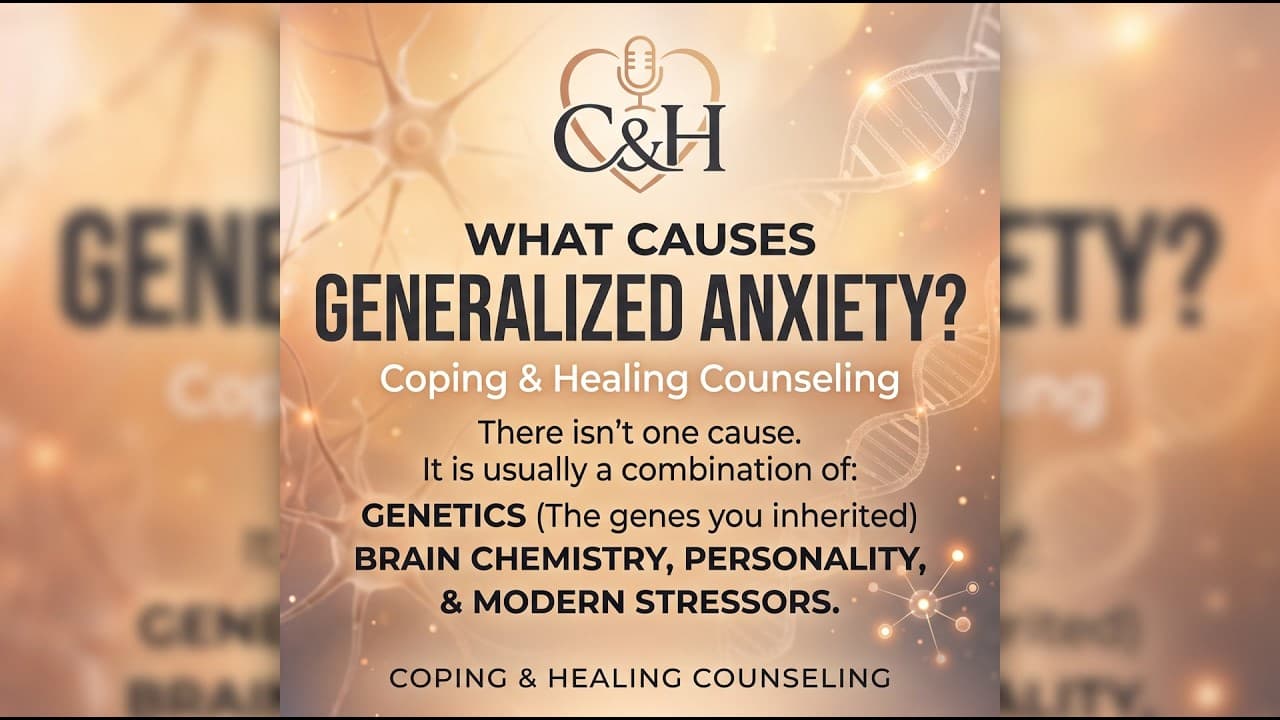
What causes generalized anxiety? — Full Episode | Georgia Telehealth Therapy
What causes generalized anxiety?
What are the 5 symptoms of major depressive disorder? — Full Episode | Georgia Telehealth Therapy
What are the 5 symptoms of major depressive disorder?

RSD and ADHD: Why One Short Text Can Wreck Your Whole Day | Georgia Telehealth Therapy
This one is for the friend who apologizes three times in a single text.
If this resonated, we have therapists who can help.
15+ licensed therapists, all 159 Georgia counties, telehealth-only. Medicaid covered at $0 copay.
Book a free consultation