
Betrayal Trauma vs. Ordinary Heartbreak | Georgia Telehealth Therapy
In this episode
Some wounds aren't about what happened. They're about who it happened with.
Betrayal trauma is what can develop when the person who hurt you is someone you depended on — a partner, a parent, a close friend, sometimes an institution you trusted. The source of the injury and the source of safety were
Generated from Coping & Healing Counseling: Accessible Telehealth for Georgia
Transcript
You know, like if you get a physical wound, say a really bad cut or um a severe burn, the protocol for healing that is is just incredibly straightforward, right? Absolutely. It's universally understood, right? Like you clean it out, you apply some sort of antibiotic ointment and then you wrap it up in a sterile bandage and you do that to protect it from the outside world. Right. The bandage is essentially your safety mechanism. Exactly. It's that barrier between your vulnerable tissue and you know the chaos is the environment. But I want you to imagine for a second if you went through all of that, you followed the protocol perfectly and then it turned out the bandage
itself was laced with like flesheating bacteria, which is just a horrific thought. Honestly, it is because the very thing you applied to protect the wound is the exact thing actively deepening it. Yeah. It completely subverts your entire foundational expectation of safety. I mean, you are expecting a sterile barrier and instead you're introducing a pathogen directly into the most vulnerable part of your body and suddenly you don't just have a physical injury to deal with anymore. You have this like profound sense of disorientation. You wouldn't even know what to trust in your medicine cabinet after that. No, every tool you have for healing suddenly becomes suspect, right? And that dynamic, that very specific terrifying kind of
disorientation is exactly what we are exploring in today's deep dive. It's a really heavy but crucial topic. It really is. So, we have this fascinating stack of notes today from Coping and Healing Counseling or uh CHC. They are a telealth therapy practice based out in Georgia. And their clinical materials outline a psychological concept that basically operates exactly like that laced bandage we just talked about. Yeah. They're outlining something specifically called betrayal trauma. And you know, we really need to look at this through a completely different lens than just standard heartache or or normal grief because it breaks the rules, right? Exactly. Betrayal trauma breaks the normal rules of psychology because it actually corrupts the healing
mechanism itself. So, our mission for you, the listener, today is to really just get to the bottom of this dynamic. We're going to explore why wounds that are inflicted by trusted figures just entirely bypass our normal emotional healing processes, leaving people completely stuck in a loop. Yeah. Right. And we want to understand how this specific type of trauma physically and you know mentally manifests in the body because it takes a massive toll on the nervous system. It absolutely does. And then most importantly we are going to look at how mental health professionals actually help people rebuild their shattered internal compass which is the ultimate goal here. Yeah. So, it's heavy material, but I think it
is profoundly validating information to understand if you or maybe someone you know has ever had to navigate a betrayal like this. Well, and validation is so often the missing piece for people experiencing this. I mean, when we discuss trauma as a society, the default imagery usually centers around a distinct, you know, isolated, often external event like a car crash or something, right? A terrible car crash, a natural disaster, maybe a random act of violence in the street. But the materials from CHC highlight this critical distinction that really changes everything about the therapeutic approach, which is what exactly? Well, it's that betrayal trauma isn't primarily about the mechanics of what happened to you. It is entirely
dependent on who it happened with. Okay, let's unpack that distinction a bit because the notes specify that betrayal trauma develops specifically when the person who hurt you is someone you actively depended on. Yes, that dependency is the key. So, we aren't talking about, you know, a stranger cutting you off in traffic or some random online scammer taking your money. We are talking of like a partner of 20 years or a parent you relied on for survival when you were a child or a lifelong best friend, sometimes even an institution that provided your livelihood. Right. Exactly. So, why does that dependency make such a massive difference in how the brain processes the trauma? Well, that dependency
is literally the lynch pin. You see, in a healthy functional dynamic, human beings are hardwired to seek out their attachment figures when they experience distress or pain. It's just a biological urge. Exactly. It is an evolutionary survival mechanism. But in betrayal trauma, we encounter this really brutal paradox. The source of the injury and the source of your biological safety are the exact same entity. Okay? So, it's kind of like I mean, imagine your house is catching on fire, right? and you run to grab the fire extinguisher to save yourself, right? But [clears throat] you pull the pin and the fire extinguisher is exactly what's shooting the flames. That is a perfect analogy. Like where do
you even go at that point? Your brain must just completely short circuit trying to process that reality. It does. And clinically, a short circuit is an incredibly accurate way to describe it. What you're experiencing is the sudden catastrophic loss of an avenue for what psychologists call co-regulation. Co-ereggulation. Okay. Tell me more about that. So co-regulation is just fundamental to human biology. You could argue it's just as important as food or shelter in our developmental years because from the time we are infants, we literally do not have the neural architecture to calm ourselves down. We can't self soothe. Not effectively. No. We learn to regulate our own nervous systems by basically borrowing the calm of our
caregivers. Oh wow. Borrowing their calm. Yeah. When an infant is distressed, a trusted person holding them and soothing them actually sends a biological signal to the infant's nervous system to exit the fight-or-flight response. So, we physically need that external person's nervous system to help us find our own baseline. Again, we're like outsourcing our emotional regulation. We are outsourcing it. And the thing is, we never fully outgrow that need. Even as adults, even as really capable adults, we rely heavily on co-regulation with our romantic partners, our close friends, our family members. I mean, studies show a hug from a spouse after a terrible day at work literally lowers your cortisol levels. That makes total sense. So,
now map that biological reality onto betrayal trauma. Imagine a scenario where the person triggering your biological fightor-flight response, the person acting as the active threat is the exact same person your brain is hardwired to seek out for co-regulation. The threat and the attachment figure are occupying the same space. Exactly. Wait, I'm getting stuck on something here, though. If your brain is screaming that this specific person is a dangerous threat to your well-being, why wouldn't your basic survival instinct just, you know, override the need for comfort? That's the logical conclusion, right? Yeah. Shouldn't the brain just instantly reclassify them as an enemy and force you to run away? I mean, survival should trump everything else. You
would think so, sure, if we were purely logical machines, but we aren't. We are mamlian creatures driven by this deeply ingrained attachment system. The biological drive to attach to a caregiver or a partner is completely fused with our survival instinct. That we needed them to survive historically, right? To the primitive brain, isolation is death. So when the attachment figure becomes the threat, the brain is caught in this impossible biological tugofwar. Oh, I see. The amydala, which is our threat detection center, is firing all these alarms, screaming, run away from them. But the attachment system is simultaneously screaming, "Run toward them for safety because we are in danger." The fire extinguisher shooting the flames. You reach
for it because there's a fire, but reaching for it just burns you worse. Yes. And that biological trap is exactly why betrayal trauma completely differs from incident based PTSD. How so? Well, in standard PTSD, let's say, after a terrible car accident, the threat is external, right? And it's separate from your support system, right? The car is the threat, not your spouse. Exactly. You survive the crash, you go home, and you retreat to your loved ones for safety and co-regulation. You have a safe environment to process the terror. But with betrayal trauma, there is literally nowhere to take the pain because the safe harbor is gone. The usual external avenue for comfort. The very mechanism you
use to process trauma is the exact thing that was destroyed. Which logically means a mind has to do something else with all that massive unprocessed distress. I mean, it can't go outward to the attachment figure. So, it has to go inward. It has no other choice. And looking at the CHC notes, this inward turn is where the daily lived symptoms just get incredibly heavy for the individual. The burden becomes immense because the mind begins to relentlessly interrogate its own judgment. Interrogate itself. Yeah, think about it. If the external world is fundamentally unpredictable and the people who are supposed to be safe are actually dangerous, the brain feels completely out of control. So to regain a
sense of order, it tries to find a solvable problem. And often it decides the problem must be you. Oh wow. The notes actually mention that people will replay the details of the relationship or the betrayal itself for months on end. Constantly. They are essentially hunting through their own memories for the exact moment they like should have known, looking for clues they missed. Yeah. And this leads to a profound loss of confidence in their own read on people. And that's a loss that persists long after the toxic relationship is actually over. We really need to emphasize a point the CHC materials make very clear here. This second guessing of yourself is not a character flaw. It's
not just someone being insecure. No, it is not a sign of inherent weakness. It is a predictable mechanical response to a broken attachment system. The brain is just trying to make a chaotic situation make sense. Okay, here's where I find the mechanics of this so incredibly counterintuitive. Okay, I was looking at the emotional timeline described in the clinical notes. Normally, if someone wrongs us, like if if a stranger steals our wallet or someone cuts us off dangerously in traffic, the immediate instinctual reaction is anger, right? We get mad. We get mad. We feel a sense of injustice. But the notes specifically point out that with betrayal trauma, people often feel a deep sense of being
foolish or ashamed long before they ever feel angry. Yes. Why? Why does shame jump to the front of the line? Well, anger is actually a highly sophisticated, empowering emotion. Really, anger is empowering. It is. It requires a foundational belief that you have been wronged, that you have intrinsic value, and that you have the right to defend yourself. Experiencing righteous anger requires a solid baseline of selfrust. Ah, I see where this is going, right? Betrayal trauma by its very definition has just completely shattered your self-rust. You trusted the person who betrayed you. So your brain's internal logic dictates that your judgment mechanism is fundamentally broken. So your brain says, "Well, I can't be angry at them
because I'm the idiot who let them in." Exactly. And shame from an evolutionary standpoint is actually an incredibly potent tool for perceived survival. Wait, shame is a survival tool in this context. Yes. When the mind turns its appraisal inward, it frames that constant rumination not just as suffering, but as an investigative mission, like trying to solve a puzzle. Yes. The client isn't just a passive victim of random, uninvited, intrusive thoughts. They are actively acting as a detective trying to figure out what clues they missed. Because if they can figure it out, they can prevent it. Exactly. The subconscious logic is a survival tactic. It says if I am foolish, if I am the one who
made the critical mistake by trusting them, then I have the power to fix this, right? I can just be smarter next time. I can learn to spot the red flags. I just want to make sure I am fully grasping this because that is wild. You're saying taking on the crushing weight of shame is actually a bizarre psychological strategy to regain control. Yes. Exactly. Because if it's my fault, I have the power to prevent it from ever happening again. Yes. But if it's their fault and they just randomly cruy chose to hurt me despite my best judgment, then the world is just chaotic and inherently dangerous and I have no control at all. The human psyche
will almost always choose the pain of self-lame over the absolute terror of utter powerlessness. Wow. Acknowledging that the person you deeply depended on is fundamentally unsafe and that you could not have predicted it is terrifying. It's unbearable. It is. It is much easier for the mind to say I was stupid and blind than to accept the person designated to keep me safe is actually a predator and I am entirely vulnerable. That makes total sense. That is the biological reason shame precedes anger. You literally have to undergo the arduous process of rebuilding that internal compass before you have the structural stability to feel righteously angry. That reframing of Shane makes so much sense, but it just
sounds absolutely exhausting for the physical body to carry around every single day. It is incredibly taxing. And the notes confirm this immense physical toll. It's not just in the mind. You know, sleep won't settle. The body stays on high alert, locked in this state that clinicians call hypervigilance. Yes. And what really struck me is that this persists even inside subsequent low-risk relationships. That's the hardest part for many. You could be with someone totally safe and you're just constantly bracing for the other shoe to drop. Well, the body is keeping the score, right? Your nervous system has essentially learned that safety is an illusion. The bandage you trusted was laced with bacteria. So years later, even
when a new genuinely safe partner offers you a clean, sterile bandage, your body reacts on a biological level as if it's infected because it remembers the last time. Exactly. The autonomic nervous system doesn't listen to logic. It operates purely on conditioning. Right. So, your heart races when your new partner just size heavily or you overanalyze a completely benign text message because your body is scanning the environment for the threat you missed last time. Which really brings us to a crucial part of the CHC materials, the clinical landscape, and how professionals actually untangle this specific diagnosis. It's a complex process because if you are constantly exhausted, running on adrenaline, barely sleeping, feeling deep internal shame, and
bracing for bad news every second of the day. Yeah. Well, I imagine this looks identical to several other mental health struggles. The symptom overlap is very significant, which is why accurate differential considerations are absolutely vital for a therapist. The clinical notes point out that betrayal trauma frequently mimics standard PTSD, adjustment disorder, and even major depressive disorder. Furthermore, comorbidity is incredibly common in these cases. Coorbidity meaning you could be suffering from betrayal trauma and clinical depression at the exact same time. Yes. The symptoms are just stacking on top of each other. They weave together into a very complex dense web of symptoms. Right? A patient might present with profound lethargy, a lack of interest in their
usual hobbies, and a deeply negative self-image. Okay. Okay, so if the presentation is that similar, I have to ask, what does this practically mean for you? If you're the one sitting in the therapist chair, it changes everything about your treatment. But if your daily symptoms mimic standard major depression, why does identifying the root specifically as betrayal trauma matter so much? The notes talk about giving the experience a quote unquote name and a shape, right? But if the house is on fire, why do we care what started the fire? Why not just treat the depression symptoms directly and get the fire out? Because treating the depression without acknowledging the betrayal trauma is basically like clearing the
smoke out of the room while completely ignoring the fact that the walls are still actively burning. Oh, that's a great way to put it. Correct. Diagnosis dictates the entire mechanism of treatment. If a clinician just sees a client who is fatigued, constantly ruminating, and expressing low self-worth, they might just diagnose major depression and focus entirely on symptom management. So, they just try to treat the sadness, right? They might use standard cognitive behavioral therapy to try and stop what they perceive as irrational negative selft talk. But in this specific case, we just established that the negative selft talk isn't just a random chemical imbalance or like irrational pessimism. Exactly. It's that protective investigative mission to maintain
the sense of control. Yes. So, if a therapist doesn't identify the betrayal trauma, they might inadvertently gaslight the patients nervous system by just telling them their fears are irrational, which just makes them trust themselves even less. Precisely. By giving the trauma a specific name and a shape, the therapeutic approach completely shifts. The therapy isn't just about making the client feel less sad. What is it about then? It specifically targets the restoration of the client's internal compass. A trained clinician helps the individual engage in a very difficult sorting process. Okay. The CHC materials actually use a beautiful phrase for this. They say the therapist helps you sort what was yours to carry from what wasn't. It's
a wonderful way to phrase it. Sorting what was yours to carry from what wasn't. That completely shifts the burden of the trauma, doesn't it? You aren't just managing anxiety anymore. You are actively taking that massive weight of shame we talked about earlier and you were returning it to the person who actually earned it. That's exactly the goal. But how does a therapist actually do that? How do you rebuild an internal compass when the person feels like their judgment is just fundamentally broken? It requires the therapist to step in and act as a temporary surrogate for that lost co-regulation we discussed, borrowing their calm again. Exactly. Since the client's attachment system is corrupted, the therapeutic alliance,
meaning the safe, predictable, boundaried relationship with the clinician, becomes the testing ground. Okay? So the therapy room becomes the safe space, right? The therapist helps the client map out their bodily sensations. When the client feels that hypervigilance spike, the therapist helps them connect that physical panic to the past trauma rather than letting the client blame themselves for being crazy or overreacting in the present. They provide context to the panic. Slowly, through repeated experiences of safety in the therapy room, the nervous system begins to rewire itself. the client learns that they can actually trust their own perceptions again. So they're essentially proving to their own brain week by week that they can accurately identify safety and
danger again. That is the essence of the healing process. But that realization brings up a massive logistical hurdle in my mind. Logistics are often the biggest barrier, right? Because knowing you need a highly trained therapist to rebuild your nervous system is one thing. Actually getting one when your internal alarm is stuck on maximum volume is a whole different mountain to climb. Oh, absolutely. Think about the logistics of traditional therapy. You have to drive to a strange office. You have to navigate an intimidating physical waiting room full of people and then sit in a closed room and be incredibly vulnerable with a total stranger. For a nervous system stuck in hypervigilance, that feels like running a
gauntlet. It really does. The traditional model requires a massive amount of upfront vulnerability from a patient whose primary injury is literally that their vulnerability was weaponized against them. Right? Which makes total sense why that would be terrifying. It can be a massive deterrent to even seeking care in the first place. And this is where the specific setup of coping and healing counseling feels less like just a business model and more like a targeted clinical adaptation for this exact type of trauma. Their model is highly conducive to trauma work. Yes. Because the source material details that CHC operates as a 100% teleaalth therapy practice. Right. They have this culturally competent team of over 15 licensed therapists
that includes clinical social workers, professional counselors, and marriage and family therapists. LCSWs, LPC's, LMFTs, a wide range of expertise. Exactly. And because it's teleaalth, they serve all 159 counties in Georgia via hea compliant video. The clinical relevance of that teleahalth structure really cannot be overstated for a trauma patient. How so? Well, lowering the barrier to entry physically reduces the allistatic load. That's the wear and tear on the body from chronic stress. Okay. By removing the commute in the waiting room, the patient doesn't have to leave their established safe space. That's huge. They can begin the arduous process of rebuilding their trust from their own couch surrounded by their own grounding objects. Whether that's a pet,
a weighted blanket, or just the security of their own locked front door. It allows the patient to retain a vital sense of control over their environment while doing the most vulnerable work imaginable. And you know, it isn't just physical accessibility that matters here. It's a financial accessibility, which is another massive trigger for a disregulated nervous system. Oh, financial stress completely compounds trauma. Definitely. The notes detail that CHC accepts Medicaid, which actually carries a Z co-pay for sessions, which is incredible for accessibility. And for most commercial insurance plans, you know, the standard ones people often have through employers like Etna, Sigma, Blue Cross, Blue Shield, United Healthcare, Humanana Sessions typically run just $10 to $40. Keeping
the financial barrier that low is vital. When a patient is already utilizing every ounce of their psychological energy just to process betrayal, worrying about how to afford the care can easily derail the healing process because it's just another threat to worry about. Exactly. It allows the client to focus their limited bandwidth entirely on the deep work of untangling the trauma rather than panicking about medical debt. It creates a comprehensive safety net and the fact that they offer specialized care across different dynamics. They do individual therapy, couples counseling, family therapy, and even teen therapy for ages 13 and up. Right. They specialize in anxiety, depression, trauma, grief, relationships, and stress. Yeah. Which means the practice can
address the fallout of betrayal trauma regardless of where it occurred in the family system. That systemic approach is so important. And having a culturally diverse staff also ensures that clients can find a practitioner who inherently understands their specific background which speeds up the process of establishing that crucial initial trust. It provides the necessary highly structured environment for that fundamental biological need for co-regulation to begin again safely. Right? Moving from just intellectually understanding the mechanics of your trauma to actually engaging in an evidence-based healing process is the most critical step a person can take. Okay, so to bring this all together for you, our listener, we've covered some incredibly intense psychological ground today. We really have.
We started by examining the absolute paradox of betrayal trauma. That biological trap that occurs when the fire extinguisher is the thing shooting the flames when a devastating threat comes from your primary place of safety. And we explored how that catastrophic loss of co-regulation forces the mind to turn its appraisal inward, the shame component, right? We looked at the evolutionary biology behind that heavy burden of shame and how the brain uses rumination as an investigative mission to try and regain an illusion of control over a chaotic world. And then we look at the clinical path forward. We discussed why giving this specific complex pain a name and a shape is necessary to separate it from standard
depression. It's vital for proper treatment, right? because it allows trained professionals like the accessible teleaalthbased team at CHC to help you systematically sort out what is actually yours to carry, effectively rewiring your nervous system so you can finally learn to trust your own judgment again. It is a profound journey from total disorientation back to self ownership. It really is. But before we wrap up today's deep dive, the source material actually leaves us with one final incredibly provocative thread that I think is worth pulling on your own time. It's a very compelling point they make at the end. I noticed this in the notes as well. We spent this entire time talking about betrayal trauma in
the context of interpersonal relationships, a partner, a parent, a friend. But the CHC text notes that this trauma can also stem from an institution you trusted. Yes. The psychological mechanics of attachment don't just apply to individuals. We often attach to systems like a job. Sure. a lifelong career at a specific workplace, a deeply held commitment to a religious organization, or even reliance on a health care or legal system. So, what happens when the betrayer doesn't have a single face? That is the big question to ponder. If the entity that betrayed you is an entire system, organization, or framework that you relied on for your survival, your livelihood, or your moral guidance, well, how does the
mind even begin to sort what is yours to carry? The scale of that is staggering. If the attachment figure isn't a person sleeping in your house, but the very fabric of the world around you, how do you navigate that hypervigilance? How do you ever feel safe treating the wound when the system itself feels like the infected bandage? Wow. It is a complex reality for many and a profound question to chew on as you process how trust operates in your own life. Absolutely. Well, a huge thank you to you, our listener, for joining us on this deep dive. If you're in Georgia, you can reach CHC at 4848320102 or online at geotherapy.com or support at giosathey.com.
Keep asking the hard questions, keep trusting your gut, and we'll catch you next time.
More episodes
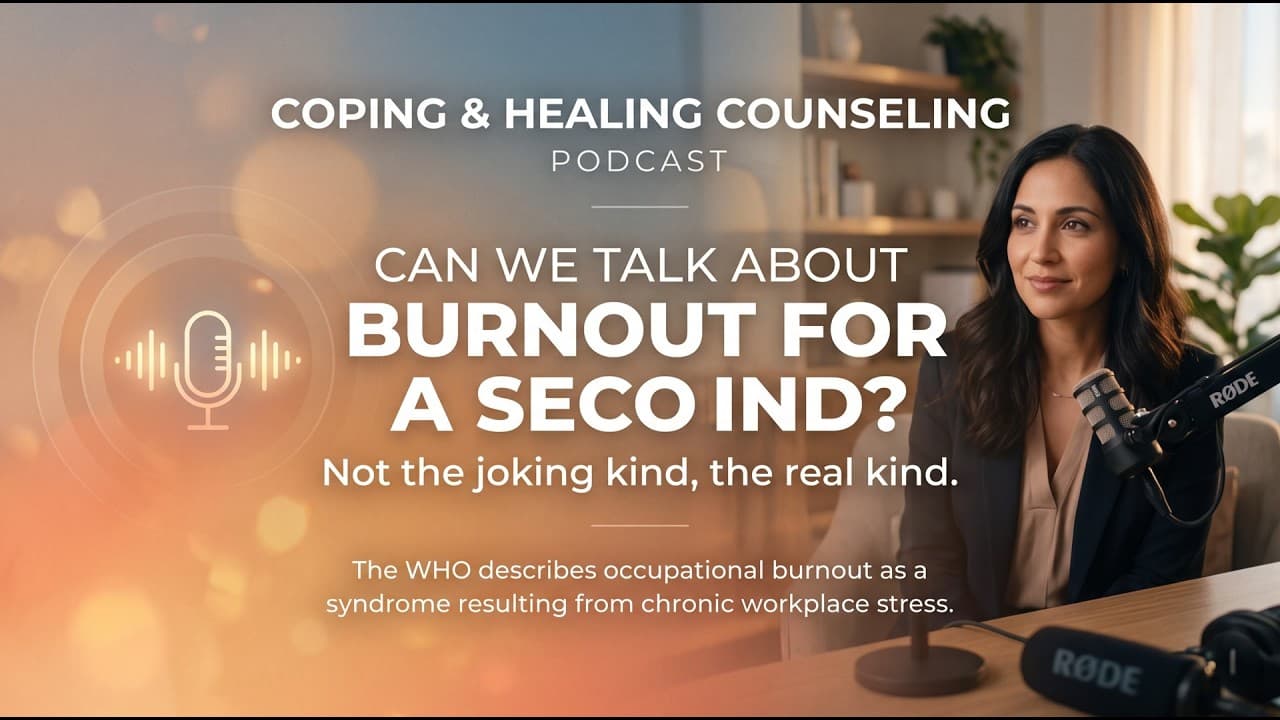
Why a Vacation Doesn't Fix Burnout | Georgia Telehealth Therapy
Can we talk about burnout for a second? Not the joking kind, the real kind.
The Grief No One Sends a Card For | Georgia Telehealth Therapy
There's no funeral. No casserole. No card. And the loss arrives again every month.
When Pain and Mood Feed Each Other | Georgia Telehealth Therapy
"The pain is real. But your labs came back fine." If you've heard some version of that, you already know how isolating chronic pain gets.
If this resonated, we have therapists who can help.
15+ licensed therapists, all 159 Georgia counties, telehealth-only. Medicaid covered at $0 copay.
Book a free consultation